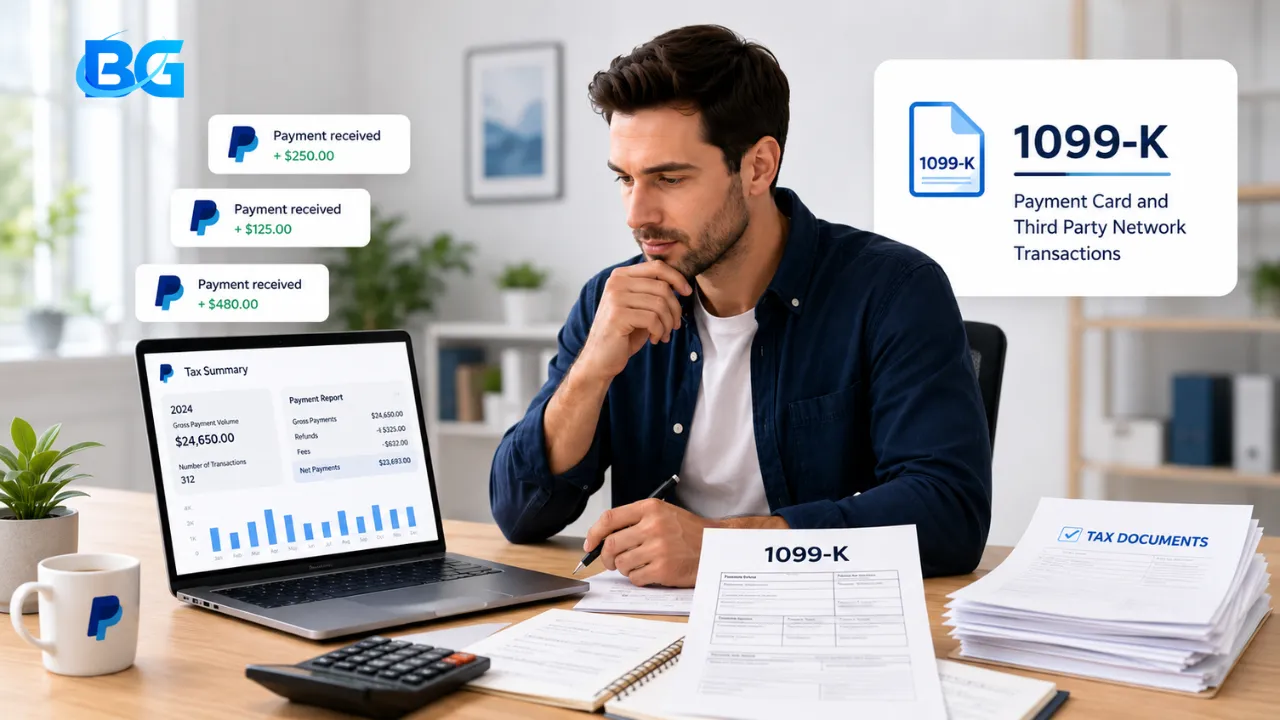

Just imagine, you’ve stepped into the U.S. financial system… Maybe you’ve started a small business, joined your spouse, invested in property, or come as a student, and everything looks fine until one line on a form stops you: “Enter your SSN.”
Quick Answer
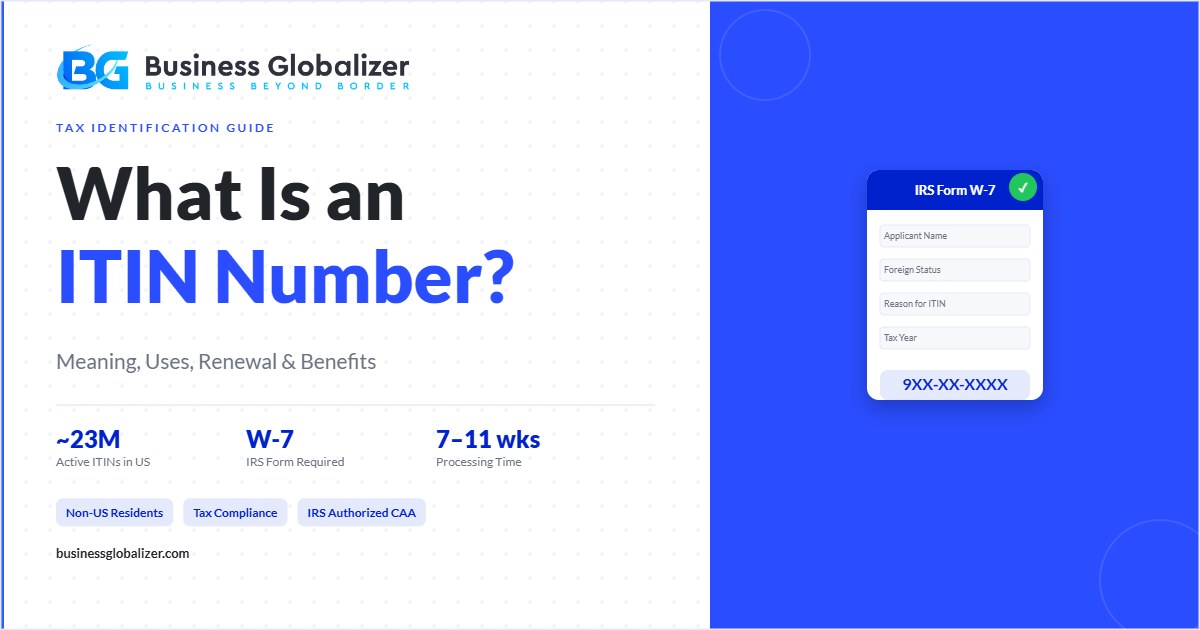
An ITIN (Individual Taxpayer Identification Number) is a 9-digit number issued by the IRS to individuals who need to file US taxes but are ineligible for a Social Security Number — including non-residents, resident aliens, and their dependents. ITINs start with the digit 9 (format 9XX-XX-XXXX) and are used for tax filing only. They do not grant work authorization or Social Security benefits. If you need an ITIN, Business Globalizer can process your application as an IRS-certified Acceptance Agent.
You don’t have a Social Security Number, but you still need to file taxes, receive payments, or stay compliant, so you quietly start Googling: “what is ITIN number and do I really need it?”
This is where the Individual Taxpayer Identification Number, or ITIN, comes into play. It gives people who can’t get an SSN a legal way to be seen in the U.S. tax system without breaking any rules.
Anyone who lives in the US but can not get an SSN, could be a dependent of a US resident, or is a non-resident doing business in the US needs to know the purpose of ITIN. This is crucial for tax filing and compliance. This can simplify your financial responsibilities and ensure you stay on the right side of the law.
Key Insights
- An ITIN is the IRS-approved tax ID for people who can’t get an SSN but still need to follow U.S. tax rules.
- It helps non-residents, dependents, spouses, investors, and students stay visible in the U.S. tax system.
- Banks, payment platforms, and even real estate transactions often rely on an ITIN to identify you.
- It allows you to file federal taxes, claim refunds, and qualify for tax treaty benefits.
- Without an ITIN, many non-residents face blocked accounts, withheld payments, or paperwork delays.
- The number doesn’t give immigration status or work rights; it simply organizes your tax identity.
- ITINs expire if unused for three years or if issued before 2015 with certain middle digits.
- Renewal is easy but must be done before filing to avoid IRS processing issues.
- A passport is the most reliable document for smooth ITIN approval.
- In short: knowing what an ITIN is, and keeping it active, keeps your financial and tax life running without disruptions.
What Is ITIN Number?
Let’s explore the core concept first: The ITIN.
If you’ve ever wondered what is ITIN number, ITIN meaning, or what does ITIN stand for, here’s the simple version.
ITIN stands for Individual Taxpayer Identification Number. These are individual tax numbers issued by the IRS to those who require a U.S. tax ID but do not have a Social Security Number (SSN). It helps non-U.S. residents, resident aliens, and their families handle their tax filings and financial tasks in the United States without running into barriers. Paying taxes without an SSN can be difficult, but the ITIN simplifies the process.
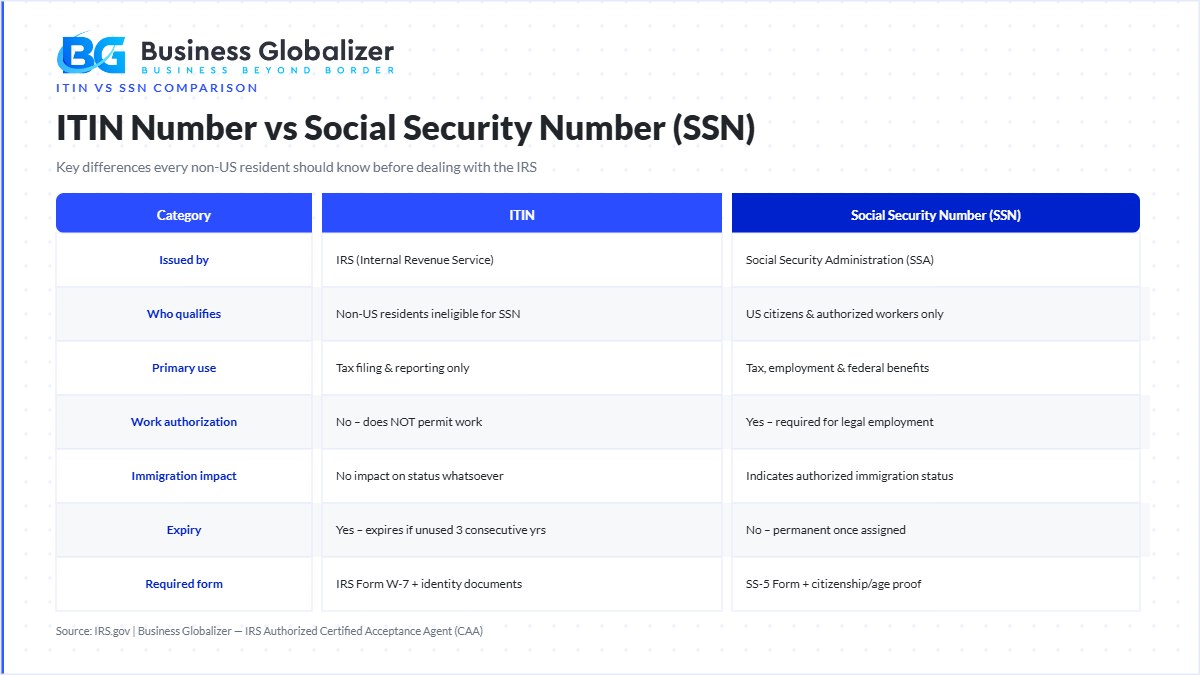
In many cases, this is the primary ITIN number USA taxpayers rely on when they’re not eligible for an SSN but still have to deal with the IRS.
Example of ITIN Number
Let us talk about Javier, a Mexican guy with enormous goals. He has always wanted to create a taco stand in Austin so he could share his passion for cooking and the great flavors of his culture. However, when he begins to prepare, he runs into a stumbling block: he needs a taxpayer ID to make it official. Javier feels frustrated; he just wants to bring a taste of home to Texas.
Thankfully, a friend mentioned ITIN as a solution. With relief, Javier applies for his IRS ITIN number. Once approved, he can finally register his business and set up a shop all while ensuring he’s meeting the tax obligations. Stories like Javier’s are exactly why understanding what is an ITIN number at a basic, fundamental level matters so much.
Who Needs an ITIN Number?
As we’ve seen with Javier’s story, individuals like him who are non-U.S. residents and don’t have a Social Security Number (SSN) often need an ITIN. This includes:
- Someone from another country working/earning here in the US and has to deal with taxes. The nonresident taxpayers.
- Dependents or spouses of residents or green card holders who reside in the United States.
- Non-resident aliens requesting a benefit under a tax treaty.
- Foreign investors earning U.S.-sourced income; such as from real estate, stocks, or partnerships.
- Property buyers and sellers who need an IRS-recognized tax ID for reporting their transaction.
- International students, researchers, or professors who need an ITIN for scholarships, stipends, or tax filing.
- Non-resident aliens seeking to open a bank account or apply for a loan in the United States.
Essentially, anyone who needs to comply with US tax laws but is ineligible for an SSN may need to obtain an ITIN to fulfill their tax obligations.
What Are the Purposes of an ITIN Number?
Just like Javier’s scenario, ITIN serves many different purposes for both individuals and business entities:
- Tax Reporting: Individuals who work or do business in the U.S. as a non-resident or resident and dependents of a US resident, mainly, those who are not qualified for SSN, might need to obtain an ITIN to fulfill their tax reporting requirements. If you’re asking what is an ITIN number used for, tax reporting is the first and most important answer.
- Information Return: If a U.S. citizen or resident owns a foreign entity abroad they might need an ITIN for filing specific tax forms like 5471 to the IRS. Individuals need this identification number to disclose information about their ownership in foreign corporations.
- Tax Filing: Non-resident aliens might obtain an ITIN by making an application with Form W-7 for filing tax returns with the IRS. This happens for the following reasons:
- Wages earned while working in the US (even temporarily).
- Investment income (interest, dividends, etc.).
- Rental income from US property.
- Business income earned in the US.
- Banking and Financial Services: Whether you are a resident or a non-resident in the US, some banks and financial organizations still require an ITIN:
- for opening your bank accounts.
- to offer financial services.
- to apply for ITIN-based mortgages offered by lenders who accept non-SSN borrowers.
- Foreign Business: Non-residents who want to launch a business in the US, often get an ITIN for:
- filing US tax returns,
- opening bank accounts,
- setting up a US PayPal account.
- Form a Company: Depending on the state laws and corporate structures, individuals may need to apply for ITIN to start a business in the US as part of the application process.
- Business and Legal Transactions: Obtaining an ITIN is necessary for a number of business and legal activities in the United States, including leasing real estate, qualifying for a mortgage loan, and carrying out other financial operations involving taxpayer identification.
To put it briefly, an ITIN is mostly used to help tax compliance and reporting for those who are not eligible for an SSN but still have legal duties in the US or need to conduct financial and legal transactions there.
Benefits of an ITIN Number
An ITIN isn’t something people get because it’s exciting. You get it because the U.S. system quietly locks half the doors until you have this one nine-digit ID. And once you finally have it, a lot of things that were stuck… start moving again.
Here’s what an ITIN actually does for you:
- It unlocks PayPal and other payment platforms
When PayPal suddenly asks for individual verification or “U.S. tax verification,” they’re not being dramatic; they’re asking for your ITIN. Without it, many non-residents hit limits, holds, or straight-up account freezes.
- It lets you open or keep a U.S. bank account
Banks want a taxpayer ID for reporting. An ITIN is your legal replacement when you can’t get an SSN.
- It allows you to file federal taxes properly
Running a U.S. LLC, earning rental income, selling property, freelancing for U.S. clients, all of it needs a tax ID.
- You can claim refunds and overpaid taxes
If you paid too much, the IRS will return it — but only if you have a valid ITIN to attach to your return.
- You can claim tax treaty benefits
Some countries qualify for reduced withholding. You can’t claim those treaty percentages without an ITIN.
- It supports spouse and dependent filings
Joint tax returns, child tax credits, dependent claims, all require ITINs for family members who can’t get SSNs.
- It makes property transactions smoother
FIRPTA withholding, refunds on sales, rental income reporting, all need a valid ITIN.
- It gives you a recognized identity in the U.S. tax system
Like it or not, the IRS won’t “know” you until you have an ITIN. Once you do, everything from tax filings to payments becomes traceable, legal, and stable. This is why understanding the basic ITIN number definition is so important before you start dealing with the U.S. tax system.
The short version?
An ITIN doesn’t solve every U.S. compliance problem, but it’s the one thing that keeps almost everything else from falling apart.
ITIN Number Requirements
Get Your ITIN Fast — With an IRS-Certified Agent
Business Globalizer is an IRS-certified Acceptance Agent. We prepare and submit your Form W-7 ITIN application — no US travel required. Most applications processed in 7-10 business days.
So, we covered the ITIN number definition, examples, who needs it, what the purpose of it, and what are the benefits of an ITIN. Think of this as your fundamental ITIN checklist. Now, let’s talk about what you would need to get one—the Form W7 requirements. Here’s what the IRS actually wants from you (nothing more, nothing less):
As a non-resident US company owner or shareholder, your requirements are:
- Article of Organization.
- Home Country Address (Bank Statement).
- EIN Document CP575 (Official) & 147C (Official).
- Company Ownership Document.
- A completed Form W-7
- Scan Copy of Passport.
Requirements for spouse or dependent ITIN applications:
- SSN of US citizen/resident alien
- A valid passport or driving license
- Tax Return or Filing Proof
- Proof of Relationship
- Proof of Residency (If Required)
- A completed Form W-7
- Face verification
That’s really it. The IRS asks for a lot of patience, but surprisingly few documents.
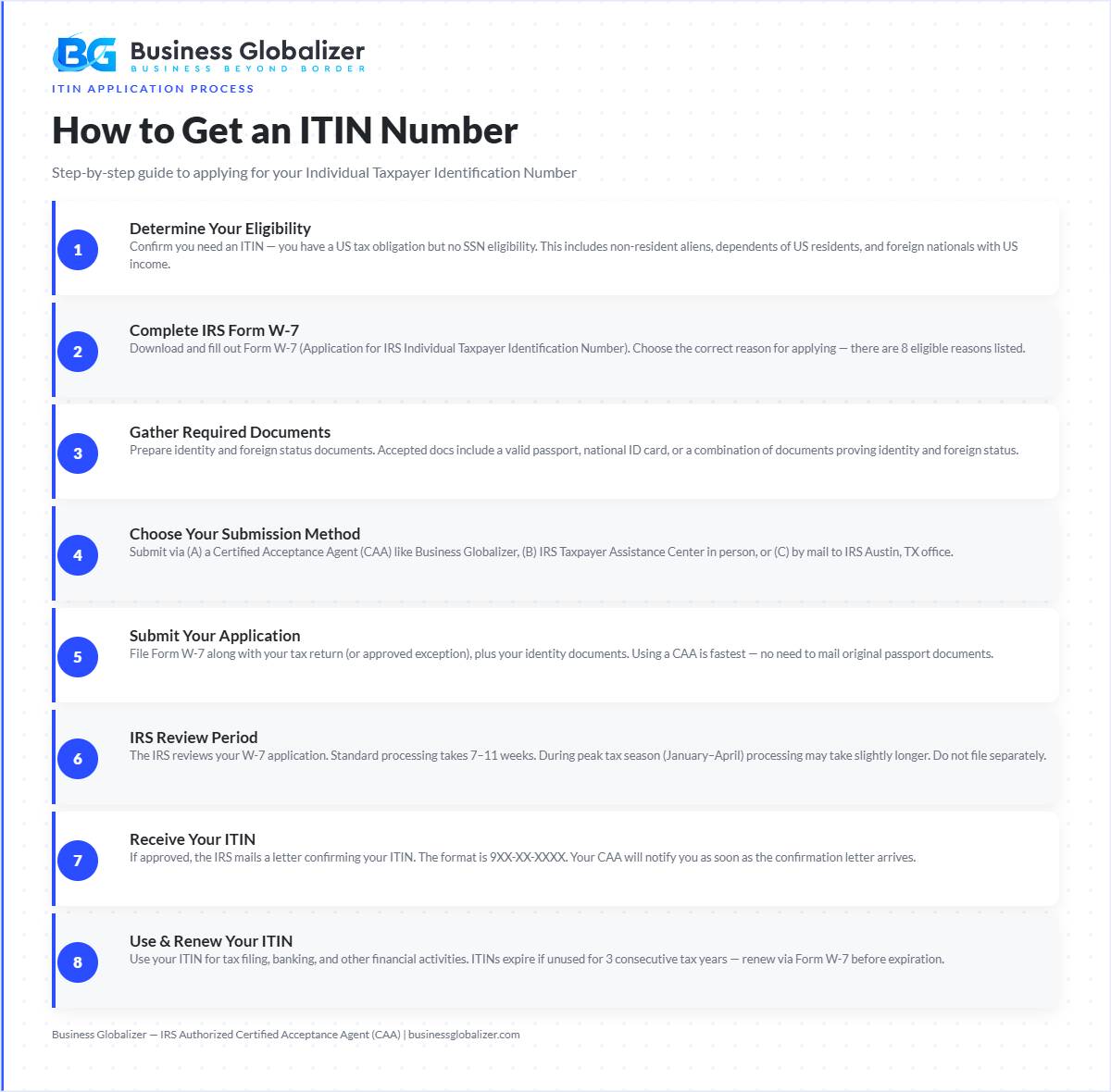
Process of Obtaining an ITIN – How to Get it?
Getting an ITIN isn’t hard, it’s just annoying when you don’t know what the IRS expects. Here’s the process simply described, the same way we walk clients through it every day:
- Identify Why You Need an ITIN
Everything starts here.
Your reason: business tax filing, PayPal verification, spouse/dependent, investment income, selling property, determines which documents the IRS will accept.
(Get this wrong and rejection is almost guaranteed.)
- Gather the Required Documents
This usually includes:
- Valid passport
- Federal tax return or applicable exception
- Proof of relationship (for spouse or dependent)
- Address proof and supporting documents depending on your scenario
Different cases need different paperwork, which is why people often mess up this step.
- Let a CAA Review & Verify Your Documents
This is where the stress drops.
A Certified Acceptance Agent (CAA) checks everything, verifies your identity, and removes the biggest risk: you do NOT have to mail your passport to the IRS.
- Prepare Form W-7 Accurately
The W-7 looks simple, but one wrong reason code, spelling mismatch, or missing detail = rejection. This form must match your documents exactly, including passport spelling, dates, and exception category.
- Sign the Form (Physical Signature Required)
The IRS still loves paper.
You must physically sign the W-7, even if everything else is done digitally.
- CAA Signs & Submits Your Application to the IRS
Your CAA adds their own signature, attaches verified documents, and sends the complete package directly to the IRS, the correct center and correct route.
- IRS Reviews the Application
This part varies:
- Standard timeline: 7–12+ weeks
- Busy season or holidays: may take longer
- Clean, verified applications usually move faster
No one, not even CAAs, can speed up the IRS once the package is in their hands. During this stage—the Form W-7 application processing time, many people spend weeks tracking ITIN application status, waiting for the IRS confirmation letter (CP565 Notice).
- ITIN Issuance
If everything checks out, the IRS assigns your ITIN and mails the confirmation letter.
Your CAA will notify you as soon as it arrives so you can use it for taxes, PayPal, property sales, payments, whatever you need it for.
In short:
The process is simple when done correctly, painful when done alone, and completely avoidable when guided by someone who already knows the IRS’s mood swings.
Interested to learn more about getting an ITIN? Simply check our blogs: How to apply for an ITIN from Bangladesh, and How to get an ITIN number for nonresidents.
ITIN Application Rejection (CP566 & CP567 Notices)
Nobody applies for an ITIN expecting a love letter from the IRS. But sometimes you get one anyway. Not a love letter of course. Notice, I mean.
It just comes in the form of CP566 or CP567, and neither feels good.
Here’s what they actually mean:
- CP566
A CP566 notice means something’s missing. Not a straight rejection.
Maybe a document didn’t match, maybe the identity proof wasn’t strong enough, maybe a form wasn’t signed.
The IRS is basically saying: “Fix this and try again.”
- CP567
This one stings more. A CP567 notice means your ITIN application was rejected, usually due to:
- wrong reason code
- incorrect document type
- expired passport copy
- mismatched information
- filing something that doesn’t qualify for an ITIN
The good news?
Almost all CP566 and CP567 issues can be corrected, and resubmitting a clean application usually gets approved.
How Much Does It Cost to Get an ITIN Number?
The IRS charges $0 for an ITIN.
You only pay for the Certified Acceptance Agent (CAA) who prepares your W-7, verifies your documents, and keeps your passport safe.
Most CAAs charge $150–$400 depending on support level.
At Business Globalizer, it’s $299 including full and customized guidance, verification, and application tracking included.
That’s it. No hidden fees. To learn more about ITIN cost and other queries, you can always talk with our experts.
ITIN Expiration: Does ITIN Expire?
Yes, they do!
An ITIN doesn’t last forever; the IRS retires them when they go unused.
In simple terms:
- If your ITIN hasn’t been on a tax return for three consecutive years, it expires.
- If the middle digits fall into the old expiration batches (like 70–99 issued before 2015), the IRS requires renewal before use.
- Using an expired ITIN can delay your tax return, refund, or verification process.
Renewing an expired ITIN is basically repeating the application; same W-7, same documents, just without the stress of figuring out eligibility again.
ITIN Renewal: When Is It Necessary?
So, if you face similar situations mentioned above and trying to figure out the U.S. tax scene, you might need an ITIN. At this point, you may be wondering if you need to renew your ITIN. If it’s, then when?
You can think of an ITIN renewal as updating your driver’s license. This renewal is necessary under certain circumstances to ensure its validity for tax purposes. Here’s when renewal may be required:
- Expiration: Any ITIN issued before 2015, especially those with middle digits from 70–99, had a renewal deadline in 2022. If it wasn’t renewed, it’s now considered expired and needs to be updated before you can use it on future tax filings.
- Non-Use: If an ITIN is not used on a federal tax return at least once, it expires after three years. In this case, it must be renewed to continue being used for taxes.
- Change in Circumstances: If something big changes in your life, like you become eligible for new tax benefits or need to report income, you might need to renew your ITIN to reflect that.
- Dependents Turning 18: When a dependent turns 18, they may no longer qualify for certain tax credits like the Child Tax Credit. However, their ITIN itself does not expire because of this. Their ITIN remains valid under the same standard rules: non-use for three consecutive years or IRS-scheduled expiry batches.
Keeping your ITIN up to date ensures you can stay on top of your taxes without any hassle or interruption.
Expert Tips
Before you apply for or renew your ITIN, a few small choices can save you weeks of frustration. Here are some practical tips that make the whole process smoother and a lot less stressful:
- Start your ITIN application early, IRS processing slows down heavily between January and April.
- Use a passport if possible; it’s the cleanest, least confusing document for ITIN approval.
- Always match your name, birth date, and address across every document, tiny mismatches cause long delays.
- Renew your ITIN before filing season begins if you suspect it may be expired or unused for three years.
- Keep a digital and printed copy of your ITIN approval letter; replacing a lost ITIN is slow.
- If you’re outside the U.S., consider using a Certified Acceptance Agent (CAA) to avoid mailing original documents.
- Don’t apply for an ITIN if you’re eligible for an SSN, the IRS will reject the application.
- Remember that an ITIN doesn’t authorize work; it only keeps your tax life legal and organized.
- If you run a U.S. business from abroad, keep your EIN and ITIN documents together, most platforms will ask for both.
- Update your tax filings the moment your life changes (marriage, property purchase, investment income), it keeps your ITIN history clean.
How Business Globalizer Can Help?
At this point, let us give you a proud declaration: Business Globalizer is an IRS-authorized CAA (Certified Acceptance Agent). What does that mean? That means we are perfectly able to issue an ITIN without any third-party interference or hassle. So, if you need one, you know where to go!
Check our CAA status on the official website of the IRS.
Final Words
By now, you should not only know what an ITIN number in theory, but also how it quietly sits behind your taxes, your bank accounts, and your cross-border plans. By understanding the needs of ITIN individuals can stay on the right path regarding tax laws. Tax benefits are available to non-residents in addition to a range of financial services. The benefits of being a part of the US financial system, such as tax obligations, are guaranteed when you get an ITIN.
In simple terms, once you understand the ITIN number definition and how it works in everyday life, you stop seeing it as “just a number” and start seeing it as your basic key to the U.S. financial system.
Key Takeaways
- An ITIN (Individual Taxpayer Identification Number) is a 9-digit tax ID issued by the IRS to non-residents, resident aliens, and dependents who cannot get a Social Security Number.
- ITINs always begin with the digit 9 (format 9XX-XX-XXXX) and are used solely for US federal tax purposes — they do not authorize you to work in the US or receive Social Security benefits.
- You need an ITIN if you’re required to file a US tax return or have US-source income but don’t qualify for an SSN — including non-resident aliens, foreign investors, and spouses/dependents of US visa holders.
- ITINs expire if not used on a federal tax return for three consecutive years, or per IRS scheduled expiration cycles — you must renew before filing.
- To apply, you submit IRS Form W-7 with your tax return and certified identity documents — or use an IRS-certified Acceptance Agent (like Business Globalizer) who can certify your documents without requiring you to mail originals.
FAQs on ITIN Number
Is an ITIN the same as a Social Security Number (SSN)?
Answer: Not at all. An SSN is for people who can legally work in the U.S. and access benefits tied to employment. An ITIN sits on the other side of the table; it’s for people who still have tax responsibilities in the U.S. but don’t qualify for an SSN. The simplest way to picture it: the SSN is tied to work and benefits; the ITIN exists purely for taxes and identification.
What does ITIN stand for?
Answer: Well, ITIN stands for Individual Taxpayer Identification Number. Most people who search things like “ITIN stands for what?” or “ITIN number in the USA” are usually double-checking whether this is the IRS-issued number for non-SSN holders. And yes, it is. If you can’t get a Social Security Number but the IRS still expects you to file something, the ITIN is the ID they’ll look for.
What is an ITIN number used for?
Answer: Think of the ITIN as the IRS’s way of keeping you in the system when you don’t have an SSN. You use it to file federal tax returns, claim a refund if you’re owed one, apply any tax treaty benefits you qualify for, or report income from U.S. investments or property. It also comes in handy for certain financial activities like opening accounts. In short, if you’re not SSN-eligible but you still have tax or reporting duties in the U.S., the ITIN is the number that keeps everything running smoothly.
Is ITIN only for non-residents?
Answer: Mostly, but not entirely. ITINs are mainly used by non-resident aliens, resident aliens who can’t get an SSN, and their dependents or spouses. The common thread is not your immigration status, but the fact that you have U.S. tax duties without being SSN-eligible.
Does every non-resident business owner need an ITIN?
Answer: Not every case, but most. If you run a U.S. LLC, receive payments, own property, or use platforms like PayPal or Stripe, you often need an ITIN because those organizations must report information tied to your personal tax ID. The EIN covers your company, but the ITIN covers you.
Is knowing what is ITIN number important before starting a U.S. business?
Answer: Absolutely. Before forming a company, opening a PayPal account, or dealing with U.S. clients, understanding what is ITIN number and whether you’ll need one helps you avoid delays, rejected applications, and compliance headaches later.
Does having an ITIN give me immigration status or work authorization?
Answer: Not at all. Having an ITIN doesn’t change your immigration status and doesn’t give you permission to work. It only gives you a legal way to file taxes, receive refunds, and stay compliant with U.S. tax laws.
Why does the IRS issue ITINs if they don’t allow work authorization?
Answer: Because U.S. tax law requires that every person with a tax obligation must be able to file, even if they’re a non-resident, a spouse, a dependent, or temporarily in the U.S. ITINs exist to keep the tax system complete, traceable, and fair.
Does applying for an ITIN make me eligible for government benefits?
Answer: No. ITIN holders cannot receive Social Security benefits, unemployment benefits, or federal welfare programs. The ITIN helps with taxes; nothing more.
Is there any situation where someone should NOT apply for an ITIN?
Answer: Yes. If you’re eligible for a Social Security Number (SSN), you should never apply for an ITIN. The IRS will reject it, and it may also create unnecessary delays in your filings. ITINs are only meant for people who cannot get an SSN.
Do I need an ITIN even if I don’t live in the U.S.?
Answer: Yes, in many cases. Non-residents earning U.S. income—from property rents, investments, business activities, or freelance work—often need an ITIN to file their federal taxes. You don’t have to live in the U.S. to owe U.S. taxes.
Can I get a tax refund with an ITIN?
Answer: Yes. If you overpaid taxes, were withheld at a higher rate, or qualify for a refund under a tax treaty, the IRS will return your money, but only if your ITIN is valid and active.
Do ITINs expire automatically or only when the IRS says so?
Answer: ITINs expire in two ways:
- If they were issued before 2015 with middle digits 70–99 and not renewed.
- If the ITIN wasn’t used on a federal tax return for three consecutive years.
If either applies, you have an expired ITIN and must renew it before filing.
Can Individuals renew their ITIN number online?
Answer: No, you cannot renew the ITIN online. Currently, the IRS doesn’t offer online renewal for ITINs. You’ll need to submit a paper application with the required documents by mail or in person.
How often does one need to renew ITIN?
Answer: An ITIN expires if it hasn’t been used on a federal tax return for three consecutive years. So, the renewal frequency depends on your tax filing history. If you use your ITIN to file at least once every three years, you won’t need to renew it.
What should I do If I lose my ITIN Number?
Answer: If you lose your ITIN number, you need to contact the IRS to retrieve or find it.
How to get the ITIN number for non-residents?
Answer: Non-residents can apply for an ITIN by filing Form W-7 on the IRS website and submitting the original documents or certified copies to verify their identity and foreign status. You can do this through mail in person or with the help of an IRS-Certified Acceptance Agent Business Globalizer.
What documents does the IRS accept to prove identity for an ITIN?
Answer: The IRS prefers a passport, but also accepts national ID cards, birth certificates (for dependents), foreign driver’s licenses, and certain immigration documents — as long as they’re original or certified by the issuing agency.
Is the ITIN process the same everywhere, or does it depend on who you are?
Answer: The form (W-7) is universal, but the documents required depend on your category — business owners, dependents, non-resident investors, spouses, and students each have slightly different requirements. The IRS looks at “why you need the ITIN” before deciding what documents they want.
Can I hire someone who has an ITIN number?
Answer: No, typically you cannot hire someone with just an ITIN. They cannot work lawfully in the US without a Social Security number (SSN). However, there might be exceptions for specific tax situations. Consult a legal expert for details.
What is ITIN Operation?
Answer: “ITIN Operation” refers to the IRS department that handles ITIN applications and renewals. When you see this on a mailing address or notice, it simply points to the IRS unit responsible for processing your ITIN paperwork, not a separate program or status.
Need an ITIN? We Make It Simple.
As an IRS-certified Acceptance Agent, Business Globalizer handles your entire ITIN application — from Form W-7 preparation to IRS submission. No US travel, no hassle.