Quick Answer
A UK VAT invoice is a legal document that VAT-registered businesses must issue for all taxable supplies. It must include your VAT registration number, a unique invoice number, the date of supply, a description of goods or services, the net amount, the applicable VAT rate, and the total VAT charged. HMRC requires VAT-registered businesses to issue a VAT invoice within 30 days of supplying goods or services to another VAT-registered business.
A UK VAT invoice is not just a billing document — it is a legal requirement under Regulation 13 of the VAT Regulations 1995. If your business is VAT-registered and you supply goods or services to another VAT-registered business, you must provide a compliant VAT invoice. Failure to do so can result in penalties, rejected VAT reclaim attempts by your customers, and complications during HMRC audits.
Last updated: May 6, 2026
What Is a UK VAT Invoice?
A VAT invoice is a document containing all VAT-related information required by HMRC. It records the transaction between a supplier and a customer, itemising taxable supplies and showing the VAT amount charged.
Under UK law, only VAT-registered businesses can issue VAT invoices. If you are not VAT-registered, you must not include a VAT number or charge VAT — doing so is a criminal offence.
However, a VAT invoice is not required if the supply consists solely of zero-rated items or exempt items within the UK. A retailer making supplies to non-VAT-registered consumers can also issue a simplified VAT invoice (see the comparison table below).

What Are the HMRC VAT Invoice Requirements?
HMRC specifies three types of VAT invoices, each with different requirements. Understanding which type applies to your situation is essential for compliance.
UK VAT Invoice Types: Full, Simplified, and Modified

| Requirement | Full VAT Invoice | Simplified VAT Invoice | Modified VAT Invoice |
|---|---|---|---|
| Unique invoice number | ✓ Required | ✓ Required | ✓ Required |
| Date of issue | ✓ Required | ✓ Required | ✓ Required |
| Supplier name & address | ✓ Required | ✓ Required | ✓ Required |
| Supplier VAT number | ✓ Required | ✓ Required | ✓ Required |
| Customer name & address | ✓ Required | ✗ Not required | ✓ Required |
| Customer VAT number | ✓ Required (if applicable) | ✗ Not required | ✓ Required (if applicable) |
| Date of supply (tax point) | ✓ Required | ✗ Not required | ✓ Required |
| Description of goods/services | ✓ Required | ✓ Required | ✓ Required |
| Net amount (ex-VAT) | ✓ Required | ✗ Not required | ✓ Required |
| VAT rate applied | ✓ Required | ✓ Required | ✓ Required |
| VAT amount charged | ✓ Required | ✓ Required | ✗ Not required |
| Gross amount (inc-VAT) | ✓ Required | ✓ Required | ✓ Required |
| When to use | B2B transactions; all standard taxable supplies | Retail; supplies under £250 inc VAT | Retail; agreed with HMRC in advance |
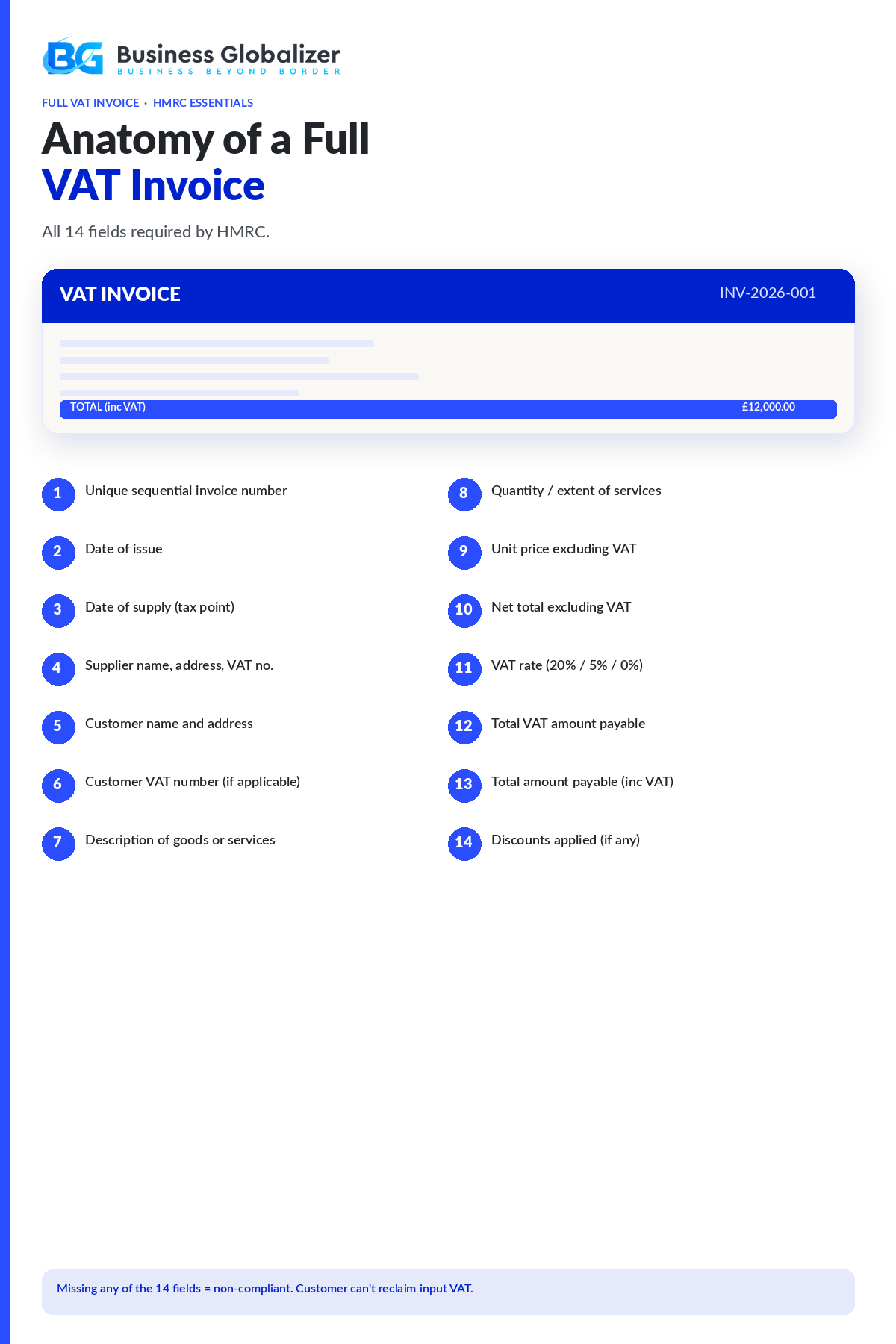
Full VAT Invoice — Required Fields

- Unique sequential invoice number — must never be reused
- Date of issue — the date the invoice is created
- Date of supply (tax point) — when goods were delivered or services performed
- Supplier’s name, address, and VAT registration number
- Customer’s name and address
- Customer’s VAT number (if the customer is VAT-registered)
- Description of goods or services — sufficient detail for HMRC to determine the VAT treatment
- Quantity of goods or extent of services
- Unit price excluding VAT
- Net total excluding VAT
- VAT rate applied to each item (e.g., 20%, 5%, 0%)
- Total VAT amount payable
- Total amount payable including VAT
- Any discounts applied (cash or trade discounts affecting the VAT calculation)
If any of the 14 required fields are missing, the invoice is non-compliant. Your customer cannot use a non-compliant VAT invoice to reclaim input VAT from HMRC.
Example of an HMRC VAT Invoice

Below is an example of a reverse-charge VAT invoice for a single contract with different VAT rates, sourced from HMRC’s guidance on domestic reverse charge:
| Description | Net (£) | VAT Rate | VAT (£) | Gross (£) |
|---|---|---|---|---|
| Refurbishment of commercial premises | 200,000 | 20% | Reverse charge applies | 200,000 |
| Conversion of office block to residential | 150,000 | 5% | Reverse charge applies | 150,000 |
| Total | 350,000 | — | — | 350,000 |
Note: Under reverse charge, the customer accounts to HMRC for the output tax. The supplier does not charge VAT on the invoice but must note “Reverse charge: Customer to account for VAT to HMRC.”
When Does a Company Need to Issue a VAT Invoice?

You are legally required to issue a VAT invoice when all three of the following conditions are met:
- Your business is VAT-registered — once your taxable turnover exceeds the current VAT registration threshold of £90,000, registration is mandatory and you must issue VAT invoices for all taxable sales.
- The supply is taxable — standard-rated (20%), reduced-rated (5%), or zero-rated (0%) supplies require a VAT invoice. Exempt supplies do not.
- The customer requests it or is VAT-registered — B2B transactions always require a full VAT invoice. For B2C transactions, a simplified VAT invoice suffices for supplies under £250.
A VAT invoice is also essential for reclaiming input VAT. If your customer is VAT-registered and wishes to reclaim the VAT they paid on a purchase, they must hold a valid VAT invoice from the supplier. HMRC can and does disallow VAT reclaims where invoices are missing or non-compliant.
What Are the Considerations Before Sending a UK VAT Invoice?
Before issuing a VAT invoice, verify the following to ensure compliance:
- Accuracy of supplier and customer details — names, addresses, and VAT numbers must be correct
- Correct VAT rate — confirm the applicable rate (20%, 5%, or 0%) for each item or service
- Appropriate invoice type — full, simplified, or modified, depending on transaction type and value
- Clear description — descriptions must be specific enough for HMRC to determine the correct VAT treatment
- Payment terms — state clearly: due date, late payment fees, and any applicable discounts
- Sequential numbering — your invoice numbering system must be sequential with no gaps or duplicates
- Record retention — you must retain all VAT invoices for at least 6 years (as required by HMRC)
What Is the Deadline for Issuing a VAT Invoice in the UK?

HMRC requires VAT invoices to be issued within 30 days of the date of supply (the tax point). The tax point is generally the earlier of:
- The date goods are delivered or services are completed
- The date payment is received
- The date you raise the invoice (if this is within 14 days of delivery)
Late invoicing is a common compliance error. Businesses can request a later tax point from HMRC in certain circumstances, but this requires prior written approval.
Who Can Send Invoices Without a VAT Number?
Businesses that are not VAT-registered must not charge VAT or issue VAT invoices. They may issue standard invoices showing their total charge without any VAT element.
Certain categories may issue simplified invoices without a VAT number in specific circumstances, including retailers making supplies directly to consumers and businesses below the VAT registration threshold. However, these invoices cannot be used by the recipient to reclaim input VAT.
If you are unsure whether you need to register for VAT, HMRC’s VAT registration guidance sets out the current thresholds and conditions for mandatory and voluntary registration.
What Should You Do If You Issue an Invoice Without a VAT Number by Mistake?

- Contact your customer immediately — notify them that the invoice is incorrect before they attempt to use it for a VAT reclaim
- Issue a credit note — cancel the erroneous invoice formally using a credit note that references the original invoice number and date
- Issue a corrected invoice — reissue the invoice with the correct VAT number, using a new sequential invoice number
- Retain both documents — never delete the original invoice. Keep the original, the credit note, and the corrected invoice together for your records
- Check your VAT return — if the incorrect period has already been submitted to HMRC, you may need to adjust your next VAT return or submit a VAT652 error correction form
Addressing invoicing mistakes promptly minimises the risk of HMRC penalties and helps maintain accurate VAT records. For businesses operating across multiple countries, see our guide on Changes to UK Company Law 2026 for broader compliance considerations.
UK VAT Invoice for Non-UK Businesses: Key Considerations
If you are a non-UK business supplying goods or services to UK customers, UK VAT rules may still apply to you. Since Brexit, the UK operates its own VAT regime, independent of EU VAT rules.
- Distance selling to UK consumers — overseas businesses selling more than £70,000 in goods to UK consumers may need to register for UK VAT
- Digital services — non-UK businesses supplying digital services to UK consumers must register for UK VAT regardless of turnover (HMRC’s MOSS equivalent no longer applies post-Brexit)
- Reverse charge mechanism — B2B services supplied by overseas businesses to UK VAT-registered businesses are generally subject to the reverse charge, which shifts the VAT accounting obligation to the UK customer
- Making Tax Digital (MTD) — all UK VAT-registered businesses must use MTD-compatible software to file their VAT returns, including foreign businesses registered for UK VAT
If you are a non-resident entrepreneur forming a UK company and need to understand your VAT obligations, our guide on running a business across borders covers cross-border compliance in detail.
Key Insights

- UK VAT invoices are legally required for all taxable B2B supplies made by VAT-registered businesses — non-compliance can result in HMRC penalties.
- There are three types of UK VAT invoice: full (required for most B2B transactions), simplified (for retail supplies under £250), and modified (by agreement with HMRC).
- A full VAT invoice must contain 14 specific fields — including your VAT number, a unique invoice number, the tax point date, and a breakdown of VAT by rate.
- The legal deadline for issuing a VAT invoice is 30 days from the date of supply (tax point).
- Your customer cannot reclaim input VAT without a valid VAT invoice — making compliance a business-to-business priority, not just a personal obligation.
- Businesses must retain all VAT invoices for at least 6 years, including credit notes and corrected invoices.
- Reverse charge invoices shift VAT accounting to the customer and must include the statement: “Reverse charge: Customer to account for VAT to HMRC.”
- Non-UK businesses supplying digital services or goods to UK consumers may need to register for UK VAT regardless of their location.
- If you issue an incorrect invoice, issue a credit note immediately, reissue a corrected invoice, and retain both documents — never delete the original.
- Making Tax Digital (MTD) requires all UK VAT-registered businesses to submit returns via HMRC-approved software — including overseas businesses registered for UK VAT.
- The current VAT registration threshold is £90,000 in taxable turnover — exceeding this triggers mandatory VAT registration and the obligation to issue VAT invoices.

FAQs: UK VAT Invoice Requirements
Is it legally required in the UK to provide a VAT invoice?
Yes. If your business is VAT-registered in the UK, you must issue a VAT invoice for all taxable goods and services supplied to other VAT-registered businesses. This applies to both B2B and B2C transactions, though simplified invoices are permitted for B2C supplies under £250.
Are a legal receipt and a VAT invoice the same thing?
No. A receipt is proof of payment; a VAT invoice is a detailed legal document showing the taxable supply, the VAT charged, and the parties involved. A VAT invoice can serve as a receipt, but a receipt does not substitute for a VAT invoice. Only a valid VAT invoice allows the recipient to reclaim input VAT from HMRC.
What happens if a VAT invoice is missing or incorrect?
If a VAT invoice is missing or incorrect, your customer cannot use it to reclaim input VAT. HMRC may disallow the VAT reclaim and issue penalties. You should issue a credit note to cancel the incorrect invoice and reissue a corrected version. Never delete original invoices.
Can a non-VAT-registered business issue a VAT invoice?
No. Only VAT-registered businesses can issue VAT invoices and charge VAT. Issuing a VAT invoice without being VAT-registered — or including a fake VAT number — is a criminal offence under UK law and can result in prosecution.
What is the difference between a full and a simplified VAT invoice?
A full VAT invoice includes all 14 required fields — including the customer’s name and address, the tax point date, the net amount, and a VAT breakdown. A simplified VAT invoice is a shorter format used for retail supplies under £250 (including VAT). It omits customer details and the net amount but must still show the supplier’s VAT number, the VAT rate, and the gross amount.
How long must UK businesses retain VAT invoices?
HMRC requires businesses to retain VAT invoices for a minimum of 6 years. This includes all original invoices, credit notes, and corrected invoices. Businesses subject to Making Tax Digital must store these records in HMRC-approved digital formats.
Does a VAT invoice need to be in English?
HMRC requires VAT records to be kept in English (or Welsh in Wales), but VAT invoices themselves do not need to be in English if the transaction involves international parties. However, if HMRC requests a VAT invoice during an audit, you must be able to provide an English translation on request.