Quick Answer
To change a trademark owner, first determine whether ownership actually changed or the owner’s name merely changed. A true transfer is generally documented and recorded through the USPTO Assignment Center.
A trademark can stay exactly the same while everything behind it changes.
A founder sells the brand. An individual transfers the business to an LLC. Two companies merge. Or perhaps the owner never changed at all; the company simply has a new legal name.
These situations may look similar on a USPTO record, but they are not legally the same, especially when maintaining or updating a U.S. trademark registration.
That distinction is the starting point for understanding how to change a trademark owner correctly. Sometimes you need a trademark assignment. Sometimes you only need to record a name change. And if the wrong party filed the original application, changing a name afterward may not solve the problem at all.
So before touching the USPTO record, figure out what actually changed.
What Does Changing a Trademark Owner Mean?
A trademark owner can be an individual or a legal entity such as a corporation or LLC.
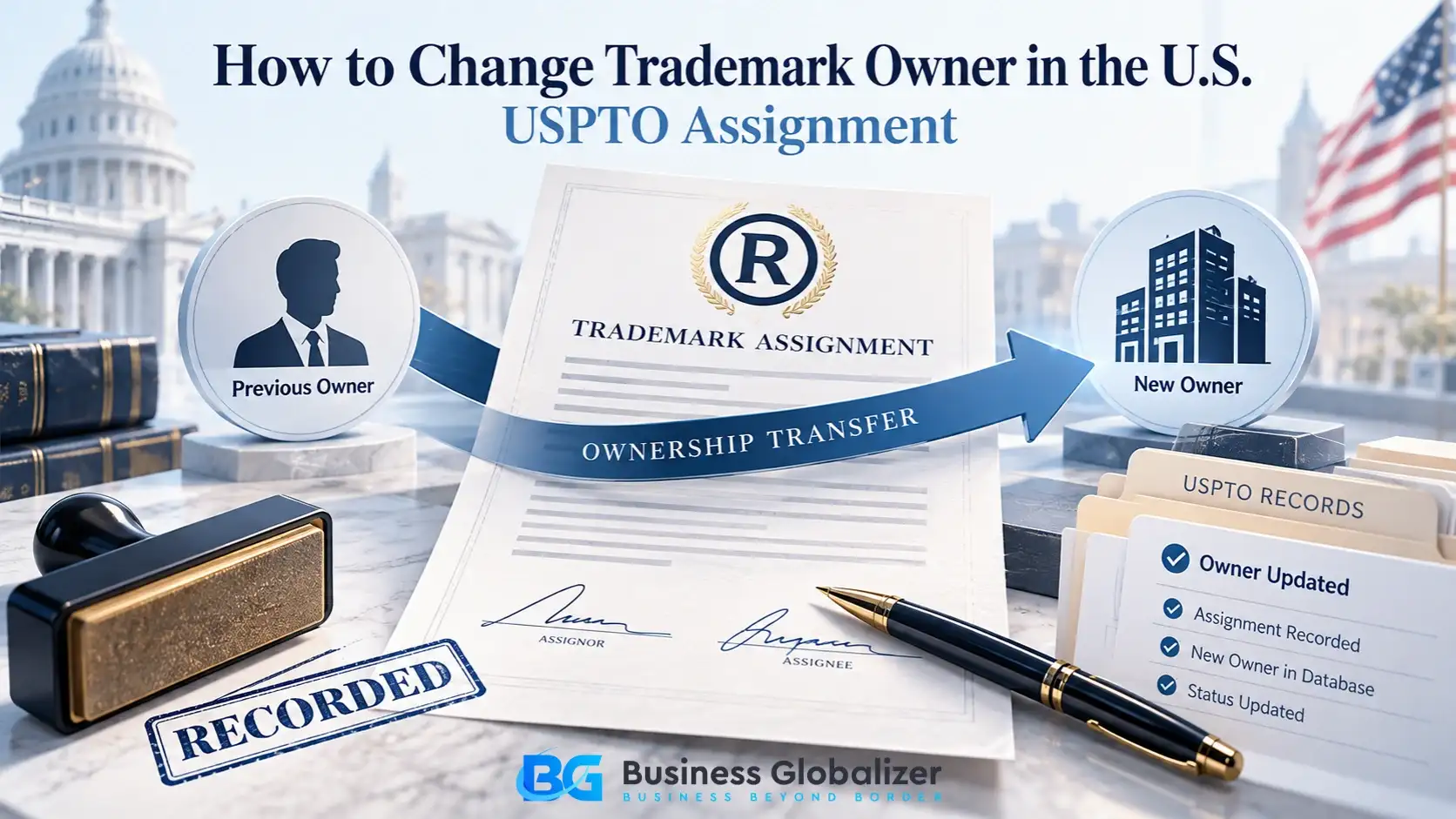
If that ownership moves from one person or entity to another, the USPTO describes the transfer as an assignment.
For example:
Before: ABC Brands LLC owns the trademark.
After: XYZ Holdings Inc. owns the trademark.
That is an ownership transfer.
But suppose ABC Brands LLC simply changes its legal name to ABC Global LLC while remaining the same legal entity. That is generally a change of name, not an assignment to a different owner.
The distinction matters because the supporting documents and legal effect are different.
This is also why ownership should be identified carefully during the U.S. trademark application requirements stage rather than treated as a detail that can always be cleaned up later.
Assignment, Name Change, or Correction: Which One Do You Need?
Here is the practical difference:
| Situation | What Happened | Typical USPTO Route |
| Business or trademark sold | Ownership moved to another party | Trademark assignment |
| Trademark transferred from one entity to another | New legal owner | Trademark assignment |
| Same legal entity changed its name | Owner remains the same | Name change |
| Typographical or correctable owner-name mistake | No genuine transfer occurred | Correction may be available |
| Wrong party owned the mark when application was filed | Original ownership may be defective | Usually cannot simply be cured by assignment |
The last row deserves attention.
There is a big difference between needing to correct trademark registration information and trying to repair an application that was legally filed by the wrong owner.
That line can determine whether a correction is possible at all.
How to Change Trademark Owner Through a USPTO Assignment
For a genuine ownership transfer, the USPTO currently directs trademark owners to the Assignment Center. Assignment Center replaced the old Electronic Trademark Assignment System, or ETAS, in February 2024.
The process broadly works like this.
- Confirm That the Trademark Can Be Assigned
Federal law allows a registered mark or trademark application to be assigned with the goodwill of the business connected with the mark.
In plain English, you cannot normally assign trademark rights as an empty piece of paperwork disconnected from the business goodwill the mark represents. There is also an important restriction for applications filed under the intent-to-use basis.
A Section 1(b) application generally cannot be assigned before the applicant files an Amendment to Allege Use or Statement of Use. An exception exists for a transfer to a successor to the applicant’s ongoing and existing business, or the relevant portion of that business.
That is one reason your original trademark filing basis can still matter when ownership changes before registration.
- Prepare the Assignment Document
The assignment itself is the legal document showing the transfer between the parties. Under the Lanham Act, trademark assignments must be made through a duly executed written instrument.
The document should accurately identify the parties and the trademark rights being transferred. A trademark assignment also needs to transfer the goodwill connected with the mark.
This is more than changing a name in an online database. The underlying transaction needs to support the ownership transfer being recorded.
- Submit the Transfer Through Assignment Center
To transfer trademark ownership, the owner can submit the recordation request through the USPTO Assignment Center.
The submission includes a recordation cover sheet containing information about the transaction and the trademark property involved. Supporting documentation may also be required depending on the type of ownership change.
The information on the cover sheet should match the underlying document.
The USPTO identifies mismatches between those records, missing information, illegible documents, and failure to transfer goodwill as common reasons an assignment may not be recorded.
- Pay the USPTO Recordation Fee
Under the USPTO fee schedule current in September 2026:
- First trademark in the same document: $40
- Each second and subsequent trademark in that document: $25
These are USPTO recordation fees. Attorney, document-preparation, or professional service costs are separate. This cost is also separate from the initial trademark application cost, which applies when seeking registration in the first place.
- Check the Updated Ownership Record
After submission, the USPTO says to look for a Notice of Recordation or Notice of Non-Recordation in about seven days.
Once the assignment is recorded, check the Trademark Status and Document Retrieval system, or TSDR, to confirm that the current owner information has been updated. The USPTO recommends waiting about a week after receiving the Notice of Recordation before checking the ownership information.
This step is easy to overlook. Recording the document and seeing the correct owner displayed in the trademark database are related, but the database does not update automatically in every situation.
Can You Change the Owner While a Trademark Application Is Pending?
Yes, ownership can change while an application is pending, but the filing basis and stage of the application matter.
For Section 1(a) use-in-commerce and certain Section 44 applications, ownership can generally be transferred when the legal requirements for an assignment are met.
As noted earlier, Section 1(b) intent-to-use applications have a special restriction before use is alleged.
For applications and registrations based on Madrid Protocol Section 66(a), ownership changes involving the international registration must be filed with the International Bureau of the World Intellectual Property Organization, or WIPO, rather than handled as an ordinary U.S. ownership transfer through the Assignment Center.
If your mark is still moving through the trademark registration process, checking its current stage before recording the transfer can prevent the ownership records from becoming unnecessarily messy.
Can You Correct the Wrong Owner on a Trademark Application?
This is where “change” and “correct” stop meaning the same thing. Suppose the correct owner filed the application, but its name was entered incorrectly. Depending on the circumstances and stage of the application, the USPTO may allow the mistake to be corrected.
But suppose the application was actually filed by the wrong party.
The USPTO states that an application must be filed by the party that owned the mark, or had the required bona fide intention to use it, on the filing date. If the wrong party was identified as the applicant, that defect generally cannot be cured by amendment or assignment.
In that situation, simply trying to update trademark registration information from Company A to Company B does not turn Company A into the proper original applicant. A new application may be necessary.
This distinction is particularly important for founders who operate through several entities. Before filing, decide whether the trademark belongs to you personally, your LLC, your corporation, or another entity.
A beginner’s understanding of U.S. trademarks should therefore treat ownership as part of the filing strategy, not just paperwork.
What If the Owner Is Correct but the Name Is Wrong?
Not every owner-name problem destroys an application. The USPTO distinguishes between:
- Identifying the wrong owner
- Making a correctable mistake in the proper owner’s name
Certain typographical mistakes or errors in stating the proper owner’s legal name may be correctable. This is possible only if the actual applicant was still the proper party on the filing date.
The required form and procedure may depend on the trademark’s stage in the USPTO process:
- Before examination
- During examination
- After publication
- After registration
After registration, some correctable errors may require a Section 7 Request for Amendment or Correction of Registration Certificate.
If you see a wrong owner trademark record, do not immediately record an assignment. First determine what actually happened:
- Was there a real transfer?
- Did the same legal entity only change its name?
- Was there a correctable naming error?
- Was the wrong applicant listed from day one?
These problems may look similar, but they can require very different fixes.
What If an Assignment Was Recorded Incorrectly?
Assignment Center errors follow specific correction procedures. Review the options below to determine which procedure applies to your situation:
If the Assignment Has Not Been Recorded
If you find an error in the Assignment Center cover sheet before recordation:
- Contact the Assignment Recordation Branch immediately.
- In some cases, the USPTO may briefly suspend recordation.
If the Assignment Has Already Been Recorded
Correction is more involved. The USPTO may require:
- A corrective assignment submission
- A new, complete cover sheet
- Information identifying the earlier recordation
- Supporting statements explaining the error
Check the Trademark Database Separately
Recording a corrective document with the Assignment Recordation Branch does not necessarily update the separate Trademark database automatically. Depending on the circumstances, the owner may also need to notify the Trademark Operation so the displayed ownership information can be corrected.
Do not treat Assignment Center like an editable profile page. Recorded ownership documents become part of the public chain-of-title history.
Does Recording an Assignment Make the Transfer Legally Valid?
This distinction is easy to miss.
USPTO recordation creates a public record of the claimed ownership interest, but the USPTO does not treat the act of recordation itself as a determination that the underlying assignment is legally valid.
The legal document and transaction still matter.
Federal law also gives recordation an important priority role: an assignment can be void against a later purchaser for value without notice unless the prescribed assignment information is recorded with the USPTO within three months after the assignment date or before the later purchase.
So recording promptly is more than housekeeping. It helps maintain a clear public chain of title. That becomes especially important during business sales, investment, licensing, enforcement, and later trademark renewal filings.
Other Trademark Details an Ownership Transfer Does Not Change
A trademark ownership change changes who owns the mark. It does not rewrite the registration from scratch. For example, transferring ownership does not automatically let the new owner expand the registered goods or services into unrelated areas.
The original trademark classes still determine how the goods and services are categorized within the registration. Likewise, an assignment does not cure a mark that should never have been registrable under the rules governing what can be trademarked in the U.S. and what cannot.
And if you’re checking the chain of title before buying a brand, a search of the U.S. trademark database review can help confirm the public registration information, while the USPTO’s assignment records provide additional ownership history.
Federal ownership records should also not be confused with state trademark records, since state and federal registrations are separate systems with different records and scope.
What About Foreign Trademark Owners?
A non-U.S. person or company can own a U.S. trademark. So transferring a federal trademark to a foreign owner is not automatically prohibited simply because the new owner lives outside the United States.
However, foreign-domiciled trademark applicants and registrants generally must be represented before the USPTO by a U.S.-licensed attorney.
That requirement matters for founders who originally followed the process for registering a U.S. trademark for non-residents and later restructure, sell, or move the trademark to another company.
Ownership may be international. USPTO representation rules still apply.
How Business Globalizer Supports Trademark Ownership Changes
Changing a trademark owner can look like a simple database update until you have to decide whether you’re dealing with an assignment, name change, correction, or a defective original owner.
Business Globalizer can support U.S. and non-U.S. founders with the practical side of that process, including:
- U.S. trademark ownership review, filing support, and qualified counsel
coordination - U.S. company formation
- Registered agent
- EIN services
- ITIN application support through an IRS Certified Acceptance Agent (CAA)
- E-commerce business registration
- U.S. tax and ongoing business compliance guidance
The goal is not to force every ownership problem into an assignment form. It is to identify what actually changed first, then use the appropriate filing route.
The Owner Changed. Make Sure the Record Tells the Same Story.
That brings us back to the question at the beginning: what actually changed? If one party genuinely transferred the trademark to another, you may need an assignment.
If the same owner simply changed its legal name, treat it as a name change. If the proper owner was entered incorrectly, a correction may be possible. And if the wrong party filed the original application, an assignment is not a magic repair tool.
Understanding how to change a trademark owner is really about matching the USPTO record to the legal reality behind the mark. Get that distinction right first.
The paperwork becomes much easier to understand afterward.
Key Insights
- A genuine trademark ownership change is generally recorded through the USPTO Assignment Center using an assignment or other ownership document.
- A trademark assignment must transfer the mark with the goodwill of the business connected with that mark.
- Recording a trademark assignment currently costs $40 for the first mark in a document and $25 for each additional mark in the same document.
- A Section 1(b) intent-to-use application generally cannot be assigned before an Amendment to Allege Use or Statement of Use is filed, except to a qualifying successor to the ongoing business.
- A simple owner name change is different from transferring the trademark to a different person or legal entity.
- If the wrong owner trademark problem existed on the original filing date, an assignment usually cannot fix an application that was filed by the wrong party.
- Recording an assignment does not always update every USPTO record automatically, so the owner should verify the change in TSDR afterward.
FAQ
Can I transfer a U.S. trademark to another person or company?
Answer: Yes. A registered U.S. trademark can generally be assigned to another person or legal entity, provided the legal requirements are satisfied, including transfer of the goodwill associated with the mark. The assignment can then be recorded with the USPTO.
How much does a USPTO trademark assignment cost?
Answer: As of September 2026, the USPTO charges $40 to record the first trademark in an assignment or other ownership document and $25 for each additional trademark included in the same document.
Can I assign trademark rights before my application is registered?
Answer: Yes in many situations, but Section 1(b) intent-to-use applications have special restrictions. Before an Amendment to Allege Use or Statement of Use, assignment is generally limited to a qualifying successor to the ongoing and existing business connected with the mark.
Can assignment correct a wrong owner trademark application?
Answer: Not if the wrong party actually filed the application. The USPTO states that this defect generally cannot be cured by amendment or assignment. A mistake in how the proper owner’s name was entered may be a different, potentially correctable situation.
Do I need a new trademark application after selling my business?
Answer: Not simply because the business or trademark changed hands. A valid existing application or registration can often be transferred through a proper assignment. Whether a new application is necessary depends on the facts and validity of the existing rights.
Does a trademark assignment have to be recorded with the USPTO?
Answer: Federal law does not make USPTO recordation the sole act that creates every assignment, but recording is strongly advisable. Among other things, federal law provides a priority rule involving recordation within three months or before a subsequent purchase by a purchaser for value without notice.
Can I update trademark registration ownership during renewal?
Answer: In some circumstances, ownership information can be addressed in connection with post-registration filings. But a genuine transfer should be properly documented and recorded rather than waiting years for the next maintenance deadline.
Is changing the company name the same as transferring trademark ownership?
Answer: No. If the same legal entity remains the owner but changes its name, that is generally a name change. If ownership moves to a different person or entity, it is generally an assignment.