Quick Answer
What Can Be Trademarked in the US includes brand names, logos, slogans, symbols, sounds, and other identifiers that distinguish your goods or services from others.
You know that tiny moment when a brand name finally clicks? The name sounds good. The logo looks clean. The domain is available. Your friend says, “This is the one.”
And then comes the less exciting question: can you actually protect it?
That is where learning what can be trademarked becomes more than a legal question. It becomes a business decision, especially when you start thinking about U.S. trademark registration.
Because not every catchy name is trademarkable. Not every logo is safe. And not every common word is off-limits either. The real question is whether your mark can identify your brand clearly enough in the marketplace.
So, before you fall too deeply in love with a name, let’s check what the U.S. trademark system usually allows, rejects, and quietly side-eyes.
What Can Be Trademarked in the US?
Basically, a trademark shields anything that helps folks figure out where a product or service is coming from. It sounds a bit legalistic, but the core concept is quite simple: the moment someone spots your brand, they should instinctively link it right back to your company.
Common examples include:
- Business names
- Brand names
- Product names
- Logos
- Slogans
- Taglines
- Symbols
- Sounds
- Packaging designs
- Certain colors or design features, in limited cases
Think of a trademark not as owning a word, but as protecting how you use that word—or a logo or slogan—to represent your specific products or services. If this is all new to you, it’s worth getting a handle on the U.S. trademark basics before you dive into whether your specific brand elements are truly protectable.
Trademark Examples Symbols: What Counts as a Mark?
When people hear “trademark,” they often think only of a brand name. That is part of it, but not the full picture. Here are some common trademark examples:
| Trademark Type | Simple Example |
| Word mark | A brand name used for products or services |
| Logo mark | A visual logo that identifies the brand |
| Slogan | A short phrase connected to the business |
| Product name | A name used for a specific product line |
| Service name | A name used for a service offering |
| Sound mark | A sound that customers associate with a brand |
| Trade dress | Distinctive packaging or product appearance |
The key is not whether something looks creative. The key is whether it works as a brand identifier. That is why a plain word can sometimes be stronger than a beautiful logo, and a beautiful logo can still be weak if it does not clearly identify the business.
What Cannot Be Trademarked?
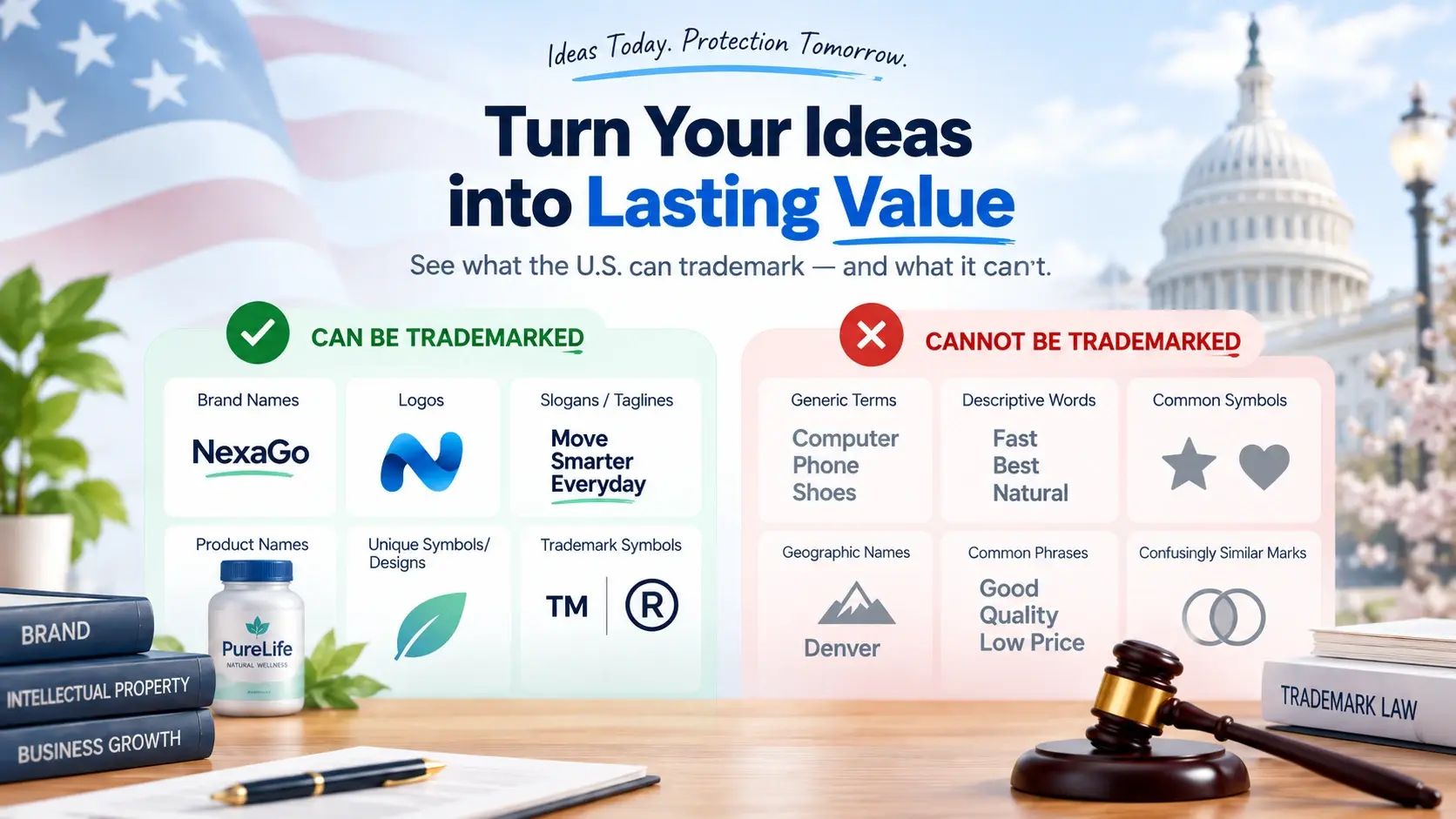
Now comes the part founders usually do not enjoy. Some things simply do not work well as trademarks. In general, what cannot be trademarked includes:
- Generic names for the goods or services
- Names that are too descriptive without acquired distinctiveness
- Marks that are confusingly similar to existing trademarks
- Deceptive or misleading marks
- Purely ornamental designs that do not identify a brand
- Common phrases used only as decoration
- Government flags, seals, or official symbols in restricted situations
- Names or likenesses of living individuals without proper consent
A trademark must point to a source. If it only describes the product, names the product, decorates the product, or misleads customers, it may run into trouble.
What Can and Cannot Be Trademarked in the US?
This is where things get practical. A name might be creative in everyday conversation but still weak under trademark rules. Another name might use a common word but still be protectable because it is used in an unexpected way.
| Usually More Trademarkable | Usually Harder to Trademark |
| A distinctive brand name | A generic product name |
| A unique logo identifying the business | A decorative design with no brand meaning |
| A slogan tied clearly to a brand | A common phrase printed as decoration |
| A product name that stands out | A name that only describes the product |
| A non-obvious word used creatively | A term customers need to describe the product itself |
| A coined or invented word | A widely used industry term |
| An arbitrary word used out of context | A phrase that directly explains the product |
| A distinctive packaging design | Standard or functional packaging |
| A unique sound tied to the brand | A common or generic sound |
| A mark with no similar competitors | A mark similar to existing trademarks |
So, what can be trademarked in the US is not answered by asking, “Is this word common?” The better question is: “Does this mark clearly identify your brand and avoid confusing customers?”
Even if something qualifies for trademark protection, the next question is how you want to protect it. Depending on where your business operates, that could mean state registration, federal registration, or even international protection.
Before You Think About Registration
Getting a trademarkable name is only half the job. The other half is choosing the right type of protection. In the United States, state trademark registration and federal trademark registration are different, and each serves a different purpose depending on your business goals. We’ll look at those differences in detail in our dedicated guide.
Trademarkability: Why Distinctiveness Matters
Here’s something many first-time founders don’t realise. A trademark is not judged only by whether someone else has registered it. It is also judged by how distinctive it is. The more distinctive your mark is, the easier it usually becomes to recognise, protect, and enforce.
Think of it this way… If your brand name instantly tells customers exactly what the product is, it may be great for marketing, but not necessarily for trademark protection. If it makes people think for a second before connecting it to the product, that’s often a stronger trademark.
That is why trademark distinctiveness sits at the heart of trademarkability.
Strong vs Weak Trademark Names
Not every trademark carries the same legal strength. Some marks are naturally stronger than others because they are more unique. Trademark law generally places marks on a spectrum.
The Trademark Strength Spectrum
| Trademark Type | Trademark Strength | Simple Explanation | Example Style |
| Generic | Very Weak | The common name of the product itself | “Coffee” for coffee |
| Descriptive | Weak | Directly describes the product or service | “Fast Cleaning” for cleaning services |
| Suggestive | Strong | Hints at a quality without directly describing it | Requires a little imagination |
| Arbitrary | Very Strong | Uses a familiar word in an unrelated way | An everyday word used for something unexpected |
| Fanciful | Strongest | Completely invented word with no previous meaning | A made-up brand name |
Understanding Generic, Descriptive, Suggestive, Arbitrary, and Fanciful Trademarks
Let’s slow that down because this is one of the most important ideas in trademark law.
Generic
Generic words identify the product itself. Nobody can normally claim exclusive trademark rights to the everyday name of a product or service. If customers need the word to describe what they’re buying, it usually isn’t available as a trademark for those goods.
Descriptive
Descriptive marks tell people something about the product. They might describe:
- Quality
- Purpose
- Function
- Ingredients
- Features
- Geographic origin
These marks are generally harder to register unless they have acquired distinctiveness through long and consistent public use.
Suggestive
Suggestive marks hint at the product without describing it directly. Customers have to make a small mental connection. Because they are more distinctive, suggestive marks are often considered much stronger than descriptive ones.
Arbitrary
An arbitrary trademark uses a real word in a completely unrelated context. The word already exists. It simply has nothing to do with the product being sold. These marks are usually very strong because they are naturally distinctive.
Fanciful
Fanciful marks are invented words created purely to function as brands. Since they had no previous meaning before the business created them, they often receive the strongest trademark protection.
Can You Trademark Common Words?
This surprises people all the time. Yes. Sometimes you can trademark common words. The word itself is not what matters. Its use is.
A common word may become a valid trademark when it identifies a particular brand rather than describing the product. On the other hand, if the same word simply tells customers what the product is, trademark protection may not be available for those goods or services.
Thus, the more appropriate question to ask is not: “Is this a common word?” It’s: “How is this word being used?”
How to Know If Your Brand Name Is Trademarkable
There isn’t one single checklist that guarantees success. Nonetheless, considering these questions provides a solid starting point.
✓ Is the name distinctive?
✓ Does it identify your brand instead of describing the product?
✓ Is it different from similar trademarks in the same industry?
✓ Will customers recognise it as a brand rather than a product description?
✓ Can people easily connect it to your business?
If your answer is “yes” to most of those questions, you’re probably starting in a much stronger position. The next step is conducting a proper U.S. trademark registration search before filing anything.
Remember, finding a trademarkable name is only the first step. Choosing the right level of protection comes after that, whether that’s state registration, federal registration, or another strategy that matches your business goals.
Trademark Examples and Symbols
Once you understand what can be trademarked, the next thing people often ask is which symbol they can use. This part matters because the symbols do not all mean the same thing.
| Symbol | Meaning | When It Is Usually Used |
| ™ | Trademark | Used for goods, even before federal registration |
| SM | Service mark | Used for services, even before federal registration |
| ® | Registered trademark | Used only after federal registration with the USPTO |
A quick warning here: do not use the ® symbol before your mark is federally registered. That symbol is reserved for registered marks. The ™ symbol is much more flexible. Businesses often use it to show they claim a brand name, logo, or slogan as a trademark, even before registration.
Common Mistakes Founders Make
Most trademark problems do not begin at the USPTO. They begin earlier, when a founder chooses a name without checking whether it can actually be protected.
The following are common mistakes along with guidance on how to avoid them:
- Choosing a generic name.
Avoid this by picking a name that identifies your brand, not just the product category.
- Falling in love with a descriptive name.
Avoid this by choosing a name that suggests an idea instead of explaining the product directly.
- Thinking a logo automatically makes a weak name strong.
Avoid this by checking whether the name itself is protectable too.
- Skipping a trademark search.
Avoid this by checking similar marks before investing heavily in the brand.
- Assuming common words can never be trademarked.
Avoid this by looking at how the word is used, not just whether it is common.
- Using a mark only as decoration.
Avoid this by making sure the mark actually identifies the source of the goods or services.
- Thinking trademarkability means guaranteed registration.
Avoid this by remembering that the USPTO still reviews conflicts, descriptions, specimens, and other filing issues.
Getting what can be trademarked right at the beginning can save you from expensive rebranding later.
Business Globalizer: Helping You Choose a Trademarkable Brand
A compelling brand name needs to do more than just sound appealing. It should also be protectable.
At Business Globalizer, we help founders understand whether a name, logo, slogan, or brand element may be suitable for U.S. trademark registration. We also assist with trademark search guidance, USPTO trademark application support, U.S. company formation, e-commerce business registration in the U.S., ITIN application support, EIN services, DUNS number assistance, U.S. taxation guidance, and ongoing compliance support for entrepreneurs expanding into the United States.
Whether you’re still testing a brand name or preparing to file your first U.S. trademark application, getting the trademarkability question right early makes everything else much easier.
Closing Thoughts
Coming back to that exciting moment when the brand name finally clicks. Yes, the name may sound perfect. The logo may look polished. The domain may even be available. But before building everything around it, ask the quieter question: What can be trademarked here?
A strong trademark is not always the flashiest name in the room. Often, it is the name that clearly identifies your brand, avoids confusion, and gives you room to grow. Choose the name with creativity, yes. But also choose it with protection in mind. That is how a brand becomes more than a pretty label.
Key Insights
- A trademark protects brand identifiers, not the business idea itself.
- What can be trademarked depends on whether the mark identifies the source of goods or services.
- Brand names, logos, slogans, product names, sounds, and packaging can sometimes qualify.
- Generic words usually cannot be trademarked for the goods or services they name.
- Descriptive marks are often weak unless they gain strong public recognition.
- Suggestive, arbitrary, and fanciful marks are usually stronger trademark choices.
- A trademarkable name should be distinctive, not confusingly similar, and tied to real goods or services.
- Common words can sometimes be trademarked, but only in the right context.
- A proper trademark search should happen before filing a U.S. trademark application.
- The stronger your mark is from the beginning, the easier brand protection usually becomes.
FAQ
What Can Be Trademarked in the US?
Answer: In the US, brand names, logos, slogans, product names, service names, sounds, symbols, and some packaging or design elements can be trademarked if they identify the source of goods or services.
What cannot be trademarked?
Answer: Generic terms, purely descriptive words without distinctiveness, confusingly similar marks, deceptive marks, purely decorative designs, and restricted official symbols are usually difficult or impossible to trademark.
Can you trademark common words?
Answer: Yes, sometimes. A common word can be trademarked if it is used in a distinctive way that identifies a brand rather than describing the product or service itself.
What is a trademarkable name?
Answer: A trademarkable name is distinctive, tied to real goods or services, not generic, not merely descriptive, and not confusingly similar to an existing trademark in a related field.
What makes a strong trademark name?
Answer: A strong trademark name is usually suggestive, arbitrary, or fanciful. It stands out as a brand identifier instead of simply describing what the product is.
What is a weak trademark name?
Answer: A weak trademark name is usually generic or too descriptive. It may tell customers what the product is, but it may not work well as a protectable brand identifier.
What does generic, descriptive, suggestive, arbitrary, fanciful trademark mean?
Answer: It describes the trademark strength spectrum. Generic marks are weakest, descriptive marks are usually weak, suggestive marks are stronger, arbitrary marks are very strong, and fanciful marks are often the strongest.
Is my brand name trademarkable?
Answer: Your brand name may be trademarkable if it is distinctive, not confusingly similar to existing marks, and used to identify your goods or services. A proper trademark search is the smart next step.
Do trademark examples symbols matter?
Answer: Yes. Trademark examples show what types of marks can identify a brand, while symbols like ™, SM, and ® help communicate whether a mark is claimed or federally registered.
Does trademarkability guarantee USPTO approval?
Answer: No. A mark may seem trademarkable but still face refusal because of similarity, descriptiveness, specimen problems, wrong ownership, or other USPTO review issues.