Quick Answer
A U.S. trademark is a legal protection for names, logos, slogans, and other identifiers that distinguish goods or services, with USPTO registration providing nationwide rights.
You spend weeks choosing the perfect business name. The domain is available. The logo is finished. Your website is live, and customers are finally starting to notice your brand.
Suddenly, you receive a message: “Were you aware that another business is using a name very similar to yours?”
That one sentence has caused legal headaches, forced expensive rebranding, and delayed product launches for countless businesses. The good news is that many of these situations can be avoided with the right planning, as well as understanding how U.S. trademark registration works early on.
Understanding a U.S. trademark isn’t just about legal paperwork. It’s really about safeguarding the brand identity you’ve put so much effort into creating. So let’s start with the basics and make the entire process easier to understand.
What Is a U.S. Trademark?
A U.S. trademark is a word, phrase, symbol, design, or combination of these elements that identifies the source of goods and distinguishes them from those offered by others. If the mark identifies services instead of physical goods, it is technically called a service mark. In everyday business conversations, however, both are commonly referred to as trademarks.
Think about brands like Nike, Apple, or Coca-Cola.
Their names and logos do much more than decorate products. They immediately tell customers who stands behind those products. That recognition is exactly what trademark law is designed to protect.
A trademark is not about owning a word by itself. It is about protecting the way that word, logo, or other identifier is used in connection with specific goods or services.
What Can You Trademark?
Many people assume trademarks only protect company names. In reality, trademark protection covers several different types of brand identifiers. So, to be on the safe side, you should know what you can trademark in the U.S.
Depending on the circumstances, a USPTO trademark may protect:
- Business names
- Brand names
- Product names
- Service names
- Logos
- Slogans
- Stylized lettering
- Certain package designs (trade dress)
- In limited cases, sounds or other distinctive source identifiers
The key requirement is distinctiveness. The more your mark helps customers identify your business rather than simply describing what you sell, the stronger your trademark is likely to be.
For example:
- Kodak is distinctive.
- Amazon is distinctive for online retail services.
- Quick Pizza Delivery simply describes a service and would usually face much greater difficulty obtaining trademark protection on its own.
Trademark Examples
Here are a few simple trademark examples to make the idea clearer:
- A brand name used on skincare products.
- A logo placed on clothing tags.
- A slogan used in advertising.
- A product name printed on packaging.
- A service name used by a consulting firm.
The main point is not the item itself. It is whether customers connect that name, logo, or phrase with one specific source.
What Cannot Be Trademarked?
This part often catches first-time applicants off guard. Not every business name or logo actually qualifies for protection under USPTO rules. Here are a few common examples of what doesn’t make the cut:
Generic Terms
Words that simply name a product or service cannot function as trademarks. For example, using “Computer” as the trademark for computers would generally not be registrable.
Merely Descriptive Marks
Marks that only describe a feature, quality, or purpose of the goods or services may not qualify for registration unless they acquire distinctiveness over time.
Confusingly Similar Marks
If your proposed mark is likely to cause confusion with an existing trademark for related goods or services, the USPTO may refuse the application. Similarity is not based only on identical spelling. Pronunciation, appearance, commercial impression, and related products or services can all be considered.
Deceptive or Misleading Marks
A trademark cannot falsely describe or misrepresent the goods or services it identifies.
Official Government Insignia
Certain government flags, coats of arms, official seals, and similar insignia generally cannot be registered as trademarks.
The important lesson here is simple: Creating a business name and successfully registering it are two very different things.
Why a U.S. Trademark Matters
Many founders assume that a trademark is only required after their business becomes successful. In reality, many successful businesses protected their brands long before they became household names.
A U.S. trademark can help your business by:
- Building stronger brand recognition.
- Making it easier for customers or clients to recognize your products or services.
- Providing stronger legal tools against confusingly similar brands.
- Supporting licensing or franchise opportunities.
- Increasing the value of your business as an intellectual property asset.
- Helping qualify for programs such as Amazon Brand Registry, where applicable.
Perhaps the biggest advantage is confidence.
Instead of constantly wondering whether someone else could challenge your brand later, you begin building your business on a stronger legal foundation.
That does not mean every business must register immediately. But understanding your options early allows you to make informed decisions before your brand becomes too valuable, or too expensive, to change.
Do You Need a U.S. Trademark Right Away?
Not necessarily.
Simply using a brand in commerce can create certain trademark rights under U.S. law. However, those rights are usually more limited than the rights provided by the federal authority.
A U.S. trademark registration through the USPTO provides additional legal advantages, including a public record of ownership, nationwide presumptive rights for the registered goods or services, and a stronger position if someone later challenges your brand.
In contrast, state trademark registration typically offers protection only within that specific state, while federal registration provides broader nationwide coverage and stronger enforcement benefits. Every business grows differently. The important thing is understanding your options before someone else claims a similar brand first.
Interested in learning more about the differences between state and federal trademark registration? Check our dedicated blog: State vs Federal Trademark Registration.
Trademark Symbols Explained: ™, SM, and ®
One of the easiest ways to spot a protected brand is by looking at the little symbol beside its name. But those symbols don’t all mean the same thing.
™ (Trademark Symbol)
The ™ trademark symbol is commonly used with names, logos, or slogans connected to goods. You do not need a federal registration to use ™. Many businesses begin using it while building their brand or while a USPTO trademark application is still being processed.
SM (Service Mark)
The SM symbol works much like ™, except it is used for services rather than physical products. For example, a consulting firm or marketing agency may use SM with its brand name before obtaining a federal registration.
In everyday business, many people simply refer to both trademarks and service marks as trademarks.
® (Registered Trademark)
The ® symbol has a different meaning.
It should generally be used only after the USPTO has officially registered the trademark. Using the registered trademark symbol before registration can create legal issues, so businesses should wait until the registration is complete.
A simple way to remember it:
| Symbol | Meaning | Registration Required? |
| ™ | Trademark for goods | No |
| SM | Service mark for services | No |
| ® | Federally registered trademark | Yes |
Service Mark vs Trademark: Which One Do You Need?
This question sounds more complicated than it really is. The answer depends on what your business offers. If you sell physical goods, your brand is generally protected as a trademark. If you provide services instead of products, the mark is technically a service mark.
For example:
- A clothing brand selling T-shirts would normally use a trademark.
- A bookkeeping firm providing accounting services would technically have a service mark.
Legally, there is a distinction. Practically speaking, most people simply use the word “trademark” to describe both.
Trademark vs. Trade Name: Are They the Same?
No, and this is one of the biggest misunderstandings among new business owners. A trade name is the name your business operates under. A U.S. trademark protects the brand customers use to identify your goods or services. Sometimes those two names are identical. Sometimes they are completely different.
Here’s a simple comparison:
| Trade Name | U.S. Trademark |
| Identifies the business itself | Identifies the source of goods or services |
| Used for business operations | Used for brand protection |
| Business registration does not automatically create trademark rights | Trademark rights come through use in commerce and may be strengthened through federal registration |
Know this: Registering an LLC or corporation does not automatically give you nationwide trademark protection for your brand.
Trademark vs Copyright vs Patent
People often mix these three together because all of them protect intellectual property. The difference is what they protect.
| Protection | What It Covers | Example |
| Trademark | Brand identifiers | Business name, logo, slogan |
| Copyright | Original creative works | Books, articles, artwork, music, software code |
| Patent | New inventions and processes | Machines, manufacturing methods, technology |
Think of it this way:
- Your logo may be protected by trademark law.
- Your website articles may be protected by copyright.
- Your new invention may qualify for patent protection.
Each serves a different purpose, and many businesses use more than one type of protection at the same time.
Who Can Apply for a U.S. Trademark?
A USPTO trademark application is not limited to large companies. Depending on the circumstances, an application may be filed by:
- An individual.
- A sole proprietor.
- A partnership.
- A limited liability company (LLC).
- A corporation (whether its a C Corp or S Corp).
- Another legal business entity.
Foreign applicants can also apply for a U.S. trademark.
However, under current USPTO rules, applicants whose domicile is outside the United States generally must be represented by a U.S.-licensed attorney when filing or prosecuting trademark applications before the USPTO.
Before You File a U.S. Trademark
Many trademark issues begin long before the application is even submitted. Taking a little extra time beforehand can help reduce avoidable mistakes. Before filing, it is worth making sure you:
- Choose a distinctive brand instead of a descriptive one.
- Carry out a U.S. trademark registration search for similar marks.
- Decide who the correct trademark owner should be.
- Identify the correct goods or services connected to the mark.
- Gather appropriate information that supports your filing basis where required.
These steps do not guarantee approval, but they can make the registration process much smoother.
U.S. Trademark Registration: A Quick Overview
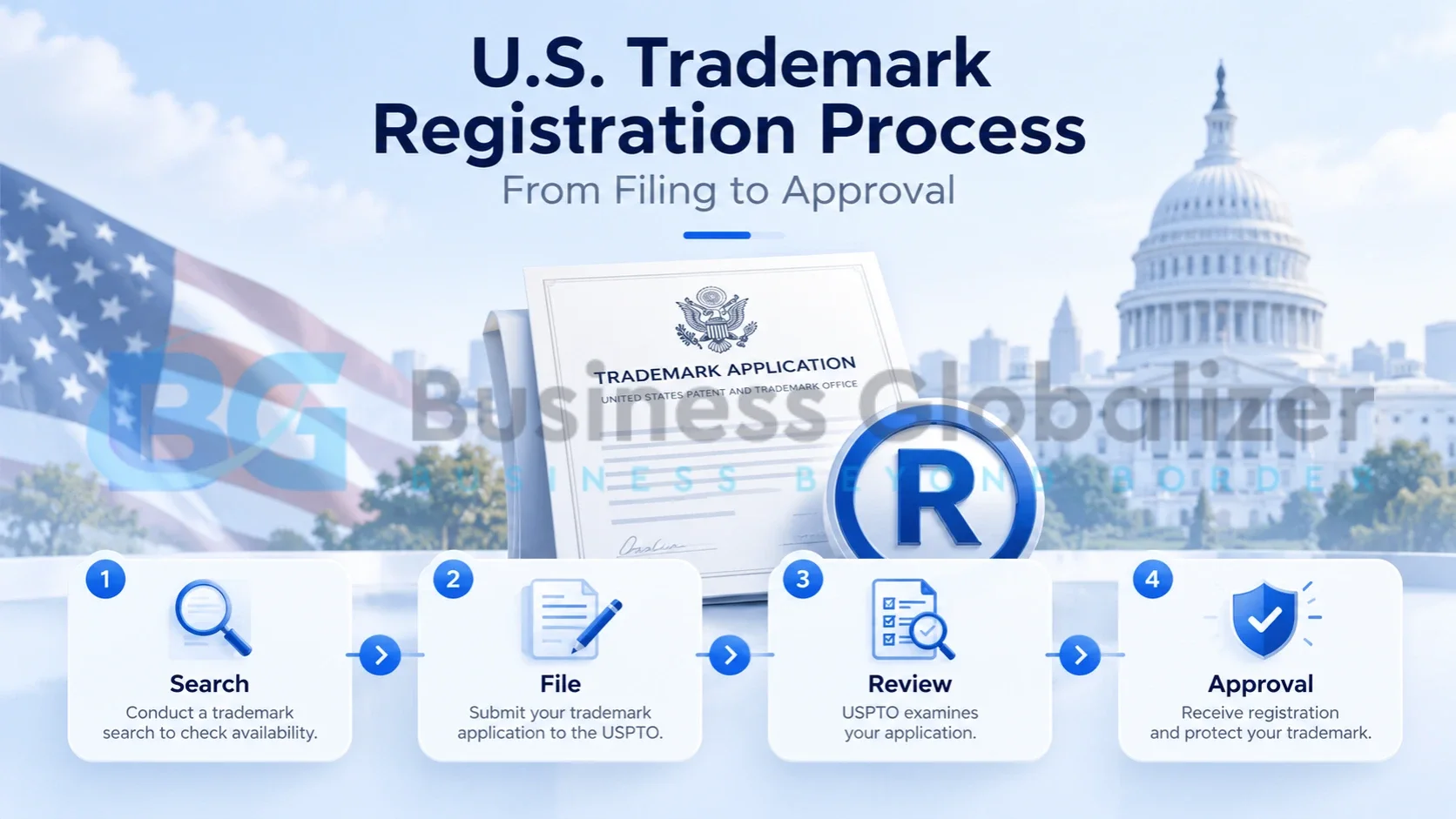
A first-time applicant often imagines trademark registration as filling out one online form and waiting for approval. In reality, the process has several stages. A typical USPTO trademark registration follows this general path:
- Choose a distinctive trademark.
- Carry out a trademark search.
- Identify the correct goods or services.
- Select the appropriate U.S. trademark classes.
- Submit a USPTO trademark application.
- The USPTO examines the application.
- If necessary, respond to any Office Action.
- If approved, the mark is published for opposition.
- Registration or the next required step follows, depending on the filing basis.
Each stage has its own requirements, which is why we have covered the full registration process in a separate guide.
U.S. Trademark Classes Explained
Not every trademark protects every product or service. Instead, the USPTO groups goods and services into different categories known as U.S. trademark classes. These classifications help define exactly what your trademark protects.
For example, two businesses might use similar names without creating a conflict if they operate in completely different industries. Trademark classes help make that distinction.
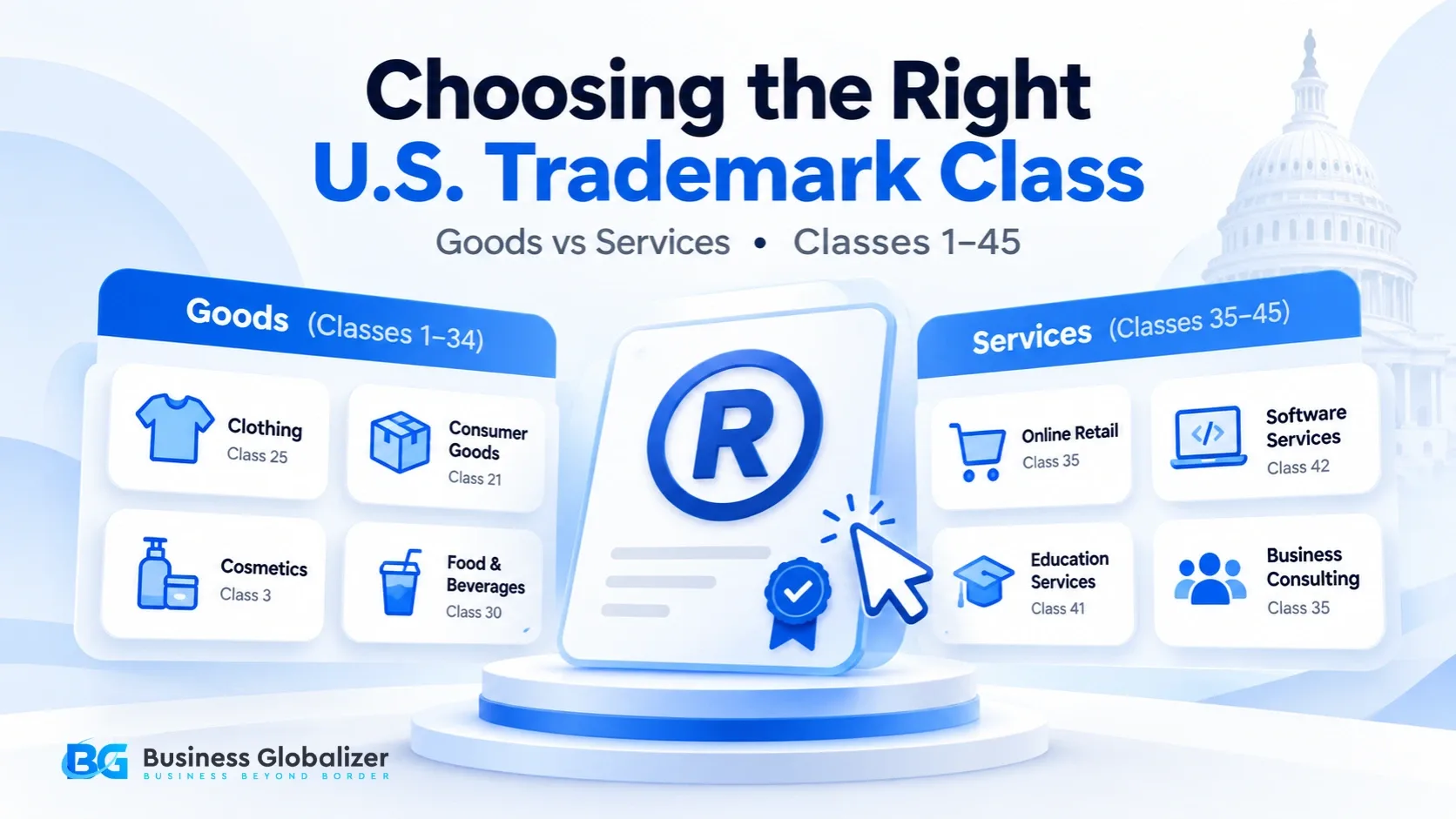
There are 45 trademark classes in total:
- Classes 1–34 cover goods.
- Classes 35–45 cover services.
Choosing the correct class is one of the most important parts of any USPTO trademark application because your registration generally protects the goods and services listed in the application. Not every possible use of the mark.
List of Trademark Classes (Simplified)
You don’t need to memorise all 45 classes. For most beginners, understanding the overall structure is enough.
| Category | Trademark Classes | Examples |
| Goods | Classes 1–34 | Chemicals, cosmetics, clothing, electronics, furniture, food products |
| Services | Classes 35–45 | Advertising, retail services, education, software services, legal services, restaurants |
The complete list of trademark classes is much more detailed, and selecting the correct class often requires careful consideration of the specific goods or services your business offers.
We have a dedicated guideon the complete list of trademark classes.
U.S. Trademark Registration Search: Why It Matters
One of the biggest pitfalls for founders is getting attached to a brand name without checking if something similar already exists. Running a U.S. trademark search helps you catch these conflicts before you’ve poured time and money into your branding, website, or marketing.
The USPTO provides a searchable trademark database, but a proper search goes beyond looking for an identical name. It should also consider:
- Similar spellings.
- Similar pronunciation.
- Similar meanings.
- Related goods or services.
- Existing registered and pending trademarks.
Spotting a similar mark doesn’t always mean you’re out of luck. However, catching these conflicts early lets you make a more informed choice before you commit to a full USPTO application.
Understanding USPTO Trademark Status
After submitting an application, many applicants regularly check their USPTO trademark status to see where things stand. Although every application is different, you may come across statuses such as:
| Status | What It Generally Means |
| Pending | The USPTO has received the application and it is moving through the review process. |
| Office Action Issued | The examining attorney has raised one or more issues that require a response. |
| Published for Opposition | The mark has been published, giving others an opportunity to oppose registration if they believe they would be harmed. |
| Registered | The trademark has completed the registration process. |
| Abandoned | The application is no longer active, often because required action was not taken or deadlines were missed. |
| Cancelled | A previously registered trademark has been removed from the register under certain circumstances. |
Seeing an Office Action or another status change does not automatically mean your application has failed. It simply means the process has reached another stage.
U.S. Trademark Certificate: What Does It Mean?
Many people confuse filing an application with receiving a registration. They are not the same thing.
Submitting a USPTO trademark application starts the registration process. A U.S. trademark certificate, sometimes referred to as a trademark registration certificate, is issued only after the registration requirements have been successfully completed.
Receiving a registration certificate confirms that the mark has been entered on the federal trademark register for the approved goods or services. It is an important milestone, but it is not the end of your trademark responsibilities.
How Long Does a U.S. Trademark Last?
A registered trademark is not something you obtain once and forget forever. As long as the legal maintenance requirements are met and the trademark continues to be used properly in commerce, a federal trademark can remain in force indefinitely.
That said, owners must submit required maintenance documents at specific intervals to keep the registration active. Missing those maintenance deadlines can place the registration at risk, even if the brand is still in use.
We have covered trademark renewals and maintenance filings in a separate guide.
Common Reasons a U.S. Trademark Application Gets Refused
Not every trademark application reaches registration. Some of the most common reasons include:
- The proposed mark is likely to be confused with an existing trademark.
- The mark is generic for the goods or services.
- The mark is merely descriptive and lacks sufficient distinctiveness.
- The wrong goods or services have been identified.
- The application contains ownership or filing errors.
- The submitted specimen or supporting information does not meet USPTO requirements.
A refusal does not always mean the end of the road, but avoiding these issues from the beginning can save considerable time and expense.
Common Mistakes Founders Make & How to Avoid Those
Trademark problems often begin long before the USPTO reviews the application. Here are a few common mistakes and some tips to avoid them:
- Assuming an LLC or corporation automatically protects the brand name.
Avoid this by understanding that business registration and trademark protection are separate.
- Filing without carrying out a proper trademark search.
Always conduct a thorough search to reduce the risk of conflicts.
- Choosing a business name that is too descriptive.
Pick a distinctive name that can be protected more easily.
- Selecting the wrong trademark class.
Make sure your application matches the correct goods or services category.
- Using the ® symbol before federal registration.
You should only start using this symbol once your trademark registration is officially complete.
- Waiting until the business becomes well known before thinking about trademark protection.
Start early to secure your rights before others do.
- Forgetting that trademark registrations require ongoing maintenance after approval.
Keep track of deadlines to maintain your registration.
Business Globalizer: Helping You Protect Your Brand
Building a strong brand takes time. Protecting it should not feel confusing.
At Business Globalizer, we help founders with U.S. trademark registration, preliminary trademark guidance, U.S. company formation, e-commerce business registration in the U.S., ITIN application support, EIN services, DUNS number, U.S. taxation, and ongoing compliance support for entrepreneurs expanding into the United States.
Whether you are launching a completely new brand or preparing to protect one that is already growing, our team can help you understand the process and move forward with confidence.
Closing Thoughts
Building a brand starts with an idea. Protecting it takes a bit more planning. Understanding how a U.S. trademark works gives you a solid foundation before investing in marketing, packaging, or growth. You do not need to be an expert. Just know the basics, avoid common mistakes, and take the right steps at the right time.
Your brand may begin with a name, but a U.S. trademark helps ensure it remains yours as your business grows.
Key Insights
- A U.S. trademark protects the brand identity customers connect with your products or services.
- Trademark protection can cover names, logos, slogans, product names, service names, and other distinctive brand identifiers.
- A trademark is different from a trade name, copyright, or patent, and mixing them up can lead to wrong business decisions.
- TM, SM, and ® do not mean the same thing; only ® is for federally registered trademarks.
- Simply forming an LLC or corporation does not automatically protect your brand name as a trademark.
- Federal registration through the USPTO provides stronger legal rights than relying solely on the informal use of a brand.
- A proper U.S. trademark registration search should happen before filing, not after.
- Choosing the correct U.S. trademark classes matters because your protection is tied to the goods or services listed.
- A USPTO trademark application can face refusal if the mark is too descriptive, generic, confusingly similar, or filed incorrectly.
- Obtaining a U.S. trademark certificate does not mean the process is over; owners must continue to properly use and maintain their registration.
FAQ
What is a U.S. trademark?
Answer: A U.S. trademark protects names, logos, slogans, and other distinctive identifiers that help customers recognise the source of goods or services. Federal registration through the USPTO provides important legal benefits beyond common law rights.
What is USPTO trademark registration?
Answer: USPTO trademark registration is the federal process of applying to register a trademark with the United States Patent and Trademark Office. Once approved, the owner receives federal trademark protection for the registered goods or services.
Can a non-U.S. resident apply for a U.S. trademark?
Answer: Yes. Both foreign individuals and businesses are eligible to apply for a U.S. trademark. However, applicants whose domicile is outside the United States generally must be represented by a U.S.-licensed attorney before the USPTO.
What is a USPTO trademark application?
Answer: A USPTO trademark application is the formal request submitted to register a trademark with the United States Patent and Trademark Office. It includes information about the owner, the trademark, and the goods or services connected to it.
How do I check my USPTO trademark status?
Answer: You can check your USPTO trademark status using the USPTO’s official trademark records. The status shows where your application or registration currently stands, such as pending, registered, or abandoned.
What is a U.S. trademark certificate?
Answer: A U.S. trademark certificate, also called a trademark registration certificate, is issued after a trademark successfully completes the federal registration process. It confirms that the trademark has been officially registered for the approved goods or services.
How many U.S. trademark classes are there?
Answer: There are 45 U.S. trademark classes in total. Goods are covered under Classes 1–34, whereas services are covered under Classes 35–45. Selecting the correct class is an important part of the registration process.
Can I use the ™ symbol without registering my trademark?
Answer: Yes. Businesses commonly use the ™ symbol without federal registration to indicate that they claim trademark rights in a brand. However, the ® symbol should generally be used only after the USPTO has officially registered the trademark.