Quick Answer
An SSN (Social Security Number) is issued by the SSA to U.S. citizens and eligible residents for general identity and tax purposes. An EIN (Employer Identification Number) is issued by the IRS to businesses, LLCs, and organizations to identify them for tax filings. An ITIN (Individual Taxpayer Identification Number) is an IRS-issued number for individuals who need to file U.S. taxes but do not qualify for an SSN. Non-U.S. residents forming a U.S. company typically need an EIN, and often an ITIN if they pay U.S. taxes personally.
If you are an entrepreneur or aspiring one, you’ll likely encounter the three important U. S. identification numbers:
- SSN
- EIN
- ITIN
However, an unavoidable question arises: “Which one do I need?”
Now, assuming you are wondering what SSN, EIN, or ITIN means, don’t worry! You are not alone. Read on as we take a look at these vital markers and explain how to tell which one is suitable for you and your company and if you qualify for the category.
This blog will help you see how identification numbers compare. To better understand SSNs, EINs, and ITINs and to learn when to apply for each of them.
What Is an SSN?
We briefly explained SSN also known as Social Security Number for you to understand. Let’s delve into this a little further.
A Social Security Number is a number assigned to United States citizens and residents so that the government can keep track of their income and calculate their payments accordingly.
SSNs were introduced as a part of The New Deal in 1936 to help citizens receive retirement and disability benefits. Originally intended to keep a record of how much an individual earned and to collect benefits, SSNs now also serve to identify people for taxation, calculate credit scores, and so on.
When you need to borrow money, open a bank account, receive assistance from the government, or purchase goods over a certain price, you are requested to provide them with your SSN.
What Is an EIN?
Now, let’s talk about another important identification number: EIN. That is also known as Employer Identification Number.
An Employer Identification Number (EIN) is a nine-digit number, also known as a Tax ID or Federal Tax Identification Number (FTIN), issued by the Internal Revenue Service (IRS). The IRS uses the EIN to track business tax returns and payments.
Thus, if you have a business venture or you are planning to hire employees necessary for your business, then you need to have an EIN for legitimacy purposes with the IRS. It will help in organizing things for tax purposes and also enable the government to monitor your business accounts in order to facilitate taxation purposes.
What Is an ITIN?
The next topic in our discussion is ITIN, an Individual Taxpayer Identification Number.
An Individual Tax Identification Number (ITIN) is a number issued by the United States Internal Revenue Service (IRS) that helps solely in the processing of tax returns.
It primarily provides the purposes of allowing those not eligible for an SSN to meet the requirements of the U. S. tax laws. Among the grantees are non-resident aliens, certain resident aliens, and dependents or spouses of US citizens or resident aliens who are required to file or be able to file for a US tax return.
ITIN does not confer the blessed individual with a work permit nor enables him or her to receive social security. This is simply because it is for the IRS to monitor that even those who might not be legally registered in the country should ensure that they comply with the U. S tax code through filing their taxes.
EIN vs. ITIN
If you’re starting a business but don’t qualify for a Social Security Number, you’ll likely need either an EIN or an ITIN. The key differences between EIN and ITIN? EIN is tied to businesses; ITIN is for individuals who need to file U.S. tax returns but aren’t eligible for SSNs.
ITIN vs. SSN
Both are personal tax ID numbers, but meant for very different people. SSN is for U.S. citizens and eligible residents. ITIN is for those who aren’t eligible for an SSN but still need to file taxes legally in the U.S. Want more on this topic? Check out our blog on ITIN vs. SSN.
EIN vs. SSN
EIN identifies your business. SSN identifies you. If you’re a sole proprietor, you might use your SSN, but as you scale, an EIN becomes a must for handling taxes, opening business bank accounts, or hiring employees. So the difference between EIN and SSN is quite clear, right?
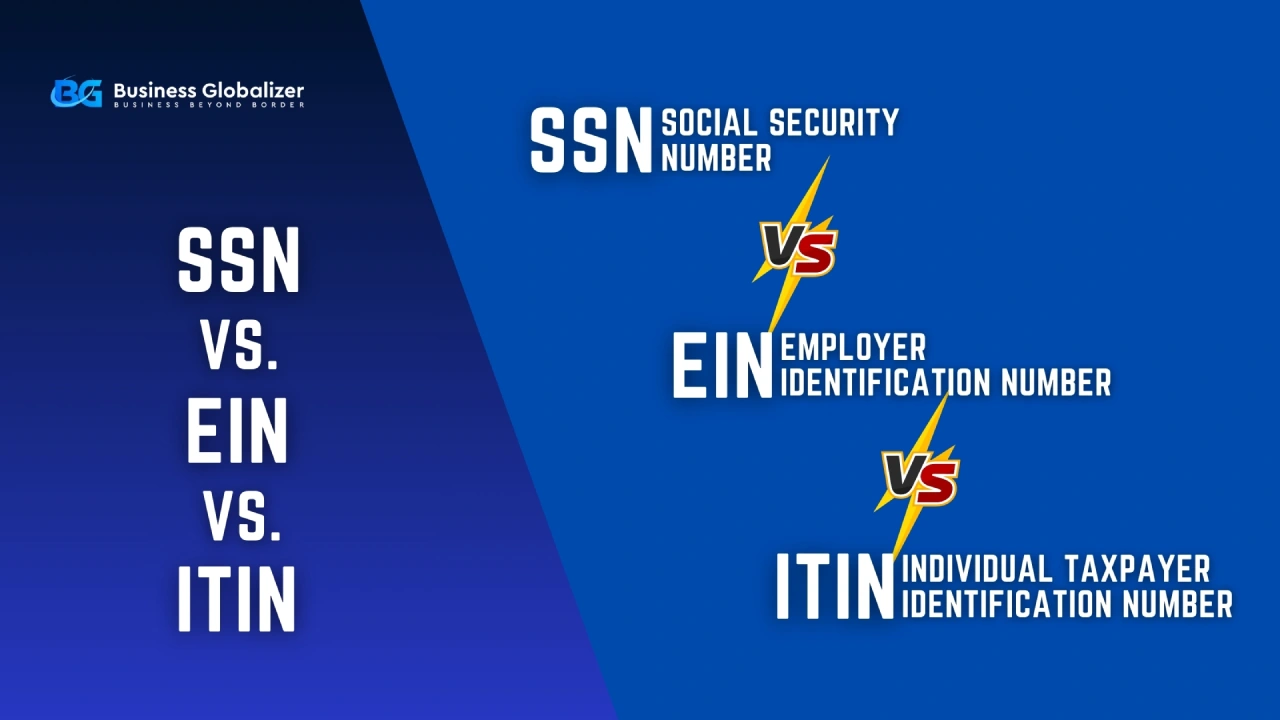
SSN vs. EIN vs. ITIN
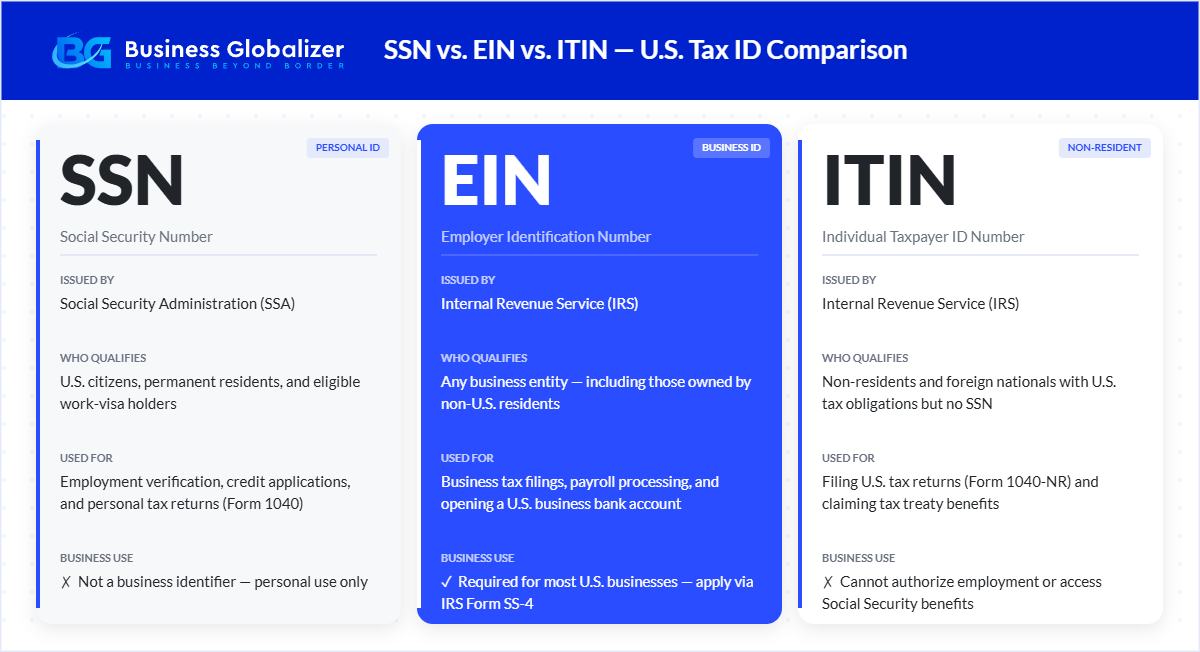
Now, let’s explore the key differences between SSN, EIN, and ITIN:
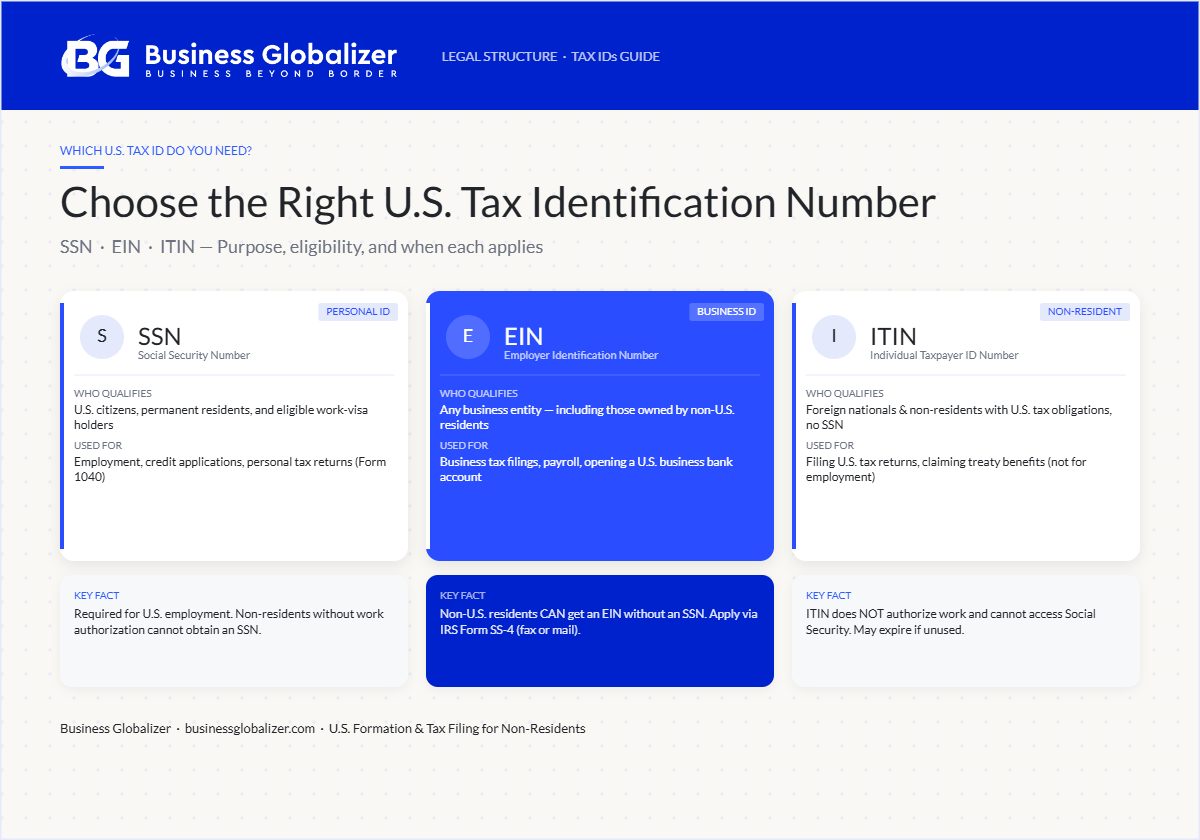
- Purpose: SSN is used for personal identification, tracking earnings, and accessing government benefits. EIN is used to identify a business entity for tax filings, hiring employees, and opening business bank accounts. ITIN is used solely for U.S. tax reporting by individuals who do not qualify for an SSN.
- Issuing Authority: SSN is issued by the Social Security Administration (SSA). Both EIN and ITIN are issued by the Internal Revenue Service (IRS), though they serve entirely different purposes.
- Eligibility: SSN is available to U.S. citizens, permanent residents, and certain work visa holders. EIN is available to any business entity, including those owned by non-U.S. residents. ITIN is available to individuals who have a U.S. tax obligation but do not qualify for an SSN, such as foreign nationals and non-resident aliens.
- Usage: SSN is used for employment, credit applications, and personal tax returns. EIN is used for business tax filings, payroll, and opening business bank accounts. ITIN is used exclusively for filing U.S. tax returns and cannot be used for employment or to access Social Security benefits.
SSN vs. EIN vs. ITIN Comparison Table
| Aspect | SSN | EIN | ITIN |
|---|---|---|---|
| Purpose | Personal identification, tracking earnings, and accessing government benefits | Business identification, tax filing, hiring employees, and opening business bank accounts | Tax reporting for individuals with U.S. tax obligations who don’t qualify for an SSN |
| Issuing Authority | Social Security Administration (SSA) | Internal Revenue Service (IRS) | Internal Revenue Service (IRS) |
| Eligibility | U.S. citizens, permanent residents, and eligible work-visa holders | Any business entity, including those owned by non-U.S. residents | U.S. citizens, permanent residents, and eligible work visa holders |
| Usage | Employment, credit applications, and personal tax returns | Business tax filings, payroll processing, and business bank accounts | Filing U.S. tax returns only; cannot be used for employment or Social Security benefits |

Need an EIN for Your U.S. Business?
As a non-U.S. resident, getting an EIN without an SSN can be confusing. Business Globalizer handles the entire EIN application process for you. Fast, accurate, and IRS-compliant.
With this, we complete the blog on the topic “SSN, EIN, or ITIN”.
This is just a basic comparison of SSN, EIN, and ITIN. If you are confused about the differences or they are too complex for you to understand, there is no need to panic: each of the comparisons is discussed separately in our blog posts. See our in-depth studies in ‘SSN vs. EIN,’ ITIN vs. SSN,’ and “EIN vs. ITIN” for more clarification.
Frequently Asked Questions: SSN vs EIN vs ITIN
What is the difference between ITIN and SSN?
An SSN is a permanent nine-digit number issued by the Social Security Administration (SSA) to U.S. citizens, permanent residents, and eligible work-visa holders. It serves as your primary government ID for employment, credit, and tax purposes. An ITIN is a tax-processing number issued by the IRS for individuals who cannot get an SSN but have U.S. tax obligations, such as foreign nationals, undocumented immigrants, or non-resident aliens with U.S. income. The ITIN cannot be used for employment or to receive Social Security benefits.
For an LLC, should I use an EIN or SSN?
Answer: You may be required to pay tax for your LLC using your EIN or SSN depending on your type of business entity. Multi-member LLCs that are filing taxes need to use an EIN. Social security numbers are accepted by sole proprietorships and LLCs with one member. One can also consult an expert about this.
For taxes, can I use my EIN instead of my SSN?
Answer: Yes, for tax purposes, if you are operating as a business entity you would use your Employer Identification Number (EIN) instead of your Social Security Number (SSN). Your EIN acts as a unique number used when you report your business income, file taxes, or meet other tax requirements.
Can individuals receive an EIN, or are they limited to businesses?
Answer: EIN is only for business. People can get an EIN by creating a legal structure such as an LLC or Corporation.
If I have an EIN, do I still need an SSN?
Answer: It is true that employees will still require SSN even though the firm may have received an EIN. SSN serves for personal identification purposes, while EIN is used for federal tax identification and related obligations.
Can I use an EIN instead of my SSN?
For business tax filings and employer-related purposes, yes, you can use an EIN in place of your SSN. For example, sole proprietors often provide an EIN on W-9 forms to avoid sharing their SSN. However, an EIN cannot replace an SSN for personal identification, credit applications, Social Security benefits, or individual income tax returns (Form 1040).
Does an ITIN number expire?
Yes. ITINs issued before 2013 or that have not been used on a federal tax return in the past three consecutive years expire and must be renewed before filing. The IRS will reject returns with expired ITINs. You can renew your ITIN by submitting Form W-7 along with valid identity documentation.
Can a non-US resident get an EIN without an SSN?
Yes. Non-U.S. residents can obtain an EIN without an SSN or ITIN. You can apply directly with the IRS by calling +1-267-941-1099 (international applicants), by faxing Form SS-4, or by mail. Many business formation services, including Business Globalizer, handle the EIN application on behalf of non-resident entrepreneurs.
Which U.S. Tax ID Do You Need for Your Business?
The right identification number depends on your residency status and how your business is structured:
- U.S. Citizen or Permanent Resident starting a business: Use your SSN initially, then get an EIN once you hire employees or form an LLC/Corporation.
- Non-U.S. Resident forming a U.S. LLC or Corporation: Apply for an EIN to open business bank accounts and file U.S. business taxes. You do not need an SSN to get an EIN.
- Foreign national earning U.S.-sourced income: Apply for an ITIN to file personal U.S. tax returns (Form 1040-NR).
- Non-resident with a U.S. LLC and U.S.-sourced income: You may need both an EIN (for the business) and an ITIN (for personal filings).
Key Takeaways
- SSN is for U.S. citizens and eligible residents; it is a lifelong identifier for employment, credit, and tax purposes.
- EIN is required by every U.S. business entity (LLC, Corporation, partnership); non-residents can obtain one without an SSN.
- ITIN is for non-residents and resident aliens who have U.S. tax obligations but cannot get an SSN.
- Non-U.S. entrepreneurs forming a U.S. company almost always need an EIN; they may also need an ITIN if they receive U.S.-sourced income.
- You can hold both an ITIN and an EIN; they serve different purposes (personal vs. business tax identification).
Official IRS Resources
For authoritative information on U.S. tax identification numbers, refer to these official IRS sources: IRS: Employer Identification Numbers, IRS: Individual Taxpayer Identification Number (ITIN), and the Social Security Administration: Social Security Numbers.
Final Words
Understanding the difference between SSN, EIN, and ITIN is foundational for any entrepreneur entering the U.S. market. Whether you’re forming a U.S. LLC or Corporation, applying for an EIN, or navigating U.S. tax filing requirements as a non-resident, Business Globalizer is here to guide you every step of the way.
Start Your U.S. Business the Right Way
Whether you need an EIN, ITIN assistance, or full U.S. company formation support, Business Globalizer guides non-residents through every step, from registration to tax compliance.