🔍 Quick Answer: Domestic LLC vs Foreign LLC
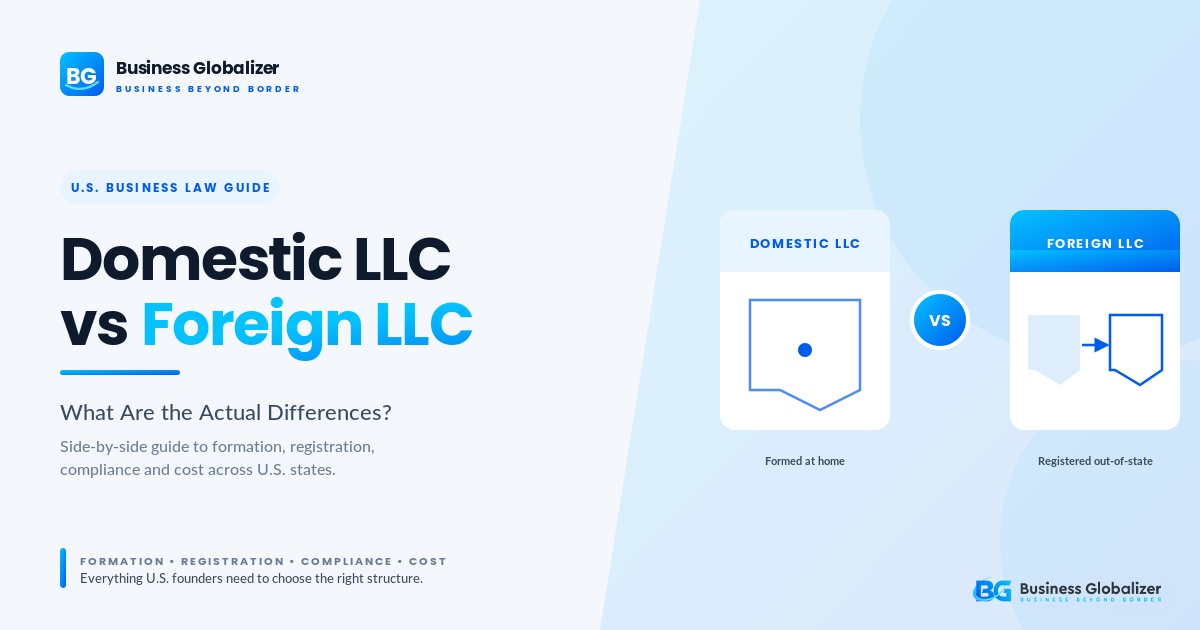
A domestic LLC is an LLC in the state where it was originally formed. A foreign LLC is the same LLC operating in a different state after registering for authority there. They are not two separate entities — “foreign” means out-of-state, not international. The real question is whether your LLC has triggered registration obligations in another state.
Key Insights
- Domestic and foreign LLCs are not different entity types — they describe the same LLC in different states.
- An LLC is domestic to where it was formed. That status stays fixed even as the business expands.
- A foreign LLC is the same company registering in another state. “Foreign” means out-of-state, not international.
- The core difference is formation versus operating authority — a domestic LLC is formed in one state; a foreign LLC is registered to operate in another.
- Foreign qualification depends on business activity, not just paperwork. Offices, employees, inventory, warehouses, and repeated in-state transactions can trigger it.
- Selling into another state does not always require foreign registration — states often look at operational presence, not occasional sales.
- Skipping foreign registration can trigger penalties, fines, court access restrictions, and costly retroactive filings.
- Foreign registration increases ongoing compliance costs — extra filings, a second registered agent, and potential multi-state tax exposure.
An LLC can feel straightforward when the business operates in just one state. The confusion usually starts when growth enters the picture. A company formed in one state may still need separate authority before doing business in another — and that is where the distinction between Domestic LLC vs Foreign LLC starts to matter.
They do not refer to two different entities. They describe the same LLC in two different legal positions. Domestic applies in the formation state. Foreign applies when an LLC registers in another state. This article explains how that distinction works, when foreign registration may come into play, and why understanding it early helps business owners avoid compliance issues. If you are still deciding which business structure is right for you, that question is worth settling before thinking about multi-state registration.
What Does Domestic LLC Mean?
A domestic LLC is the LLC in its original state of formation. The business is considered domestic where its formation documents were accepted and approved. If the LLC was formed in Wyoming, Wyoming is its domestic state. Registering elsewhere later does not change that.
The domestic LLC files its articles of organization or certificate of formation in that state and pays whatever state fees apply. It follows that state’s rules for annual reports, operating agreements, and member records. Once an LLC is properly formed, its domestic status is permanent unless the entity is dissolved and re-formed elsewhere.
Domestic does not mean the LLC only operates in that one state. It means the state of formation has primary authority over the entity. If you have not yet formed your LLC, the USA Company Formation service at Business Globalizer can help you choose the right state and get set up correctly from day one.
What Is a Foreign LLC?
A foreign LLC is an LLC that was formed in one state and has since registered to do business in a different state. The business itself does not change. It is still the same legal entity with the same members, the same operating agreement, and the same EIN. What changes is that it now has operating authority in a second (or third) state.
The term “foreign” in this context does not mean the business is based outside the United States. It simply means the LLC is an outsider from the perspective of the state it is registering in. A Wyoming LLC registering in Texas is a foreign LLC in Texas, even though both are US states. This applies regardless of where the business owners live or where most of the activity happens.
To register as a foreign LLC in another state, the business typically submits an application for authority, designates a registered agent in that state, and may need to provide a Certificate of Good Standing from its home state.
Domestic LLC vs Foreign LLC: The Core Difference
The most direct way to understand the difference: a domestic LLC is created in its home state, while a foreign LLC is recognized in a second state where it wants to operate. Here is how that plays out across the key areas:
| Factor | Domestic LLC | Foreign LLC |
|---|---|---|
| Definition | LLC in its home state of formation | Same LLC registered to operate in a new state |
| Filing type | Articles of Organization | Application for Authority / Certificate of Authority |
| Entity type | Original entity | Same entity, different jurisdiction |
| Registered agent | Required in formation state | Also required in each additional state |
| Annual filings | Home state only | Both home state and qualifying state(s) |
| State fees | Home state fees only | Additional fees in each qualifying state |
| Tax exposure | Home state tax rules | Potential tax obligations in additional states |
| Good standing | Must maintain in home state | Usually required before foreign qualification |
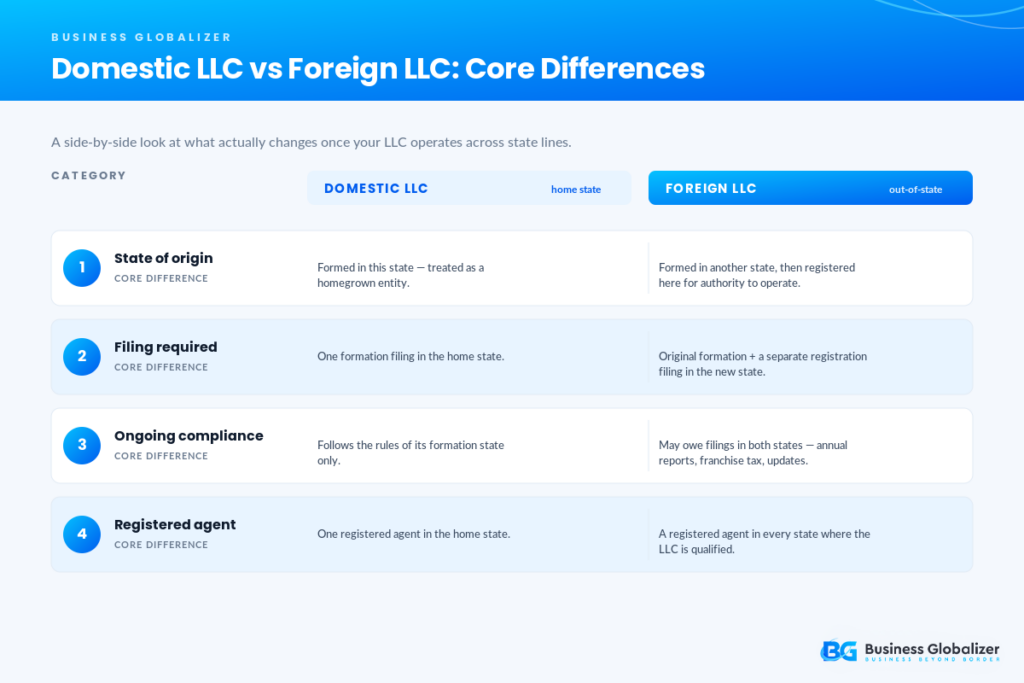
1. State of origin vs. operating status
A domestic LLC is formed in that state. A foreign LLC was formed somewhere else and then registered in the new state. One state treats the LLC as homegrown. Another treats it as an outside entity asking for authority to operate locally.
2. Formation vs. registration
A domestic LLC begins with a formation filing in its home state. A foreign LLC begins somewhere else, then adds a second filing when it enters a new state. The second state is not forming a new entity — it is recognizing an existing one.
3. Ongoing compliance
A domestic LLC follows the rules of its formation state. Once it qualifies elsewhere, the business may have filing obligations in both places — annual reports, biennial statements, franchise tax exposure, or state information updates. Understanding the full cost of maintaining an LLC before expanding can prevent surprise expenses.
4. Registered agent
The SBA states that the registered agent must be located in the state where the business registers. Foreign qualification often creates a second registered-agent requirement in the additional state. Business Globalizer’s US Registered Agent Service covers this across all the states where you operate.
When Does an LLC Need to Register as a Foreign LLC?
Not every LLC that touches another state needs to register there. The trigger is usually something called “doing business” in that state — and each state defines it differently. The SBA points to factors such as having a physical office, employees, inventory, a warehouse, or repeated business transactions in another state.
Selling goods or services online to customers in another state does not automatically require registration. States tend to look at operational presence rather than occasional sales. Signing a contract, collecting a payment, or having a customer in another state is generally not enough on its own.
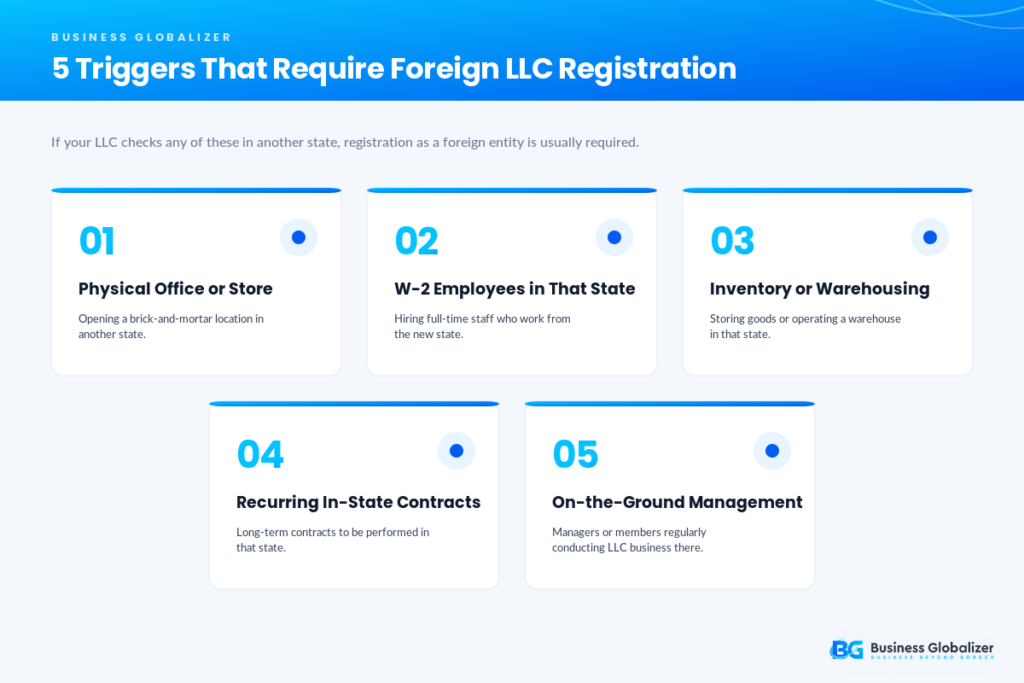
Activities that commonly require foreign registration include:
- Opening a physical office or store in another state
- Hiring W-2 employees who work from that state
- Storing inventory or operating a warehouse there
- Entering into recurring contracts to be performed in that state
- Having managers or members who regularly conduct LLC business in that state
State-specific rules matter. Texas, Florida, and Delaware each have different thresholds and definitions for “doing business.” The Business Consulting service at Business Globalizer can help you assess whether your activity in a given state requires registration.
Do You Need a New LLC to Operate in Another State?
No — and this is one of the most common misconceptions about multi-state operations. In most cases, you keep the original LLC and register that same entity as a foreign LLC in the second state. You are not creating a new company; you are asking for permission to operate the existing one in a new jurisdiction.
Forming a brand-new LLC in a second state carries different implications. If you form a separate LLC in the second state, you now have two distinct entities, each with its own compliance requirements, tax filings, bank accounts, and operating agreements. For most businesses, thinking through the formation strategy early is far better than retrofitting it after growth happens.
There are situations where forming a separate LLC makes sense — for example, when businesses want to separate liability between operations, or when a structure where one LLC owns another provides useful separation. But for most standard multi-state expansion, foreign registration of the existing entity is the simpler and more cost-effective path.
What Happens If You Do Not Register a Foreign LLC?
Most states impose civil penalties on businesses that operate without registering as a foreign entity when required. The consequences usually fall into a few categories.
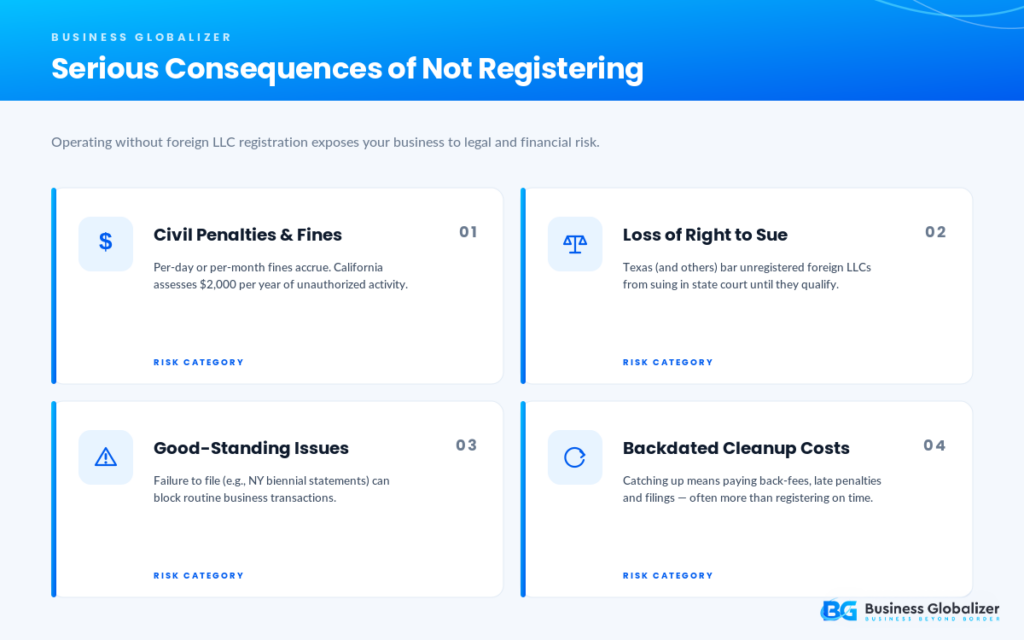
Civil penalties and fines
Many states charge a per-day or per-month fine for the period the LLC operated without authority. California, for example, assesses a penalty of $2,000 for each year or part of a year the LLC transacted business without qualifying. The penalty accrues whether or not the business was aware of the requirement.
Loss of ability to sue in state courts
Texas states that an unregistered foreign entity may be unable to maintain an action, suit, or proceeding in Texas court until it registers. That can become a real operational problem when a dispute reaches the point where the business needs judicial relief.
Good-standing and transaction issues
In New York, domestic and foreign LLCs must file biennial statements, and the Department of State warns that failure to file may prevent an LLC from completing certain business transactions. Even if the underlying business is active, an administrative gap can still block practical steps later.
Backdated compliance cleanup
Once a state identifies the issue, the LLC may have to correct missed filings retroactively, pay accumulated charges, and straighten out agent, address, and reporting records. That is usually more expensive than registering when the obligation first appears. The Business Consulting team at Business Globalizer regularly helps businesses resolve these situations — but early registration is always the better option.
Costs and Compliance Differences Between Domestic and Foreign LLCs
The cost difference between a domestic LLC and a foreign LLC is not just the first extra filing. Once an LLC registers in another state, it may take on a second layer of obligations alongside its home-state requirements. Understanding the full cost of maintaining an LLC in multiple states is important before expanding.
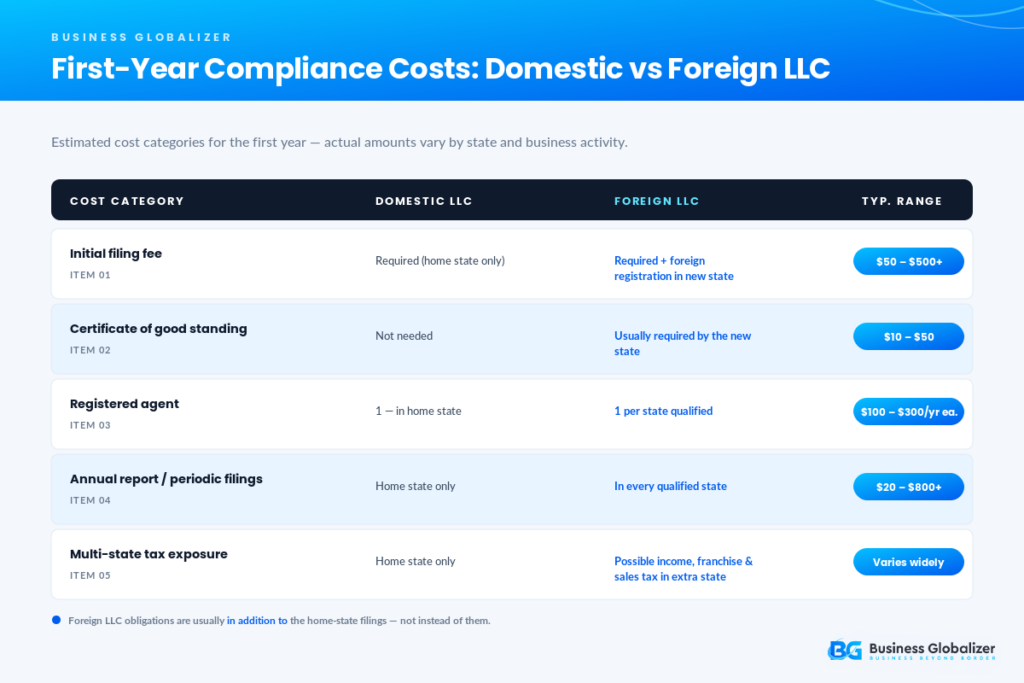
1. Foreign registration filing
A domestic LLC begins with its original formation filing and whatever recurring rules apply in its home state. A foreign LLC adds a separate registration filing in the new state before it can lawfully operate there. Filing fees vary widely — typically ranging from $50 to over $500 depending on the state.
2. Certificate of good standing
Many states require proof that the LLC is active and compliant in its formation state before approving foreign registration. That usually means submitting a certificate of good standing or a similar state-issued document.
3. Registered agent requirement
A foreign LLC typically needs to appoint and maintain a registered agent in the additional state. If the LLC already has one in its formation state, this becomes a second registered-agent obligation. Business Globalizer’s US Registered Agent Service makes it easy to stay compliant across states without managing multiple providers.
4. Annual report and periodic filings
Most states with a foreign registration requirement also have ongoing reporting obligations. Wyoming, Delaware, and Florida each have annual or periodic reporting requirements for both domestic and foreign LLCs. Missing these deadlines can result in late fees or administrative dissolution.
5. Multi-state tax exposure
Registering as a foreign LLC in another state may create tax obligations there as well. Some states impose franchise taxes, income taxes, or minimum taxes on every registered entity regardless of revenue. Understanding LLC taxation before expanding helps avoid unexpected bills. Business Globalizer’s US Tax Filing Services cover multi-state tax obligations for growing businesses.
How to Tell Whether Your LLC Is Domestic or Foreign
The question is always relative to the state you are asking about. The same LLC can be domestic in one state and foreign in another — simultaneously. Here is a practical way to think about it:
- Where was the LLC formed? That is the domestic state. Check the articles of organization or certificate of formation to confirm.
- Is the LLC operating in another state? If so, check whether that state requires foreign registration based on the level of activity there.
- Has the LLC submitted a foreign registration filing in that state? If yes, it is operating as a foreign LLC there. If not, and activity meets the threshold, that is where the compliance problem begins.
If you are unsure whether your current activity in a second state rises to the level of “doing business,” that is where the real analysis begins. The Business Consulting service at Business Globalizer can walk through this with you based on your specific situation and the states involved.
How Business Globalizer Helps with Domestic and Foreign LLC Compliance
The real challenge for business owners is not understanding the terms “domestic” and “foreign.” It is knowing what to do once registration, filings, and compliance start to overlap across states. That is where Business Globalizer helps. Instead of treating formation, foreign registration, and compliance as separate issues, BG supports businesses in keeping the structure, filings, and ongoing obligations aligned as the company grows.
- USA Company Formation Services — for setting up the LLC in the right state from the start
- Annual compliance with the state — for handling recurring state filings and renewals across all active states
- US Registered Agent Service — for receiving official state and legal notices in any state where you operate
- US Tax Filing Services — for managing tax and reporting duties across states
- Premium Business Consulting — for case-specific guidance on foreign qualification and compliance strategy
Ready to Form or Expand Your LLC?
Whether you are setting up a domestic LLC or qualifying an existing LLC to operate across state lines, Business Globalizer handles the formation, registration, registered agent, and ongoing compliance — so you can focus on running the business.
Final Thoughts
“Domestic” and “foreign” do not describe two different LLCs. They describe the legal position of the same LLC from one state to another. The LLC is domestic where it was formed, but it may become foreign in another state if registration is required there.
The real issue is not the terminology itself. It is whether the business has reached the point where another state expects registration, a registered agent, ongoing filings, or tax compliance. Once an LLC starts operating beyond its formation state, understanding the Domestic LLC vs Foreign LLC distinction early is far better than discovering those obligations later through a penalty notice.
If you recently formed your LLC and are wondering what comes next, our guide on what to do after getting an LLC covers the key steps. If you are evaluating whether an LLC is the right structure, the business structure guide covers alternatives — including sole proprietorship vs LLC, S corp, and C corp.
FAQs
1) What is the difference between a domestic LLC and a foreign LLC?
A domestic LLC is registered in its home state of formation. A foreign LLC is the same entity registered to operate in an additional state. They are not two separate companies — “foreign” simply means out-of-state, not international.
2) Does “foreign LLC” mean the company is based outside the US?
No. A foreign LLC in the US context is an LLC from another US state, not a company incorporated outside the country. If you are looking for information on a non-US-owned LLC, see our guide on foreign-owned LLC taxation, which covers different tax implications.
3) When does an LLC need to register as a foreign LLC?
An LLC generally needs to register when it has a physical office, employees, inventory, or repeated business activity in another state. Simply selling online to customers in a state does not usually require foreign registration — states focus on operational presence, not occasional sales.
4) Can I avoid foreign registration by forming a new LLC instead?
You can form a separate LLC in a second state, but that creates a distinct legal entity with its own compliance obligations. For most businesses, foreign qualification of the existing LLC is simpler and more cost-effective than running two separate companies.
5) Is a domestic LLC better than a foreign LLC?
They serve different purposes. A domestic LLC is the entity itself. A foreign LLC is a status — it describes how that same entity is treated when operating in a second state. One is not inherently better; they reflect different stages of the same business.
6) How much does foreign LLC registration cost?
Costs vary by state. Filing fees typically range from about $50 to over $500. On top of that, there may be annual report fees, a second registered agent cost, and potential franchise or minimum taxes. See our breakdown of LLC maintenance costs for a fuller picture.
7) What is a Certificate of Authority?
A Certificate of Authority is the document many states issue when a foreign LLC registers to do business there. It grants the LLC legal authority to operate in that state. The name varies — Texas uses an “Application for Registration” and New York uses an “Application for Authority.”
8) Do I need to form a new LLC to do business in another state?
Usually, no. In most cases, you keep the original LLC and register that same entity as a foreign LLC in the second state. A new entity is not required.
9) What filing is used to register a foreign LLC?
The filing name depends on the state. Many states use a Certificate of Authority, while New York uses an Application for Authority and Texas uses an Application for Registration.
10) Does a foreign LLC need a registered agent in the new state?
Yes, in most cases. The SBA notes that the registered agent must be located in the state where the business is registering. Expansion typically creates a second registered-agent requirement alongside the one in the formation state.
11) Do states ask for a Certificate of Good Standing when a foreign LLC registers?
Many do. Foreign qualification often requires a Certificate of Good Standing from the LLC’s formation state, confirming the entity is active and compliant before it can register elsewhere.
12) What happens if a foreign LLC does not register in Texas?
Under Texas law, an unregistered foreign entity transacting business in Texas may lose the ability to bring a lawsuit in Texas courts until it registers and pays any applicable late fees. Texas also imposes civil penalties on businesses that operate without authority.
13) Is a foreign LLC taxed differently than a domestic LLC?
The LLC’s federal tax treatment does not change based on domestic or foreign status. However, registering in a second state may create state-level tax obligations there — franchise taxes, income taxes, or minimum fees. A US tax filing advisor can help you navigate multi-state exposure before it becomes a liability.