High-Risk Business: A Real Risk or a Thrilling Path to Success?
High-risk businesses are exactly what their name suggests—these ventures operate in industries where the stakes are high, but the potential rewards are even greater. They face hurdles like fraud, chargebacks, and financial uncertainty, making banks and financial institutions extra cautious. Unlike low-risk businesses, they often deal with stricter terms for merchant accounts and payment gateways, including higher fees and tighter transaction limits.
A business is labeled high-risk when payment processors identify elevated exposure to chargebacks, fraud, or regulatory issues. The 10 key signs include operating in a flagged industry, high chargeback ratios, international sales, recurring billing, and a low personal credit score. High-risk classification affects merchant accounts and business banking — but specialist solutions exist.
But here’s the exciting part: high-risk businesses often thrive in booming industries like e-commerce, gaming, or cryptocurrency, where the opportunities for growth and profit are unmatched. Yes, the challenges are real, but isn’t that what makes success even sweeter?
For those bold enough to dive in, the rewards can far outweigh the risks. With the right approach and determination, a high-risk business can be more than just a gamble—it can be an exhilarating journey. So, are you ready to take on the thrill?
Common High-Risk Businesses
In this section, let’s very shortly discuss the examples of industries that are often considered high-risk by payment processors:
- Gambling and Online Gaming.
- Adult Entertainment.
- CBD and Cannabis Products.
- Nutraceuticals and Supplements.
- Cryptocurrency Trading.
- Tobacco and Vaping Products.
- Travel and Tourism Agencies.
- Debt Collection Services.
- E-commerce with High Chargebacks.
- Multi-Level Marketing (MLM) Businesses.
These industries typically face higher scrutiny due to chargebacks, fraud risks, or regulatory challenges.
Why Is Understanding a Business’s Risk Status Important?
Knowing if your business is high-risk or low-risk can make a big difference in how you operate daily and handle annual compliance. It’s not just about labels—it’s about being prepared. When you understand your risk status, you can plan smarter strategies to keep your business stable and help it grow, no matter the challenges your industry might bring.
Here’s a brief list of reasons I put together for you:
- Securing Payment Processing: High-risk businesses may face rejection or higher fees from standard payment processors.
- Improving Financial Planning: Understanding risk status helps you prepare for challenges like chargebacks or fraud.
- Meeting Compliance Requirements: High-risk businesses often have stricter regulations to follow, requiring more resources.
- Building Credibility with Partners: Transparent risk management can make lenders, investors, and processors more willing to work with you.
- Avoiding Unexpected Costs: Identifying risk early helps mitigate penalties, fraud losses, and compliance fines.
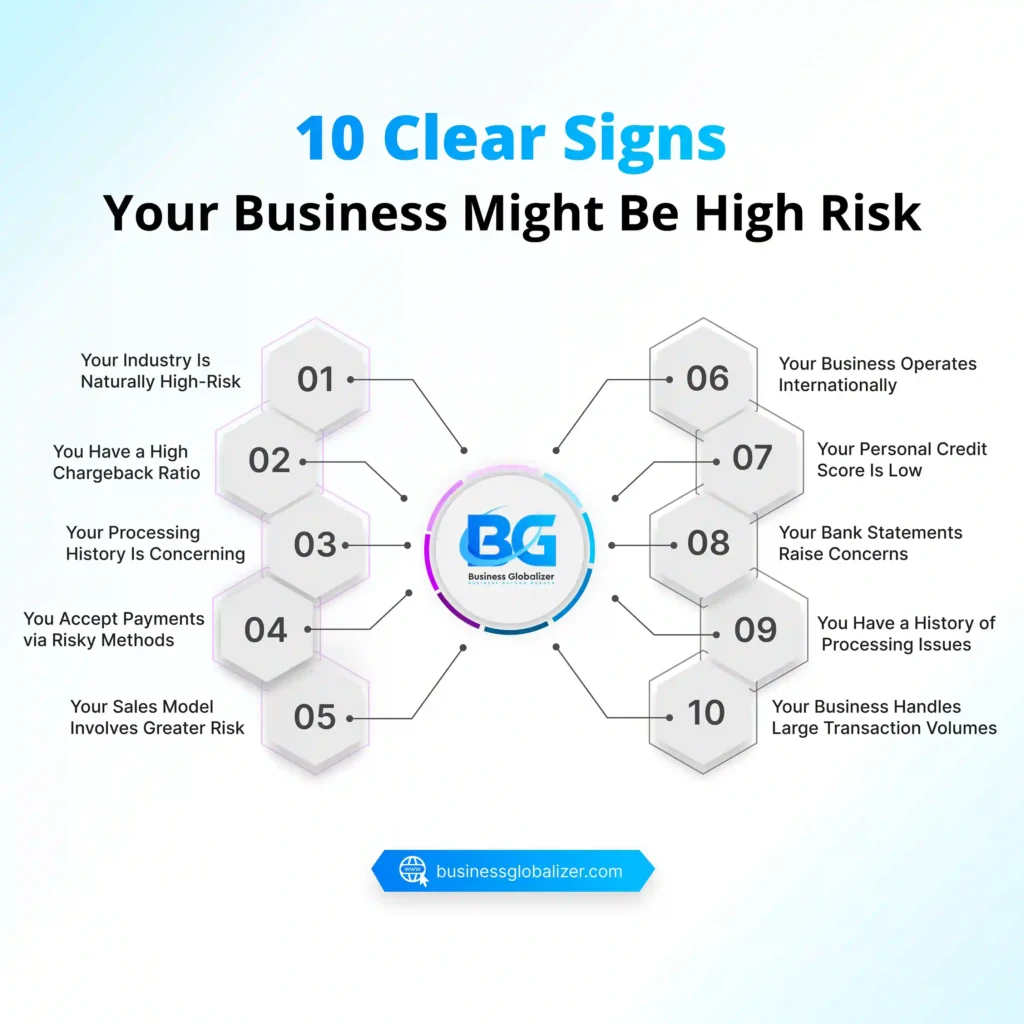
The 10 Clear Signs: Are You Operating a High-Risk Business?
| # | Sign of High Risk | Primary Risk Factor | Risk Level |
|---|---|---|---|
| 1 | High-Risk Industry | Sector classification | 🔴 High |
| 2 | High Chargeback Ratio (>1%) | Account termination risk | 🔴 High |
| 3 | Concerning Processing History | MATCH list / terminations | 🔴 High |
| 4 | Risky Payment Methods | Crypto, wire transfers | 🟡 Medium |
| 5 | High-Risk Sales Model | Subscription / recurring billing | 🟡 Medium |
| 6 | International Operations | Cross-border fraud exposure | 🟡 Medium |
| 7 | Low Personal Credit Score | Below 600 FICO | 🟡 Medium |
| 8 | Irregular Bank Statements | Cash flow inconsistency | 🟡 Medium |
| 9 | History of Processing Issues | Past holds / rollbacks | 🔴 High |
| 10 | Large Transaction Volumes | High-ticket or high-volume sales | 🟡 Medium |
Running a business comes with its own set of challenges—whatever the business is—but being labeled “high-risk” by payment processors can feel like an added hurdle. Don’t worry—it doesn’t mean you’re doing something wrong. It just means your industry or business model comes with complexities that require extra attention. So how can you tell if your business might fall into this category? I can’t give you all the answers to it, because you know rules do change.
1. Your Industry Is Naturally High-Risk
Some industries automatically land in the high-risk category because of the nature of their products or services. Merchant Category Codes (MCC) are used to classify industries, and sectors like adult entertainment, nutraceuticals, firearms, gambling, or CBD often make the list. These businesses face higher regulatory scrutiny and tend to have more chargebacks, which adds to their risk level.
Example: If you’re selling dietary supplements online, you’ve probably already dealt with the maze of varying regulations. These challenges make your business high-risk in the eyes of payment processors.
2. You Have a High Chargeback Ratio
Chargebacks are one of the most common reasons businesses are labeled high-risk. If your customers frequently dispute transactions—whether because of dissatisfaction, fraud, or errors—it raises red flags. Payment processors typically consider a chargeback rate over 1% as risky, regardless of the reason.
Example: Think of a travel agency offering high-value vacation packages. Last-minute cancellations or complaints about service quality can easily lead to chargebacks, pushing the business into the high-risk category.
3. Your Processing History is Concerning
Your payment processing history says a lot about your business’s stability. Payment processors want to see consistency—typically at least six months of steady transactions. If your patterns are unpredictable, include frequent large transactions, or result in disputes, it can make your business appear risky. This history helps processors decide if they can trust your operations.
Example: Imagine an online retailer whose transaction volumes spike during the holidays but drop drastically afterward. This inconsistency could unintentionally raise red flags about the business’s reliability and stability.
4. You Accept Payments via Risky Methods
How your business processes payments matters. If you heavily rely on credit card payments, especially from international customers, it increases your exposure to fraud and chargebacks. Larger transactions only amplify this risk, as the stakes are higher for both you and your payment processor.
Example: A luxury goods e-commerce store accepting global credit card payments may attract fraudulent transactions, which could lead to disputes and a high-risk classification.
5. Your Sales Model Involves Greater Risk
Certain sales models naturally come with higher risks of disputes or refunds. Dropshipping, multi-level marketing (MLM), subscription services, and high-ticket sales (over $500) are common examples. These models often involve complex logistics or recurring payments, which can lead to customer dissatisfaction if something goes wrong.
Example: Imagine a subscription-based fitness app offering annual memberships. If users forget to cancel auto-renewals, disputes can arise, increasing the business’s chargeback rate.
Operating a High-Risk Business?
Business Globalizer connects high-risk businesses with specialist fintech accounts — regardless of industry classification or processing history.
Explore Banking Solutions →6. Your Business Operates Internationally
Selling to customers outside regions like the U.S., Canada, Western Europe, Australia, and Japan increases your risk. Fraud rates are typically higher in regions with less robust fraud prevention measures, and payment processors factor this into their assessment.
Example: A tech accessories store shipping to developing countries might face higher incidences of fraudulent orders, making it riskier in the eyes of financial institutions.
7. Your Personal Credit Score is Low
Your personal credit history doesn’t just affect your ability to get a loan—it also influences how payment processors view your business. A low credit score signals financial instability, which might make providers hesitate to work with you.
Example: A small business owner with a personal credit score under 600 may face challenges in securing a low-risk merchant account, even if their business is well-run.
8. Your Bank Statements Raise Concerns
Payment processors closely review your bank statements to evaluate your financial health. Inconsistent deposits, frequent overdrafts, or unexplained large transactions can make them question your stability. It’s not just about how much money you have but how predictable and well-managed your finances appear.
Example: A seasonal business like a beachside cafe might have irregular bank activity due to fluctuating income, which could raise questions for payment processors.
9. You Have a History of Processing Issues
If your business has faced frequent disputes, unresolved chargebacks, or even a terminated merchant account, it might be categorized as high-risk. Payment processors view these patterns as warning signs of future complications.
Example: Imagine a digital marketing agency that had its merchant account terminated because of too many chargebacks. That agency could face significant challenges when trying to secure a standard merchant account again.
10. Your Business Handles Large Transaction Volumes
Processing large amounts of money every month—especially over $20,000—can put your business under closer scrutiny. Higher sales volumes come with increased chances of disputes and fraud, especially in industries like travel or electronics.
Example: An online retailer processing $50,000 monthly in global sales might be flagged, even though their high volume reflects their success.
If your business matches any of these signs, don’t worry. High risk doesn’t mean failure—it means you need a smarter strategy. Understand why you’re labeled high-risk, work on lowering chargebacks, and find the right provider to get the merchant account per your needs. With preparation and the right tools, high-risk businesses can not only manage risks but also grow and thrive.
Additional and Exclusive Signs
As we’ve already explored the top 10 signs of high-risk businesses, it’s worth mentioning other, often overlooked, factors that could push your business into the high-risk category. These are just as important to consider:
Unexpected Growth Spikes
While rapid growth might seem like a good thing, it can raise red flags for payment processors. Scaling too quickly can lead to delivery issues, customer complaints, or a surge in chargebacks—all things financial institutions dislike.
Entering New Territories
Expanding into international markets or unfamiliar industries can bring unforeseen challenges. New regions may have higher fraud rates or stricter regulations, making your business appear unpredictable to payment providers.
Unproven or Emerging Products
Selling products like supplements or other items in industries with unclear regulations puts you under the “high-risk” spotlight. Payment processors avoid industries that could face future legal or reputational challenges.
Financial Strain
If your business has significant debt or cash flow issues, it may be seen as unstable. Payment providers worry about potential defaults or operational disruptions.
Non-Compliance
Failing to meet industry regulations or legal standards can quickly label your business as high-risk. Non-compliance increases scrutiny from payment processors and financial institutions, making it harder to secure merchant accounts.
Shifting Rules, Perceptions, and Others
Regulatory shifts or market dynamics can quickly turn a low-risk business into a high-risk one. Abrupt changes in industry rules, unexpected transaction patterns, or market control by powerful authorities can impact a business’s classification. Sometimes, even a lack of understanding, subjective opinions—like “I don’t understand this business,”—or trust from decision-makers can lead to the high-risk label.
Payment Solutions for High-Risk Businesses: Are There Any Specifics?
To answer the question, yes, high-risk businesses have tailored solutions to manage their unique challenges:
High-Risk Merchant Accounts: Special accounts designed for high-risk businesses with high chargeback rates or fraud risks. These merchant accounts accept higher processing fees but provide better support for risk management.
Specific Payment Gateways: Some specific payment gateways work well with high-risk businesses. For example: Authorize.net, NMI.
How to Get a High-Risk Merchant Account
To get a merchant account for your high-risk business, follow the steps:
- Form Your Business: Legally establish your company with proper documentation.
- Assign an Authorized Signer: Designate someone to manage banking and compliance.
- Prepare Necessary Documents: Include incorporation papers, ID proofs, and application forms.
- Ensure Website Compliance: Add privacy policies, terms, refund policies, and contact details.
- Choose the Right Payment Processor: Work with someone experienced in high-risk industries.
- Submit Your Application: Provide all details and be ready for additional scrutiny.
For more details, visit our blog, “High-Risk Merchant Accounts.”
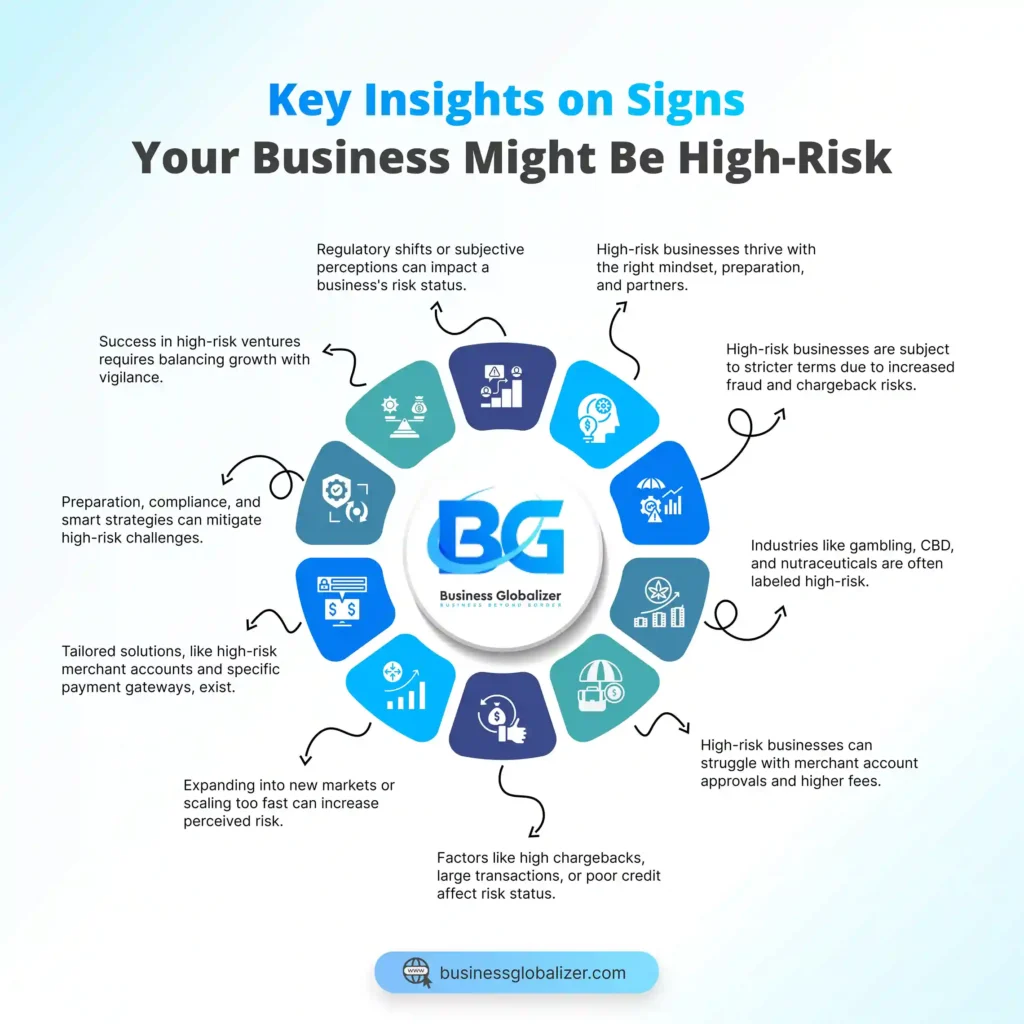
★ Key Insights: Signs Your Business Is High Risk
- Operating in a flagged sector (adult, firearms, crypto, CBD, travel, online gambling) automatically triggers high-risk classification regardless of actual performance history.
- A chargeback ratio above 1% is the payment industry’s critical threshold — exceeding it puts your merchant account at immediate risk of suspension or termination.
- Your personal credit score matters even for business accounts — processors use it as a proxy for financial reliability when your business history is limited.
- International sales increase classification risk due to higher cross-border fraud rates, currency disputes, and varied chargeback rules by country.
- Subscription and recurring billing models create higher chargeback exposure because customers dispute charges they do not immediately recognize on statements.
- Bank statements showing irregular cash flow, large rapid deposits, or overdraft activity are red flags that trigger manual underwriting reviews.
- A previous merchant account terminated for cause creates a MATCH list entry that limits future processing options for up to 5 years.
- High-ticket transactions (typically over $500 per order) require additional fraud prevention measures and increase scrutiny from acquiring banks.
- Non-compliance with PCI DSS or unresolved regulatory issues in your jurisdiction compound classification risk and may result in processing holds.
- High-risk status is not permanent — consistent low chargebacks, transparent processing history, and clean compliance records can improve your profile over 12 to 18 months.
- Business Globalizer’s international fintech banking solutions are built for high-risk businesses that traditional banks decline — with multi-currency accounts and fast approval.
FAQs
Q1: What Does Being a High-Risk Business Mean?
Answer: Being labeled as high-risk means payment processors and banks see your business as more likely to face fraud, chargebacks, or financial challenges. This label usually brings stricter conditions, higher fees, and fewer traditional banking options.
Q2: Can I Change My High-Risk Status?
Answer: While you can’t change factors like your industry, you can improve your business’s profile by lowering chargeback rates, enhancing fraud prevention, maintaining stable sales volumes, and building a strong financial track record. Partnering with high-risk-friendly payment processors can also help.
Q3: Does Being High Risk Mean My Business Will Fail?
Answer: Not at all! Many high-risk businesses thrive by understanding their challenges and working proactively to address them. It’s about finding the right partners, managing risks effectively, and maintaining compliance.
Q4: Why Do Industries Like Gambling or CBD Get Labeled as High-Risk?
Answer: These industries often face higher chargeback rates, regulatory scrutiny, and potential legal risks. This makes payment processors cautious, leading to the high-risk classification.
Q5: How Can I Lower My Chargeback Rate?
Answer: To lower your chargeback:
- Provide clear product descriptions.
- Offer excellent customer support.
- Use fraud prevention tools.
- Respond promptly to disputes.
- Keep customers informed and happy.
Q6: Are High-Risk Merchant Accounts Worth It?
Answer: Absolutely! If you’re in a high-risk industry, these accounts let you process payments and keep your business running smoothly, even with the challenges. Yes, the fees might be higher, but they’re often the most reliable way to sustain and grow your operations.
Q7: How Do I Know If My Payment Processor Supports High-Risk Businesses?
Answer: Check if the processor specifically mentions working with high-risk industries. Look for features like customized fraud prevention tools and experience handling businesses like yours. Don’t forget to read reviews and carefully review their terms before making a decision.
Need Banking Solutions for a High-Risk Business?
Get a business bank account designed for high-risk industries — fast approval, multi-currency support, and no traditional bank requirements.
Open Your High-Risk Business Account →