Quick Answer
To start a U.S. property preservation business as a nonresident, set up the LLC, EIN, physical banking, insurance, U.S. signatory support, compliance documents, and vendor-readiness process.
Starting a business from another country already feels like trying to assemble furniture without the manual. Starting a property preservation business from abroad? That adds a few extra screws.
The basic idea sounds simple: form a U.S. company, get clients, and manage property maintenance work through field contractors. But the real setup is more layered. You need the business entity, EIN, U.S. physical banking, insurance, compliance, and a U.S.-based authorized person before the business is actually ready to approach vendor networks.
So, if you are searching for how to start a property preservation business or researching a property preservation business for nonresidents, this guide will keep the answer practical, clean, and honest.
What Is a Property Preservation Business?
A property preservation business helps keep vacant, abandoned, foreclosed, or REO properties safe, clean, secure, and maintained.
HUD describes field service managers as companies that provide property preservation and protection services such as inspecting properties, securing them, making repairs, and handling ongoing maintenance.
Common property preservation services may include:
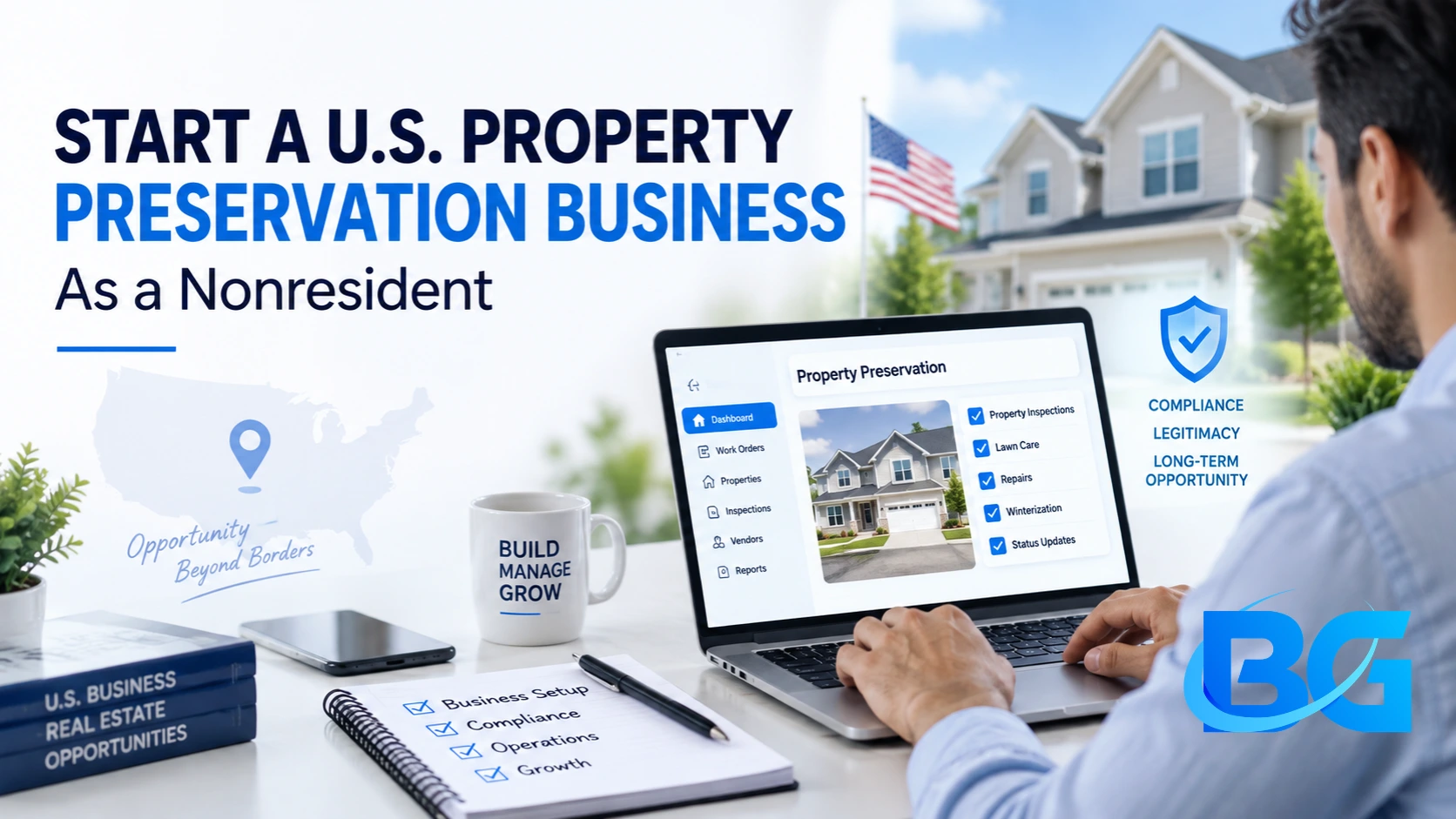
- Property inspections
- Lawn and yard maintenance
- Debris removal
- Lock changes or securing vacant properties
- Winterization
- Cleaning and basic upkeep
- Minor repairs
- Photo documentation
- Safety and condition checks
The clients are usually not everyday homeowners. This work often connects to banks, mortgage servicers, asset management companies, REO companies, property managers, and field-service platforms.
That is why this is not just “house cleaning with a business card.” It sits inside a B2B service chain where documents, compliance, insurance, and work-order standards matter.
Who Needs These Services?
Property preservation becomes important when a property is empty, distressed, foreclosed, or waiting to be sold, transferred, repaired, or managed.
A bank or mortgage servicer may need the property inspected. An REO company may need the lawn maintained. A property manager may need a vacant unit secured. A work-order platform may send contractors to handle photos, debris, repairs, or winterization.
In short, the property still needs care even when nobody is living there.
That is where the business opportunity sits.
If you are a nonresident founder, you are not usually planning to fly to the U.S. and cut grass yourself. Your likely model is different: you set up the U.S. business, coordinate operations remotely, and use U.S.-based contractors or field teams for the actual on-site work.
How to Start a Property Preservation Business as a Nonresident
The first thing to understand is this: forming the LLC is only the opening move.
A serious property preservation setup usually needs:
| Setup Area | Why It Matters |
| U.S. LLC or business entity | Needed to operate under a business name and work with clients or vendors |
| EIN | Used for business, banking, tax, and compliance purposes |
| U.S. physical banking support | Important for checks, ACH, and business payment handling |
| Insurance | Often required before client or vendor work |
| U.S. signatory or authorized support | May be needed for banking, insurance, background checks, and vendor requirements |
| Background check and compliance | Often part of field-service or vendor network requirements |
| Vendor onboarding documents | Needed to approach clients or work-order platforms |
These are the core pieces that make the business operational, not just legally registered.
Step 1: Form the U.S. Business Entity
Most nonresident founders begin with a U.S. LLC because it is common, flexible, and widely used by small businesses. But the “best state” is not automatically Wyoming, Delaware, New Mexico, or any other internet-favorite answer.
The right state for a property preservation business depends on:
- Where the business will operate
- Banking needs
- Insurance requirements
- Vendor or client expectations
- State annual compliance
- Tax and reporting obligations
- Whether you have a U.S.-based signer or partner involved
Business registration, taxes, licenses, and permits can depend on your business structure and location, and local requirements may also apply.
When people ask about the “top tax-free state” for a property preservation LLC, the answer isn’t a simple one-word name; it depends entirely on your specific operating model. the honest answer is: it depends on the actual operating model. That may sound less exciting than a one-word answer, but it is far safer.
Step 2: Apply for an EIN
An EIN is the business tax ID issued by the IRS. It is commonly needed for business banking, tax matters, vendor paperwork, and general business setup.
The IRS says that if you are creating a legal entity such as an LLC, partnership, or corporation, you should register the entity with the state before applying for an EIN.
For nonresidents, the EIN process can involve extra care because the responsible party, entity details, and application method need to be handled correctly.
This is one reason many readers searching for how to start a property preservation company get stuck. They think the order is “EIN first, company later.” For an LLC, that order is usually backwards.
Step 3: Set Up U.S. Physical Banking
This is one of the biggest practical differences in property preservation.
Your business may receive payments through physical business checks, ACH transfers, and other payment methods. Check-deposit capability can be particularly important if clients still pay by mail.
That is why the better question is not only: “Do I need a U.S. business bank account?”
The better question is: “Do I need a U.S. business bank account with physical check-deposit support?”
For this business model, the answer may be yes. You may also need to think about:
- ACH payments
- Physical business checks
- Contractor payments
- Client payments
- Payment apps such as Zelle or Venmo, where available and eligible
- Recordkeeping for income and expenses
Banks may request some common documents when opening a business bank account, which means the bank process is not only about having a company name.
Step 4: Arrange the Right Insurance
Property preservation work happens around real property, vehicles, workers, tools, and client instructions. That creates risk.
Insurance needs for property preservation business may include:
- General Liability Insurance
- Errors & Omissions Insurance
- Workers’ Compensation Insurance
- Commercial Auto Insurance
- Umbrella or Excess Liability Insurance
- Client or vendor-specific insurance requirements
Insurance pricing varies based on the services you provide, your location, your workers, your vehicles, and the requirements of each client or vendor.
That matters because property preservation startup costs are not only the LLC filing fee. Insurance can be one of the larger early expenses.
Workers’ compensation also deserves special care. The U.S. Department of Labor explains that workers employed by private companies or state/local government agencies generally fall under state workers’ compensation systems.
So your requirements can change depending on the state, whether you use employees or subcontractors, and what the client or vendor network asks for.
Step 5: Plan for U.S. Signatory or Authorized Support
This is where many nonresident founders hit the wall.
They can form the LLC. They can apply for the EIN. But banking, insurance, background checks, and vendor paperwork may require a U.S.-based authorized person or signatory.
For some nonresident setups, having a U.S.-based signatory or authorized person is essential for handling banking, insurance, background checks, compliance, and vendor requirements.
This is not something to phrase casually as “we’ll just put someone’s name there.” It needs proper authorization, documentation, and a clean business relationship.
For a nonresident, this support can be connected to:
- Physical banking setup
- Insurance coordination
- Background check requirements
- Vendor registration
- Compliance documents
- Client paperwork
In other words, this is not a decorative add-on. For many nonresident setups, it is part of making the business workable.
Step 6: Understand Background Checks, ShieldHub, and ShieldID
Property preservation and mortgage field-service networks may require background screening for contractors, inspectors, field personnel, or authorized individuals.
According to ShieldHub, ShieldIDs (formerly known as ABC#s) are issued once an individual successfully passes a criminal background check conducted by one of ShieldHub’s accredited Consumer Reporting Agency partners.
That does not mean every business has the same screening process. Requirements can vary depending on:
- The client
- Vendor network
- Work-order platform
- Role of the person being screened
- Whether the work involves field access
- Whether the person is an owner, contractor, or authorized representative
This is where older terms like “Aspen Grove ABC#” and newer terms like “ShieldHub” or “ShieldID” can confuse people. The safest approach is to check the exact vendor or platform requirement before assuming one background check satisfies everything.
Step 7: Prepare for Vendor Onboarding
After the company is formed and the setup pieces are in motion, the next goal is vendor readiness.
This is where you may approach:
- Banks
- Mortgage servicers
- REO companies
- Asset managers
- Property management firms
- Field-service platforms
- Work-order networks
People often search for banks looking for property preservation vendors, but banks are not the only route. Many property preservation businesses enter through vendor networks, servicing companies, asset managers, or national property preservation companies.
Vendor onboarding may ask for:
- Company documents
- EIN confirmation
- Insurance certificates
- Service area
- Website or business profile
- Experience details
- Background screening information
- Banking information
- W-9 or tax documents, where applicable
- Contractor or field team details
This is also where the question of how to become a property preservation contractor becomes slightly different from starting a company. A property preservation contractor may work under another company or platform. A nonresident business owner may be building the company that coordinates contractors and vendor relationships.
Both paths connect, but they are not the same.
Can You Run the Business Remotely?
Yes, the remote-owner model is possible, but it has to be set up carefully.
A nonresident owner can manage:
- Business formation
- Client communication
- Documentation
- Vendor applications
- Contractor coordination
- Work-order tracking
- Payment organization
- Compliance records
The U.S.-based field team or subcontractors may handle:
- Property inspections
- Photos
- Lawn care
- Debris removal
- Repairs
- Securing
- Winterization
- On-site reporting
The weak point is usually not the idea. The weak point is coordination.
If the business has no clear banking path, no insurance, no background check plan, no U.S.-side authorized support, and no vendor-ready documents, it may look good on paper but struggle in real operations.
Common Mistakes Nonresident Founders Should Avoid
Here are the mistakes that come up again and again:
- Forming an LLC without understanding banking needs
- Assuming an online bank account will handle physical checks
- Choosing a state only because someone said it is “tax-free”
- Ignoring insurance until a vendor asks for it
- Thinking EIN alone makes the business ready
- Not planning for a U.S.-based authorized person
- Mixing up property preservation and ordinary property management
- Applying to vendor networks without documents ready
- Assuming every platform uses the same background check rule
- Not knowing whether they want to use their own website/business identity or a supported setup model
Many articles explain services and startup basics, but they do not deal with the nonresident bottlenecks: physical banking, authorized support, compliance, and vendor-readiness.
How Much Does It Cost to Start?
There is no single universal price. A realistic property preservation startup cost can include:
- LLC formation costs
- Registered agent
- EIN support
- Business documents
- U.S. physical banking support
- Insurance premiums
- U.S. signatory or authorized support
- Background check or ShieldID-related costs
- Website or business profile preparation
- Vendor registration preparation
- State annual compliance
Insurance costs vary based on client requirements, coverage limits, location, services, vehicles, and staffing. So, the best approach is to quote this business after reviewing the founder’s model, target state, workers or subcontractors, vehicle use, banking needs, and vendor plans.
How Can Business Globalizer Help?
Business Globalizer can help nonresident founders prepare a U.S. property preservation setup from the business foundation to operational readiness.
This may include:
- U.S. LLC formation
- EIN application support
- Business documentation
- U.S. physical banking guidance
- Registered agent support
- U.S. federal & state tax filing
- U.S. Trademark filing support
- Insurance coordination support
- General Liability, E&O, Workers’ Compensation, and Commercial Auto guidance
- U.S. signatory or authorized person support
- Background check and ShieldHub / ShieldID-related guidance
- Vendor compliance and onboarding preparation
The point is not to claim guaranteed vendor approval. No serious provider should promise that.
The real value is helping the founder avoid a half-built setup: a company that exists legally but is not ready for banking, insurance, compliance, or vendor conversations.
Before We Call It a Day
Starting from abroad is not the problem. Starting without the right setup is.
If you are learning how to start a property preservation business, the big lesson is simple: the LLC is only one piece. A real property preservation business for nonresidents needs banking, insurance, signatory support, compliance planning, and vendor-readiness.
Think of it like preparing a property before inspection. You do not just paint the front door and call it done. You check the locks, yard, utilities, safety, paperwork, and photos too. This business works the same way. The stronger the setup, the easier the next conversation becomes.
Key Insights
- A property preservation business usually serves vacant, abandoned, foreclosed, or REO-type properties that need inspection, securing, cleaning, maintenance, or repairs.
- Nonresidents can form a U.S. business entity, but the real challenge is making the company usable for banking, insurance, background checks, and vendor onboarding.
- The IRS says legal entities such as LLCs should generally be registered with the state before applying for an EIN.
- Property preservation businesses may receive physical business checks, ACH transfers, and other payment types, so banking with check-deposit support can matter a lot.
- Insurance needs may include General Liability, E&O, Workers’ Compensation, Commercial Auto, and client-specific coverage.
- Workers’ compensation rules for private employers are generally handled at the state level, so requirements can change by state and work model.
- ShieldHub issues ShieldIDs (previously referred to as ABC#s) through background checks conducted by its Consumer Reporting Agency (CRA) partners.
- Vendor approval is not automatic. Banks, servicers, REO companies, and work-order platforms may each ask for different documents, insurance, background checks, or compliance proof.
FAQ
Can a nonresident start a property preservation business in the U.S.?
Answer: Yes. A nonresident can form a U.S. business entity and prepare a property preservation setup. The harder part is arranging the practical pieces: EIN, banking, insurance, authorized support, compliance, and vendor readiness.
Do I need an LLC to start a property preservation business?
Answer: Usually, yes. A properly formed U.S. business entity helps you operate under a business name, open business accounts, prepare documents, and work with vendors or clients.
Do I need a physical U.S. business bank account?
Answer: For many property preservation setups, a U.S. business bank account with physical check-deposit support may be important because these businesses may receive physical business checks, ACH payments, and other business payments.
What insurance does a property preservation business need?
Answer: Common insurance may include General Liability, E&O, Workers’ Compensation, Commercial Auto, and sometimes Umbrella or client-specific coverage. Exact needs depend on the state, workers, vehicles, services, and vendor requirements.
Is ShieldHub or ShieldID required for property preservation work?
Answer: It may be required by certain clients, vendor networks, or work-order platforms. According to ShieldHub, background screening conducted via accredited CRA partners is used to issue ShieldIDs (formerly known as ABC#s). Always check the exact platform requirement.
How to become a property preservation contractor if I live outside the U.S.?
Answer: If you live outside the U.S., you may not personally perform fieldwork. Instead, you can form the business, arrange the required setup, and work with U.S.-based contractors or field teams, depending on client and compliance requirements.
Are there banks looking for property preservation vendors?
Answer: Some banks work through servicers, asset managers, REO companies, and vendor networks rather than directly hiring small vendors. So the better route is often preparing your documents and applying through property preservation vendor channels.
How long does it take to start a property preservation business?
Answer: Timing varies. LLC formation, EIN, banking, insurance, background checks, signatory support, and vendor paperwork can each move at different speeds depending on the state, provider, bank, insurer, and platform requirements.