Quick Answer
A property preservation business may need U.S. physical banking to deposit checks, receive ACH payments, manage client payments, pay contractors, and support nonresident business banking requirements.
A payment problem usually does not look scary at first. It looks like a check sitting somewhere, waiting for the “right person” to deposit it. Cute, until it starts blocking your cash flow.
That is why banking matters so much in a property preservation business. This is not always a clean online-only service where every payment lands neatly through one app. Property preservation work can involve checks, ACH, contractor payments, client invoices, and vendor documentation. For nonresidents, there is another layer: who can open the account, sign where needed, and handle banking tasks in the U.S.?
So, before treating banking like a small admin step, let’s talk about why U.S. physical banking may sit right at the center of the setup.
Why Banking Matters in a Property Preservation Business
A property preservation business usually works around vacant, abandoned, foreclosed, or REO-type properties. The service may include inspections, lawn care, securing properties, winterization, debris removal, cleaning, minor repairs, and basic upkeep.
The business side is very practical. You may need to receive payments from clients, pay subcontractors, manage invoices, keep records, and prove that your company can handle real operations.
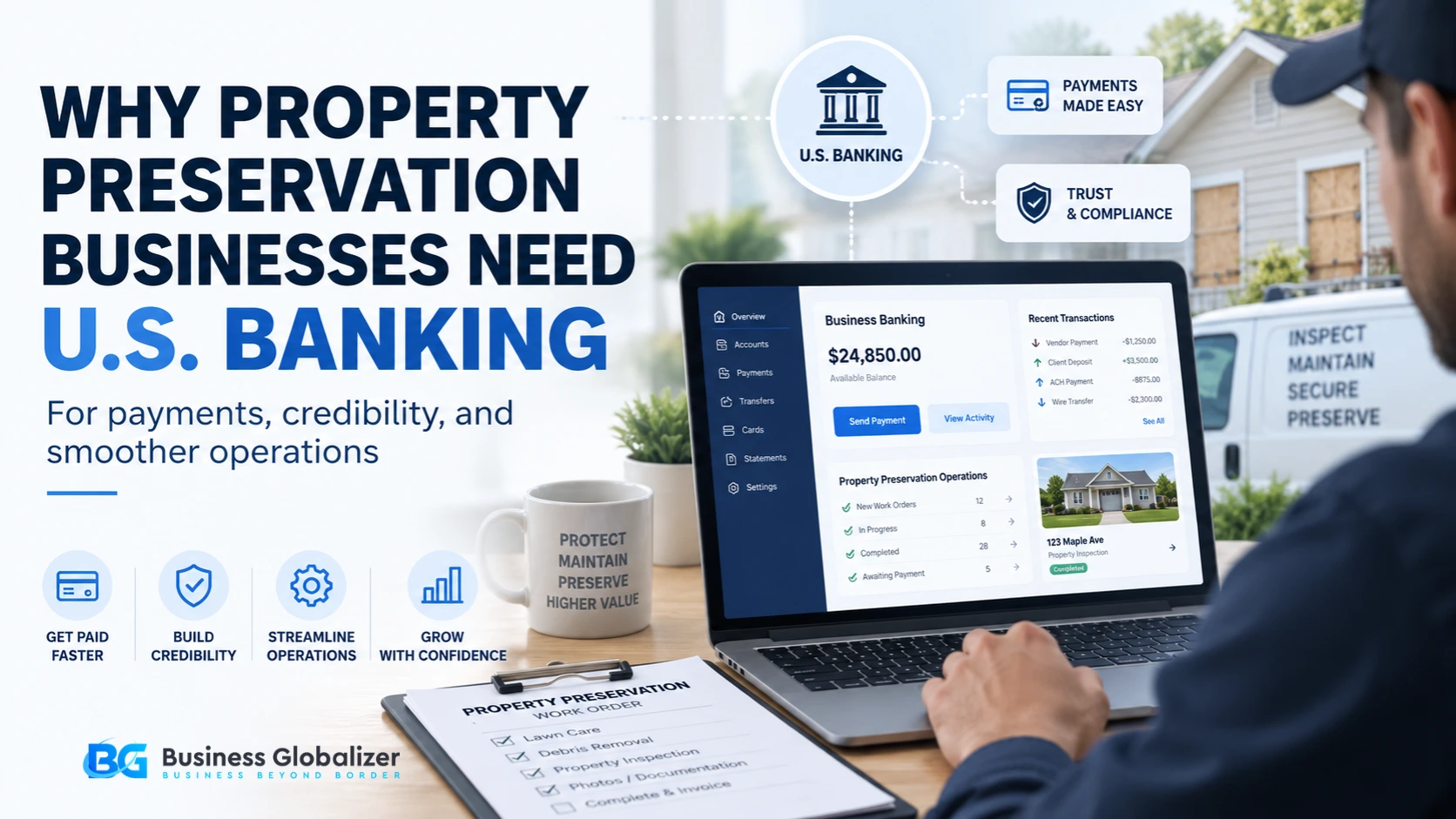
Property preservation businesses may receive payments through physical business checks, ACH transfers, and other payment methods. Suitable check-deposit capability can be particularly important for this type of business.
That is the core issue.
An LLC and EIN may create the business on paper. Banking makes the money move.
What Does U.S. Physical Banking Actually Mean Here?
Let’s clean up the phrase first.
A physical U.S. business bank account does not simply mean “a bank account in America.” In this context, it means a U.S. business banking setup that can support practical banking needs such as:
- Depositing physical business checks
- Receiving ACH payments
- Managing business income
- Paying contractors or vendors
- Supporting business documentation
- Helping with client payment processing
- Allowing authorized banking actions when required
The phrase physical business bank account is often used because some property preservation payments may still involve paper checks. If a check comes in, someone may need to deposit it properly.
That is very different from just having a fintech account that looks nice on a dashboard but cannot solve the actual check problem.
The Check Deposit Problem
This is where many nonresident founders get surprised.
A client may issue a check. A vendor network may pay through a method that requires a regular U.S. business bank account. A work-order relationship may expect standard business banking details.
If the company cannot deposit checks, the payment is technically received but practically stuck. That is not a finance strategy. That is a headache with a memo line.
This is why property preservation check deposit support deserves attention early. You need to know whether your banking arrangement can handle:
- Paper checks
- Mobile check deposit, if allowed
- In-branch or ATM deposits, if required
- Authorized signer access
- Business account verification
- Payment records for accounting
The exact setup depends on the bank, account type, signer authority, and business documents. But the key point is simple: if checks are likely, business check deposit is not optional planning. It is cash-flow planning.
ACH Payments and Client Payment Processing
Checks are only one piece. Many U.S. business payments move through ACH.
Nacha explains that ACH payments move through a network that reaches U.S. bank and credit union accounts, and the system is used for consumer, business, and government payments.
For a property preservation business, ACH payments may be relevant for:
- Receiving client payments
- Paying contractors
- Handling recurring service payments
- Managing vendor or platform payments
- Keeping business transactions traceable
ACH can be cleaner than checks in many cases, but it still usually requires proper U.S. business banking. If your account setup is incomplete, your client payment processing may become messy fast.
The point is not that every client will pay by ACH. The point is that your business should be ready for standard U.S. payment methods.
Zelle and Venmo: Useful, But Not Guaranteed
Now let’s talk about the part everyone wants to shortcut. Can a property preservation business use Zelle or Venmo?
Sometimes, yes. But not automatically.
Zelle says small business use depends on whether the financial institution offers Zelle for the business account, and both parties need eligible checking or savings accounts.
Venmo is also not a simple “bank account equals access” situation. Venmo says users must be physically located in the United States and have a U.S.-based mobile number that can receive short-code texts. It also says users can add a bank account or debit card to transfer received funds.
For business profiles, Venmo may verify business identity using information such as business name, physical address, and EIN.
So the safe wording is this:
A U.S. banking setup may help you become eligible for local payment options such as Zelle or Venmo, but access depends on the bank, platform rules, identity verification, location requirements, and account eligibility.
No serious setup should promise guaranteed Zelle or Venmo access. That is not how payment providers work.
Why Nonresident Business Banking Is Harder
For U.S. residents, opening a business bank account still involves paperwork. For nonresidents, it can be more layered.
Businesses can usually open a business bank account after getting a federal EIN, and common bank-requested documents may include formation documents.
For nonresidents, banks may also care about:
- Who owns the company
- Who is authorized to sign
- Whether the company has a U.S. business address
- The business activity
- Expected transaction types
- Formation documents
- EIN confirmation
- Identification documents
- Whether someone can complete required bank procedures
This is why U.S. business banking for nonresidents needs planning. It is not just “open an account after LLC.” It is “open the right account with the right structure for how this business gets paid.”
You can say, physical banking is a crucial part of starting a property preservation business in the U.S. as a nonresident because it supports the larger setup, including your LLC, EIN, insurance, authorized signatory support, compliance, and vendor readiness.
Where a U.S. Authorized Signatory Fits
For some nonresident setups, a U.S. authorized signatory can be important.
Your property preservation setup source says a U.S.-based signatory or authorized person is mandatory for meeting banking, background check, compliance, insurance, and vendor requirements in this service model.
This does not mean the person automatically owns the business. It means the person may be authorized to help with specific U.S.-side requirements, depending on the arrangement.
That authority should be:
- Clearly documented
- Limited to what is actually needed
- Aligned with bank or vendor requirements
- Separated from ownership unless ownership is intentionally involved
- Handled carefully, not casually
For banking, this can matter because someone may need to sign documents, complete verification steps, handle approved banking actions, or support check-deposit procedures.
Common Business Bank Account Requirements
Exact business bank account requirements vary by bank, but common items may include:
| Requirement | Why It May Matter |
| LLC or formation documents | Proves the business legally exists |
| EIN confirmation | Connects the account to the business tax ID |
| Owner or signer ID | Helps the bank verify responsible parties |
| Business address | Supports account setup and compliance checks |
| Operating agreement | May show ownership and signing authority |
| Business description | Helps explain the nature of property preservation work |
| Expected transaction types | Helps the bank understand checks, ACH, and payment flow |
For a property preservation business, banks may also want to understand why physical checks, ACH payments, and contractor payments are part of the model.
That is normal. Banks like knowing what kind of money movement they are looking at. Honestly, we would too.
Contractor and Client Payments
Property preservation work often involves people in different roles.
A client may pay your company. Your company may then pay contractors or field teams. Those contractors may handle inspections, lawn work, lock changes, cleanouts, repairs, or photos.
That creates two important payment flows:
- Client payments coming in
- Contractor payments going out
If your business banking is weak, both sides become harder.
You may struggle with:
- Depositing client checks
- Receiving ACH
- Paying subcontractors on time
- Tracking work-order income
- Matching payments to invoices
- Keeping clean records
- Showing financial readiness to partners or vendors
This is why nonresident business banking should be treated as an operating requirement, not a back-office afterthought.
The state you choose for your property preservation business also connects here because your business structure, banking plan, and U.S. authorized support can all affect how practical the setup becomes.
Mistakes to Avoid
Here are the common banking mistakes nonresident founders should avoid:
- Forming an LLC without checking banking practicality
- Assuming every U.S. bank will accept a nonresident structure
- Assuming online-only banking will handle physical checks
- Treating localized payment gateways/solutions access as guaranteed
- Ignoring ACH setup until a client asks
- Not planning who will deposit physical checks
- Mixing personal and business payments
- Failing to document signer authority
- Applying to vendors before the payment setup is ready
- Choosing a state without considering banking and authorized signatory needs
The uncomfortable truth is simple: a business can be legally formed but still operationally stuck. Banking is often where that shows up first.
Where Does Business Globalizer Come in?
Business Globalizer helps nonresident property preservation founders prepare for U.S. banking requirements, including check deposits, ACH payments, and authorized signer needs.
Our service includes:
- U.S. company formation
- EIN support
- Full property preservation business setup
- U.S. physical banking guidance
- U.S. Trademark filing support
- Registered agent support
- U.S. federal & state tax filing
- Business documentation support
- Check-deposit planning
- U.S. authorized signatory support
- Insurance and compliance coordination
- Vendor-readiness guidance
- Ongoing business setup support
The point is not to promise approval from a bank, local payment gateways, client, or vendor platform. Those decisions depend on the relevant provider and their requirements.
The real goal is to help the founder avoid a broken setup: a company that exists legally but cannot properly receive checks, process client payments, or manage contractor payments.
Before You Build the Payment Side
A property preservation business needs more than a name, an LLC, and a logo. It needs a way to get paid without turning every check into a mini-crisis.
That is why a physical U.S. business bank account, check deposit capability, ACH payments, and signer planning matter so much for nonresident founders.
Think of banking as the plumbing of the business. Nobody admires it when it works. Everyone notices when it does not.
So before you chase vendors, clients, or work orders, make sure the money side can actually move. For a property preservation business, that small detail can decide whether the setup feels ready or constantly stuck.
Key Insights
- A property preservation business may receive physical business checks, ACH payments, and other payment types, so ordinary online-only banking may not always fit the work model.
- A physical U.S. business bank account is not just about having an account number; the real issue is practical check deposit capability.
- Businesses can usually open a business bank account after getting a federal EIN, and banks commonly ask for business formation documents.
- ACH payments move money electronically between U.S. bank and credit union accounts, and Nacha describes ACH as a network used for consumer, business, and government payments.
- Zelle for small business depends on whether the financial institution offers it and whether both parties have eligible accounts.
- Venmo has U.S.-specific requirements, including being physically located in the United States and having a U.S.-based mobile number.
- For nonresident founders, a U.S. authorized signatory may be needed for banking, compliance, insurance, background check, or vendor requirements.
- Banking should be planned before vendor onboarding because client payments, contractor payments, and documentation can all depend on the banking structure.
FAQ
Does every property preservation business need a physical U.S. business bank account?
Answer: Not every case is identical, but many property preservation businesses may benefit from a physical U.S. business bank account because checks, ACH, contractor payments, and client payment processing may be part of the work model.
What is property preservation check deposit?
Answer: Property preservation check deposit means depositing physical business checks received from clients, vendor networks, or related payment sources into the company’s business bank account.
Can an online bank handle business check deposits?
Answer: Sometimes, but not always. Some online banks may offer mobile check deposit, while others may limit check handling. The real question is whether the account has reliable check deposit capability for the business model.
Are ACH payments important for property preservation businesses?
Answer: Yes. ACH payments can be useful for receiving client payments, paying contractors, and keeping business transactions traceable. ACH is a common U.S. electronic payment method used by businesses and financial institutions.
Can a nonresident property preservation business use Zelle?
Answer: Possibly, but it depends on the financial institution. Zelle small business access depends on whether the bank offers it for eligible business accounts and whether the parties have eligible accounts.
Can a nonresident property preservation business use Venmo?
Answer: Not automatically. Venmo has U.S.-specific requirements, including a U.S. physical location and a U.S.-based mobile number. Business profile verification may also require business identity information.
Why might a U.S. authorized signatory be needed?
Answer: A U.S. authorized signatory may be needed for banking, check-deposit tasks, documents, insurance coordination, background checks, vendor requirements, or other approved U.S.-side business actions.
What are common business bank account requirements?
Answer: Common business bank account requirements may include formation documents, EIN, owner or signer identification, business address, operating agreement, and details about the company’s activities and expected payment methods.