Quick Answer
A property preservation business from abroad may need a U.S. authorized signatory for banking, insurance, background checks, vendor onboarding, and approved U.S.-side business actions.
A remote business sounds clean until the first document asks for a U.S.-based signer. Then suddenly, the “I can manage everything online” plan starts sweating a little.
That is the real issue with starting a property preservation business from abroad. You may be able to form the LLC, apply for the EIN, build the website, and coordinate contractors from another country. But some parts of the setup may still need a person in the U.S. who is authorized to sign, verify, coordinate, or support specific business requirements.
This does not mean giving away your company. It means structuring the business properly so it can function in the real U.S. market, not just exist on paper.
What Is a U.S. Authorized Signatory?
A U.S. authorized signatory is a person who has been given authority to sign or act for a business in specific situations. That authority usually comes from company documents, written authorization, a banking resolution, contract authorization, or another approved business document.
In simple words: the signatory is allowed to do certain approved things for the company.
That may include:
- Signing specific business documents
- Helping with banking paperwork
- Acting as an authorized signer for business bank account matters
- Supporting insurance or vendor documentation
- Completing certain verification steps
- Coordinating U.S.-side administrative tasks
But here is the important part: an authorized signatory is not automatically the owner, manager, or decision-maker for everything.
Good documentation should explain:
- Who the person is
- What they are allowed to do
- What they are not allowed to do
- Whether the authority is temporary or ongoing
- Whether the authority is limited to banking, contracts, compliance, or another area
- How the authority can be changed or revoked
This is where many nonresident founders need to slow down. “Just use someone’s name” is not a business setup. It is a future argument waiting politely in the corner.
Why a Property Preservation Business from Abroad Needs One
A property preservation business usually works around vacant, abandoned, foreclosed, or REO-type properties. The business may involve the following:
- Inspections,
- Lawn care,
- Debris removal,
- Securing properties,
- Winterization,
- Repairs,
- Photos,
- Vendor platforms, and
- Work-order documentation.
If you are outside the U.S., you may still manage the business remotely. But the business itself often needs to interact with U.S. systems.
That is where a U.S. business authorized representative or signatory may become useful. A signatory may help with:
- Physical banking support
- Check-deposit-related tasks
- Bank account documentation
- Insurance coordination
- Background check or identity verification steps
- Vendor onboarding paperwork
- Client or platform documentation
- U.S.-side administrative follow-up
This is especially relevant when the founder is building the business from Bangladesh, India, UAE, Pakistan, or another country, but the actual fieldwork happens inside the United States.
So yes, you can run a U.S. business from abroad. But the operating structure should be built for that reality.
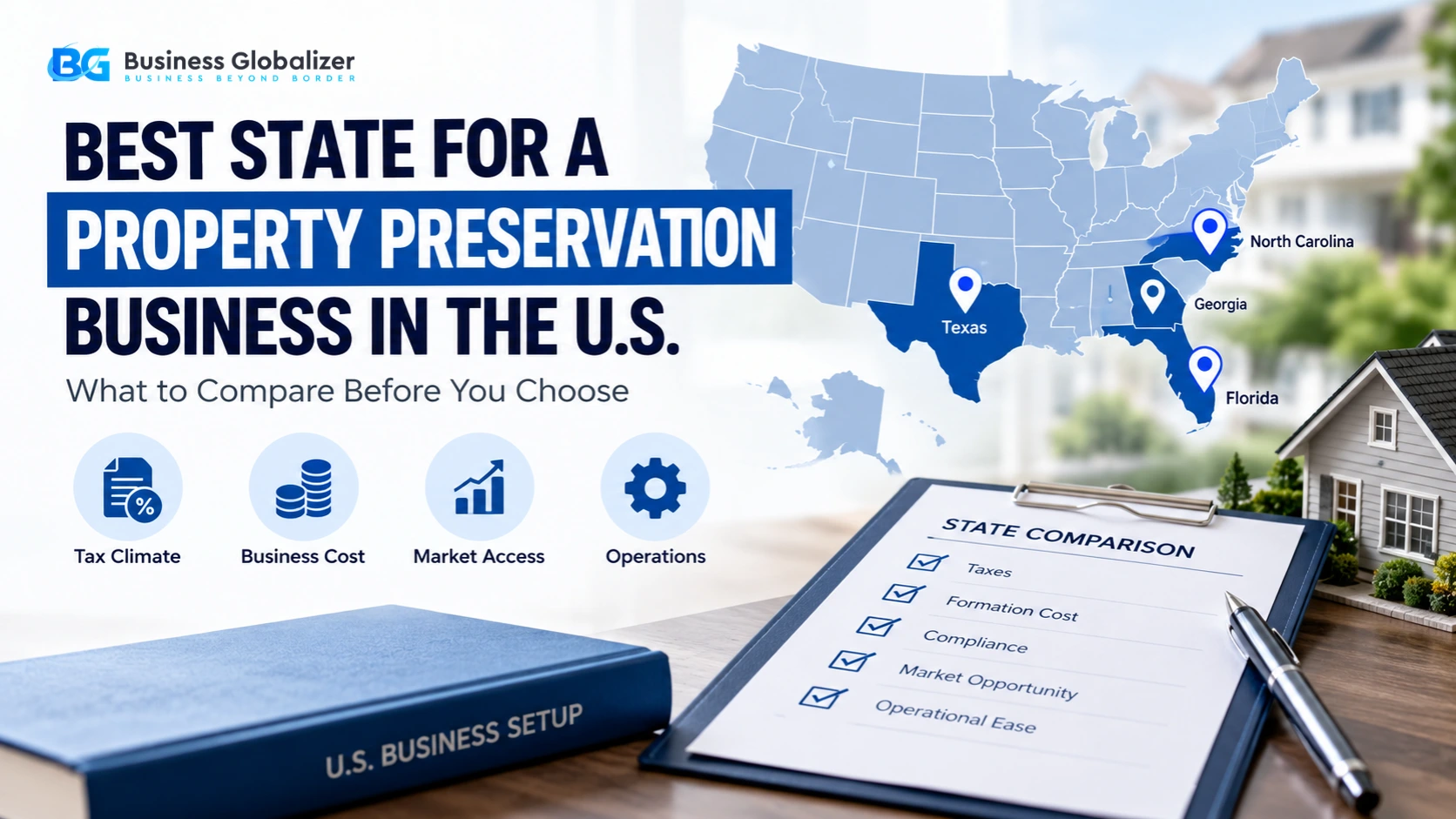
Important Note: When choosing the best state for a property preservation business, founders starting a property preservation business in the U.S. must consider operating locations, contractor coverage, and state rules governing banking, compliance, insurance, and vendor onboarding.
Signatory vs. Owner vs. Responsible Party
These roles are often confused because they can overlap in practice, but each one involves different responsibilities, authority, and legal considerations, so let’s separate them.
| Role | What It Usually Means |
| Owner / Member | The person or entity that owns the LLC or business |
| Manager | The person authorized to manage the company, depending on the LLC structure |
| Responsible Party | The person who controls, manages, or directs the entity and its assets for EIN purposes |
| Authorized Signatory | A person authorized to sign or act for the company in defined situations |
| U.S. Partner | A broader business relationship that may include operational support, strategic support, or authorized duties |
For EIN purposes, the application requires a responsible party, and nominees should not be used as the responsible party. If a nominee helped with formation, the responsible party should be identified before applying for the EIN.
That is not the same thing as having a U.S. authorized signatory.
A nonresident founder can own the company while still appointing an authorized person for specific U.S.-side actions. The details depend on the company documents, bank rules, vendor requirements, and the authority granted.
Where the Signatory Helps Most
A U.S. authorized signatory can help remove practical barriers in banking, insurance, vendor onboarding, and other U.S.-side business processes.
Banking and Check Deposits
Banking is usually one of the first places this issue appears.
A property preservation business may receive checks, ACH payments, contractor payments, or client payments. Banks commonly ask for business details, formation documents, EIN information, and signer identification when opening a business account.
For nonresidents, banking can be more layered because the bank may need to know:
- Who owns the business
- Who is authorized to sign
- Who can complete bank procedures
- Whether the business has a U.S. address
- What kind of payments the business expects
- Whether physical checks need to be deposited
This is why an authorized signer for a business bank account matters. The role may help the business handle bank-approved signing and account-related tasks, depending on the bank’s rules.
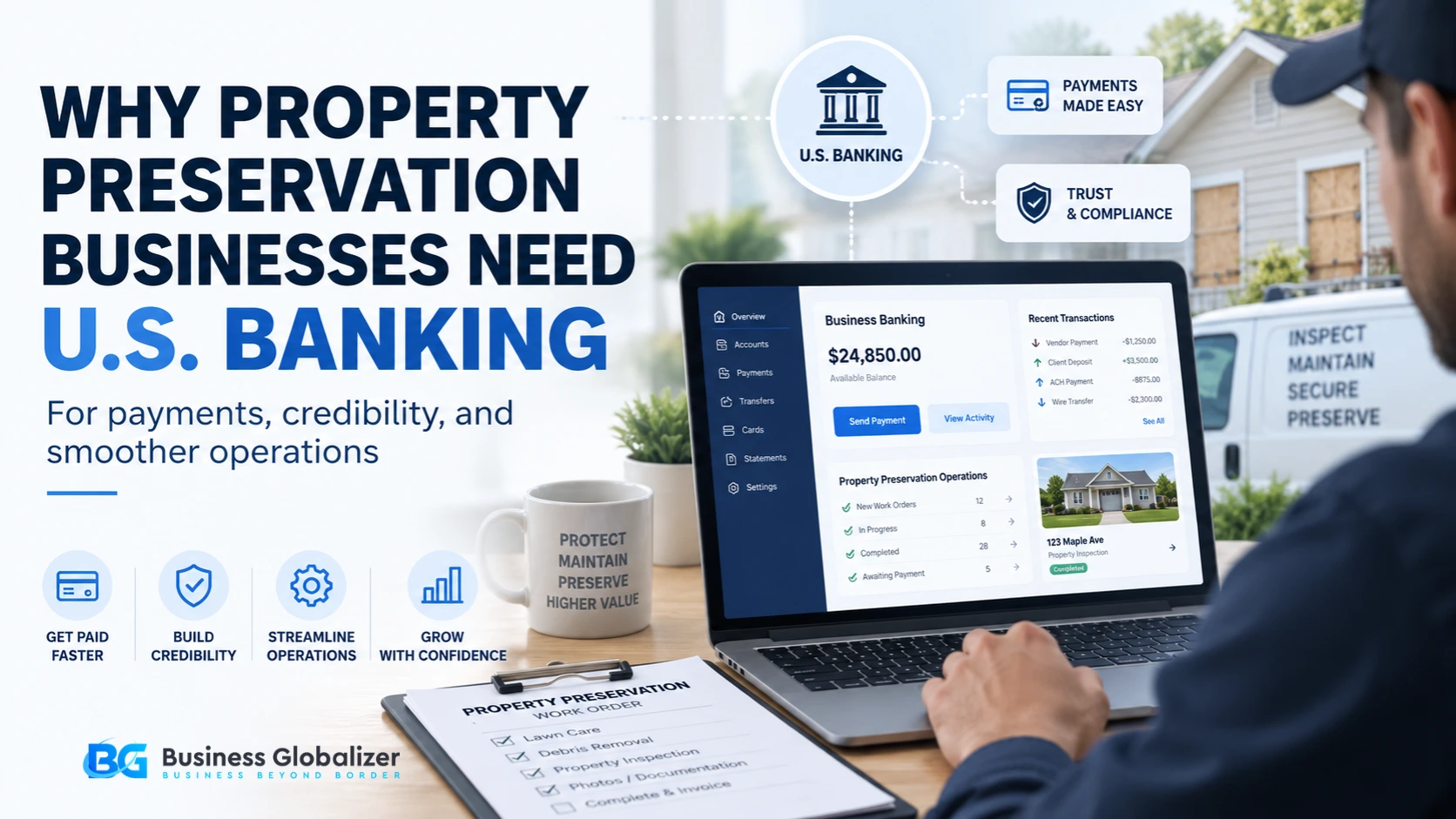
This also connects naturally with the question of why property preservation businesses need U.S. banking, because payment flow is not a side issue in this business. It can decide whether the company can actually operate.
Insurance and Vendor Documents
Property preservation work may involve real property, vehicles, contractors, workers, tools, and client requirements. Insurance may include General Liability, E&O, Workers’ Compensation, Commercial Auto, Umbrella coverage, or client-specific requirements.
Sometimes, insurance applications or vendor packets may require authorized business information, signatures, certificates, or supporting documents.
A U.S. authorized signatory may help coordinate these steps, but the insurance itself should still match the actual business model. If the business uses subcontractors, vehicles, or field teams, the policy review should reflect that.
Insurance and signatory planning often move together, especially for nonresident founders, which is why understanding property preservation insurance requirements is an important part of building the business properly.
Background Checks and Compliance
Vendor networks, work-order platforms, banks, servicers, or field-service companies may have their own compliance process. Some may request identity verification, background checks, certificates, contracts, or company documents.
A U.S. signatory or authorized representative may help support the process where U.S.-side action is required.
But be careful with one thing: a signatory should not be used to misrepresent who owns, controls, or operates the business. The role should match the truth of the setup.
Clean structure beats clever shortcuts. Every time.
Remote Management and Subcontractors
Many nonresident founders want to manage a U.S. business remotely. In property preservation, that is possible in concept because the owner may coordinate the business while U.S.-based contractors handle field work.
The remote owner may handle:
- Business planning
- Client communication
- Vendor applications
- Contractor coordination
- Work-order tracking
- Payment monitoring
- Documentation
- Compliance follow-up
U.S.-based contractors or field teams may handle:
- Property inspections
- Photos
- Lawn care
- Debris removal
- Lock changes
- Winterization
- Repairs
- On-site reporting
This is why understanding the U.S. partner for a property preservation business matters. In some cases, the partner may be a strategic support person. In other cases, the person may be an authorized signatory with limited authority. In more involved models, the partner may support operations, documentation, or vendor readiness.
The right structure depends on the business model, not a template.
Own Website vs. Supported Setup
This is an important sales and qualification point. Some founders want to use their own company identity, own website, own brand, and own client-facing setup. That can work, but it may require more documentation.
They may need:
- U.S. LLC documents
- EIN letter
- Business website
- Business profile
- Service descriptions
- Insurance documents
- Bank account setup
- Authorized signatory paperwork
- Vendor registration documents
- Proof of business activity
- Local documents or owner identity documents, where required
Other founders may want a more supported setup, where Business Globalizer helps structure the property preservation business setup and related U.S.-side requirements. That can make the process easier to coordinate, but the exact requirements still depend on the bank, insurer, client, vendor network, and platform.
So the question is not only, “Can I start?”
The better question is: “Will I use my own business identity fully, or do I need supported U.S.-side setup help?”
That answer affects how much documentation and U.S.-side support may be needed.
Do Nonresidents Need a U.S. Authorized Signatory?
The question “do nonresidents need a U.S. authorized signatory?” has a practical answer: not for every single business action, but often for property-preservation-related banking, insurance, compliance, or vendor-readiness steps.
A nonresident may be able to form a company without a U.S. signatory. But forming the company is not the same as making it ready to operate.
A U.S. authorized signatory may become relevant if:
- The bank requires a U.S.-side authorized signer
- Physical check deposit needs local support
- Insurance paperwork requires authorized handling
- Vendor onboarding asks for U.S.-side documentation
- Background check or verification needs U.S.-based coordination
- The business needs a U.S. partner for property preservation business operations
- Client paperwork requires someone authorized to sign on behalf of the company
The point is not to add unnecessary people to the business. The point is to remove operational bottlenecks before they become expensive.
How to Structure the Role Properly
A U.S. authorized signatory role should be clear from the beginning.
Use proper documents such as:
- Operating agreement provisions
- Company resolution
- Authorized signatory letter
- Banking authorization
- Contract-specific authorization
- Limited power of attorney, if appropriate and legally reviewed
- Internal approval records
The document should state:
- Name of the authorized person
- Company name
- Scope of authority
- Whether banking authority is included
- Whether contract signing is included
- Any dollar limits or transaction limits
- Effective date
- Revocation process
- Owner/member approval
If the authority overlaps with legal rights, banking control, or contract obligations, get proper professional review. This is not the place for casual copy-paste documents from the internet.
Mistakes to Avoid While Appointing a U.S. Authorized Signatory for Your Property Preservation Business
When appointing a U.S. authorized signatory for your property preservation business, nonresident founders should avoid the following common mistakes:
- Appointing someone without written authority
- Giving broad signing power when limited authority would be safer
- Confusing signatory with owner
- Using a nominee as the responsible party for EIN purposes
- Not documenting the authority clearly
- Letting someone sign bank or vendor documents without proper approval
- Assuming a signatory guarantees bank, insurance, or vendor approval
- Ignoring state, insurance, and compliance requirements
- Trying to run everything remotely without U.S.-side operational support
- Not deciding whether the business will use its own website or a supported setup
A property preservation business from abroad can work. But it needs clean lines. Who owns? Who signs? Who manages? Who handles banking? Who works in the field? Those answers matter.
How Business Globalizer Supports Your Property Preservation Setup
Business Globalizer helps nonresident founders structure a property preservation setup that can move beyond basic company formation.
Our support includes:
- U.S. company formation
- EIN support
- Registered agent support
- U.S. physical banking guidance
- Authorized signatory in the US
- U.S. business authorized representative support
- Business documentation
- Insurance coordination guidance
- Background check and compliance guidance
- Vendor-readiness support
- U.S. federal and state tax guidance
- Ongoing compliance support
The goal is not to promise approval from a bank, insurer, vendor network, or client. Those decisions depend on each provider’s own requirements. The real value is helping the founder avoid a half-built setup: an LLC that exists, but cannot complete banking, insurance, signing, vendor, or operational steps properly.
Before You Hand Someone the Pen
A property preservation business from abroad is not just about distance. It is about authority.
If you are trying to run the company remotely, the real question is not “Can I control everything from my laptop?” The better question is, “Which parts of the business need approved U.S.-side action?”
That is where a U.S. authorized signatory can become useful.
Used properly, the role supports banking, documents, insurance, compliance, and vendor readiness. Used carelessly, it creates risk and confusion. So before you hand someone the pen, make sure the authority is clear, limited, documented, and aligned with the actual business model.
That is how a property preservation business from abroad becomes more than an idea. It becomes something that can actually function.
Key Insights
- A property preservation business from abroad can be managed remotely, but U.S.-side banking, signing, insurance, and vendor steps may still need local support.
- A U.S. authorized signatory is not automatically an owner. Their authority should be clearly documented and limited to approved business actions.
- For EIN purposes, the business must identify a responsible party, and that role is different from simply using a nominee or signer.
- Business bank account setup often depends on EIN, formation documents, signer identity, and bank-specific requirements.
- A U.S. authorized signatory may be useful for banking, check deposits, insurance coordination, vendor paperwork, background checks, and compliance steps.
- Nonresident founders should not treat a signatory casually. The person’s role, authority, limits, responsibilities, and documentation should be clear.
- If you plan to manage a U.S. business remotely, the setup should also account for contractors, work orders, payment flow, insurance, and vendor onboarding.
- A supported setup may reduce friction, but your own company, website, and business identity may require more client-side documents and verification.
Frequently Asked Questions
What is a U.S. authorized signatory for nonresident business?
Answer: A U.S. authorized signatory for a nonresident business is a person in the United States who is given documented authority to sign or handle specific approved business actions for a company owned or managed by a nonresident.
Do nonresidents need a U.S. authorized signatory?
Answer: The answer to whether nonresidents need a U.S. authorized signatory depends on the business model. For property preservation, a signatory may be needed for banking, check deposits, insurance, background checks, vendor documents, or compliance steps.
Is a U.S. authorized signatory the same as an owner?
Answer: No. A signatory is not automatically an owner. Ownership should be defined in the company documents. A signatory only has the authority granted to them by written authorization, company resolution, bank forms, or contract documents.
Can I run a U.S. business from abroad without a partner?
Answer: You may be able to run a U.S. business from abroad without a partner for some activities. But property preservation may still require U.S.-side support for banking, signing, field coordination, vendor paperwork, or compliance.
Do I need a U.S. partner for property preservation business setup?
Answer: A U.S. partner for property preservation business setup may be useful if the business needs local signing, banking, insurance coordination, background check support, or vendor-readiness help. The role should be clearly documented.
Who can be an authorized signer for business bank account setup?
Answer: An authorized signer for business bank account setup is usually someone the company formally authorizes and the bank accepts. The bank may require identity documents, company documents, EIN details, and proof of signing authority.
Can I manage a U.S. business remotely with subcontractors?
Answer: Yes, you can manage a U.S. business remotely with subcontractors if the company structure, contracts, payments, insurance, documentation, and vendor requirements are handled properly.
Does a U.S. authorized signatory guarantee bank or vendor approval?
Answer: No. A U.S. authorized signatory may support the process, but approval depends on the bank, insurer, vendor network, client, or platform’s own requirements.