Quick Answer
Non-U.S. residents can apply for a U.S. trademark, but those domiciled abroad must generally use a U.S.-licensed attorney and complete the standard steps like confirming ownership, checking conflicts, selecting goods/services and filing basis, and going through USPTO review.
Imagine building a brand from your desk in Dhaka, Dubai, London, or Lagos while most customers are in the United States. The business may be international, but the risk is local: another party could already hold conflicting U.S. trademark rights.
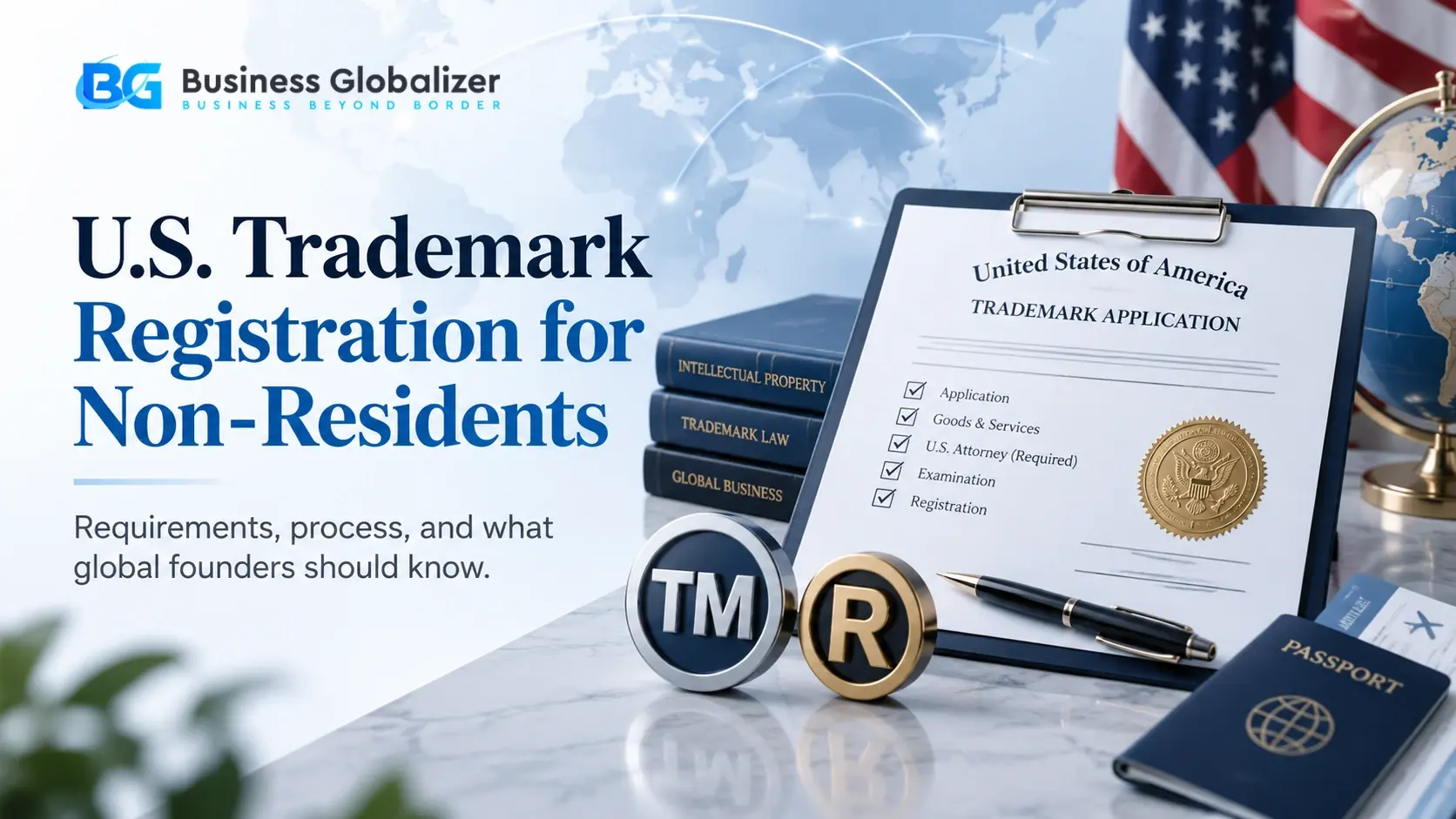
That brings us to today’s topic: how to register a U.S. trademark for non-residents, and what it takes to secure a successful trademark registration in the U.S. from outside the country.
The reassuring part is that you do not need to be a U.S. citizen to seek federal registration. You also do not automatically need a U.S. company. The USPTO, however, closely reviews domicile, ownership, legal representation, and how the mark will be used in any US trademark application.
So, the real question is not whether a foreign founder may apply. It is whether the application is structured correctly from day one for a successful outcome.
Can Non-Residents Register a U.S. Trademark?
Yes. Why not?
An individual or business based outside the United States may seek federal trademark registration with the United States Patent and Trademark Office.
The USPTO’s rules focus on matters such as:
- Who legally owns the trademark.
- Where the applicant is domiciled.
- What goods or services the trademark identifies.
- Whether the mark qualifies for registration.
- Whether the application satisfies U.S. legal and procedural requirements.
Foreign nationality by itself does not disqualify an applicant.
A trademark may be a word, phrase, symbol, design, or a combination that identifies the source of goods or services. Federal registration can provide nationwide legal benefits in the United States, but the protection is tied to the listed mark and the registered goods or services, not ownership of a word in every possible context.
For a broader foundation, understanding the basics of U.S. trademark law first makes the rest of the filing decisions easier to follow.
What Does USPTO Trademark Registration for Non-US Residents Protect?
A successful USPTO trademark registration may provide important federal benefits, including:
- Public notice of the registered claim.
- A legal presumption of ownership and the right to use the mark for the registered goods or services.
- The right to bring certain trademark claims in federal court.
- The ability to use the federal registration symbol, ®, with the registered mark for the covered goods or services.
- The possibility of recording the registration with U.S. Customs and Border Protection.
- A potential basis for seeking trademark protection in other countries.
That does not mean a U.S. registration covers every country.
Trademark rights are territorial. A federal U.S. registration primarily concerns protection under U.S. law. Separate applications or international filing arrangements may be needed in other markets.
This is also where learning the differences between state and federal trademark registration matters. State registration generally offers narrower, state-level coverage, while federal registration may provide broader nationwide benefits.
Who Is a Foreign-Domiciled Applicant?
The phrase “non-resident” is commonly used, but the USPTO’s legal rule is based on domicile. A foreign-domiciled applicant is an applicant whose domicile is outside the United States or its territories.
For an individual, domicile generally means the place where that person resides and intends to maintain their principal home.
For a legal entity, domicile generally means its principal place of business; the headquarters where senior executives or officers ordinarily direct and control the company’s activities.
This distinction matters because:
- Citizenship and domicile are not always the same.
- Forming a U.S. LLC does not necessarily establish a genuine U.S. domicile.
- A mailing address, virtual office, registered-agent address, or P.O. box may not be the applicant’s true domicile.
- The USPTO may request clarification or supporting information when the submitted address does not appear to represent the actual domicile.
Every applicant must provide and keep current its domicile address so the USPTO can determine whether U.S. counsel is required. A P.O. box is generally insufficient as a domicile address.
Do Non-US Applicants Need a US Trademark Attorney?
For a foreign-domiciled applicant, generally yes.
Foreign-domiciled applicants, registrants, and participants in Trademark Trial and Appeal Board proceedings must comply with the requirement of a U.S. licensed attorney. The attorney must be qualified and licensed to practise law in the United States. The requirement also applies to Canadian applicants domiciled outside the United States.
The rule has applied since August 3, 2019. It was introduced to improve compliance with U.S. trademark law, reduce inaccurate or fraudulent filings, and protect the integrity of the federal trademark register.
A foreign applicant should not use:
- A foreign attorney who is not authorised to practise before the USPTO.
- A non-attorney filing company as a substitute for U.S. counsel.
- An attorney whose name or bar details are being used without meaningful legal involvement.
- Any service company guaranteeing a workaround for the attorney or domicile mandates.
The USPTO specifically warns that non-attorneys cannot legally represent applicants before the agency and that some filing firms improperly use attorney credentials to get around the rule.
The attorney’s role may include reviewing ownership, conducting or assessing a clearance search, preparing the application, selecting the correct filing basis, communicating with the USPTO, and responding if a trademark Office Action is issued.
Does a Non-Resident Need a U.S. Company to Register a Trademark?
No, not as a general rule. Applying for a U.S. trademark is open to foreign individuals and existing foreign legal entities alike. Forming an LLC or corporation just to become “eligible” for trademark registration is not automatically necessary.
However, the more important question remains: who holds actual ownership of the brand?
The applicant listed in the filing must be the true owner of the trademark. That could be:
- The individual founder.
- A foreign company.
- A U.S. company.
- Another valid legal entity.
The decision must be based on actual ownership, rather than selecting whichever name appears most convenient on the application form.
Creating a U.S. company may still make sense for wider operational reasons, such as banking, contracts, investment, liability planning, or conducting business in the United States. But company formation and trademark ownership are separate legal decisions.
Therefore, before submitting your application, you should thoroughly review all trademark application requirements, focusing specifically on the owner’s legal name, entity type, country of formation, domicile, goods or services, and filing basis.
Two Ways to Register a U.S. Trademark From Outside the U.S
A foreign applicant commonly has two possible filing routes.
- Direct Filing With the USPTO
Applicants can file a federal U.S. application directly with the USPTO through a U.S.-licensed attorney. Generally, applicants do not need an existing registration in a different country to utilize this option.
A direct application may be based on:
- Current use of the mark in U.S. commerce.
- A bona fide intention to use the mark in U.S. commerce.
- Certain foreign applications or registrations, when the legal requirements are met.
During the trademark registration process, the selected filing basis determines the necessary documentation, deadlines, and required evidence.
- Filing Through the Madrid Protocol
If you qualify, you can bring your international brand rights over to the U.S. using the Madrid Protocol, as long as you have a WIPO registration and pick the U.S. for coverage. From there, the USPTO looks over your request based on local rules.
However, this route does not guarantee approval, and foreign-domiciled applicants must still comply with the U.S. attorney requirement when dealing with USPTO correspondence or refusals.
Why Foreign Founders Seek U.S. Trademark Protection
A foreign applicant trademark USA filing often makes sense when the brand has a real connection to the U.S. market. That connection may include:
- Selling physical products to U.S. consumers.
- Operating an Amazon, Walmart, Etsy, or Shopify business serving the United States.
- Offering software or subscription services to U.S. customers.
- Licensing a brand to U.S. partners.
- Preparing to enter the U.S. market.
- Building a company for investment, acquisition, or franchising.
- Addressing unauthorised brand use or counterfeiting in the United States.
Still, filing should not happen just because “the U.S. is a big market.”
The application should reflect the owner’s real commercial plans, including what can be protected, how to trademark a phrase or name, the correct goods or services, and whether the mark is already in use or intended for future use.
A quick rundown of what can be trademarked in the U.S. and what cannot can prevent an applicant from spending money on wording that is generic, merely descriptive, or otherwise difficult to register.
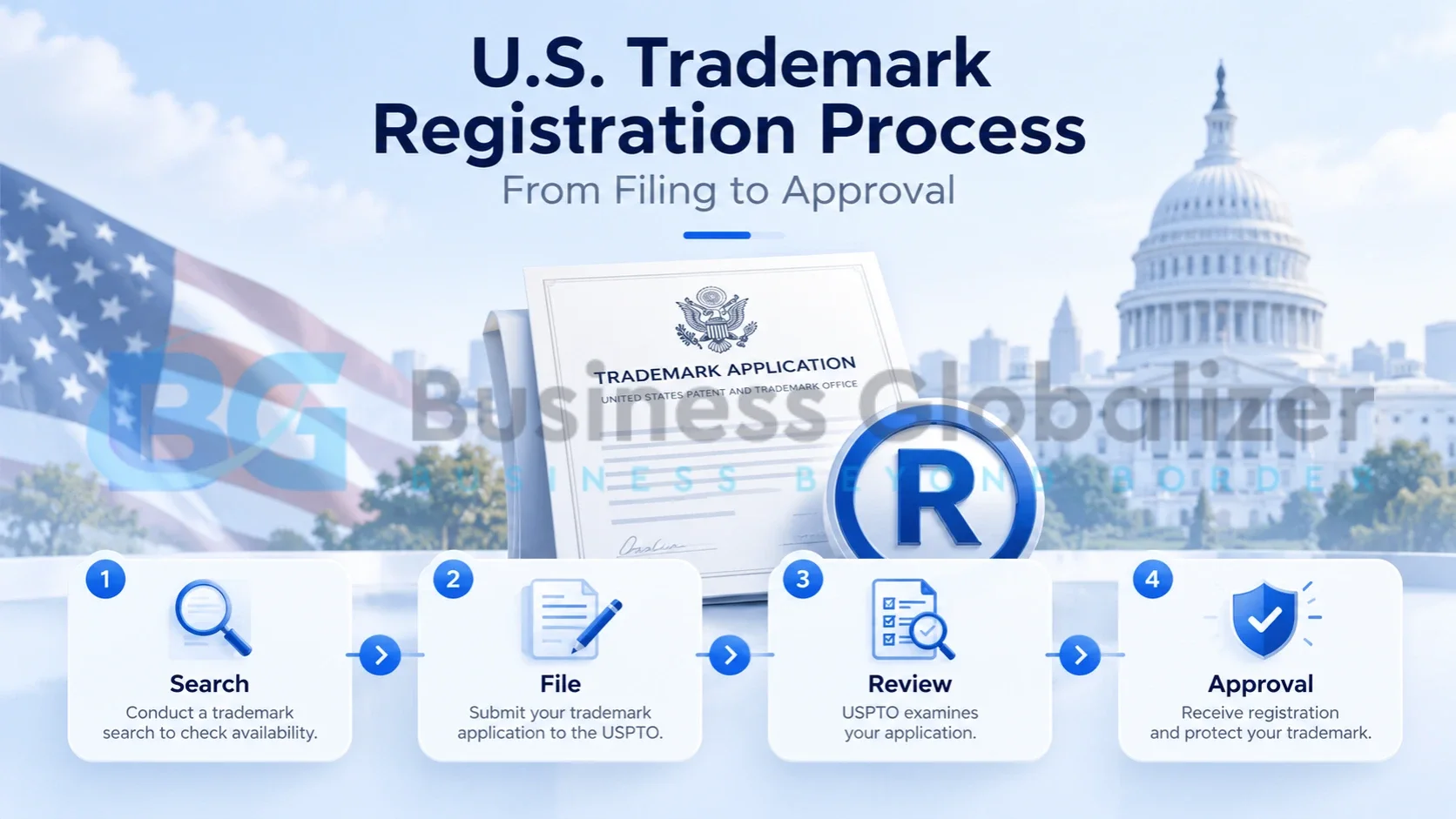
How to Register a US Trademark for Non-Residents: Step by Step
Now that the eligibility question is settled, let’s turn it into an actual filing plan.
- Confirm Who Owns the Trademark
Start with ownership, not the logo.
The applicant must be the individual or legal entity that owns the mark. For a company, use its full legal name, entity type, and country or state of organisation. For an individual, provide the required personal and citizenship details.
The USPTO requires the applicant’s name, domicile address, legal entity, citizenship or place of organisation, filing basis, verified statement, and a fee per class.
Do not list a newly formed U.S. company unless it truly owns the rights.
- Appoint a Qualified U.S.-Licensed Attorney
A foreign-domiciled applicant must appoint a U.S.-licensed attorney to act before the USPTO.
The attorney must hold a valid license and be in good standing within a U.S. jurisdiction. A foreign lawyer or filing service cannot replace this requirement unless properly U.S.-licensed. This is not a formality; the attorney should actively review and manage the application.
- Search for Conflicting Trademarks
Before filing, search the USPTO Trademark Database. Look beyond identical names. Conflicts may include:
- Similar spelling or sound
- Related meaning or impression
- Similar goods or services
The USPTO will still conduct its own search, so this step only helps reduce obvious risks.
- Decide What You Want to Protect
You may apply for:
- Brand name
- Slogan or phrase
- Logo or design
- Stylised wording
When learning how to trademark a phrase, check if it clearly identifies your business rather than acting as general marketing language.
Word marks and logos can be filed separately if both are important, though each requires its own application.
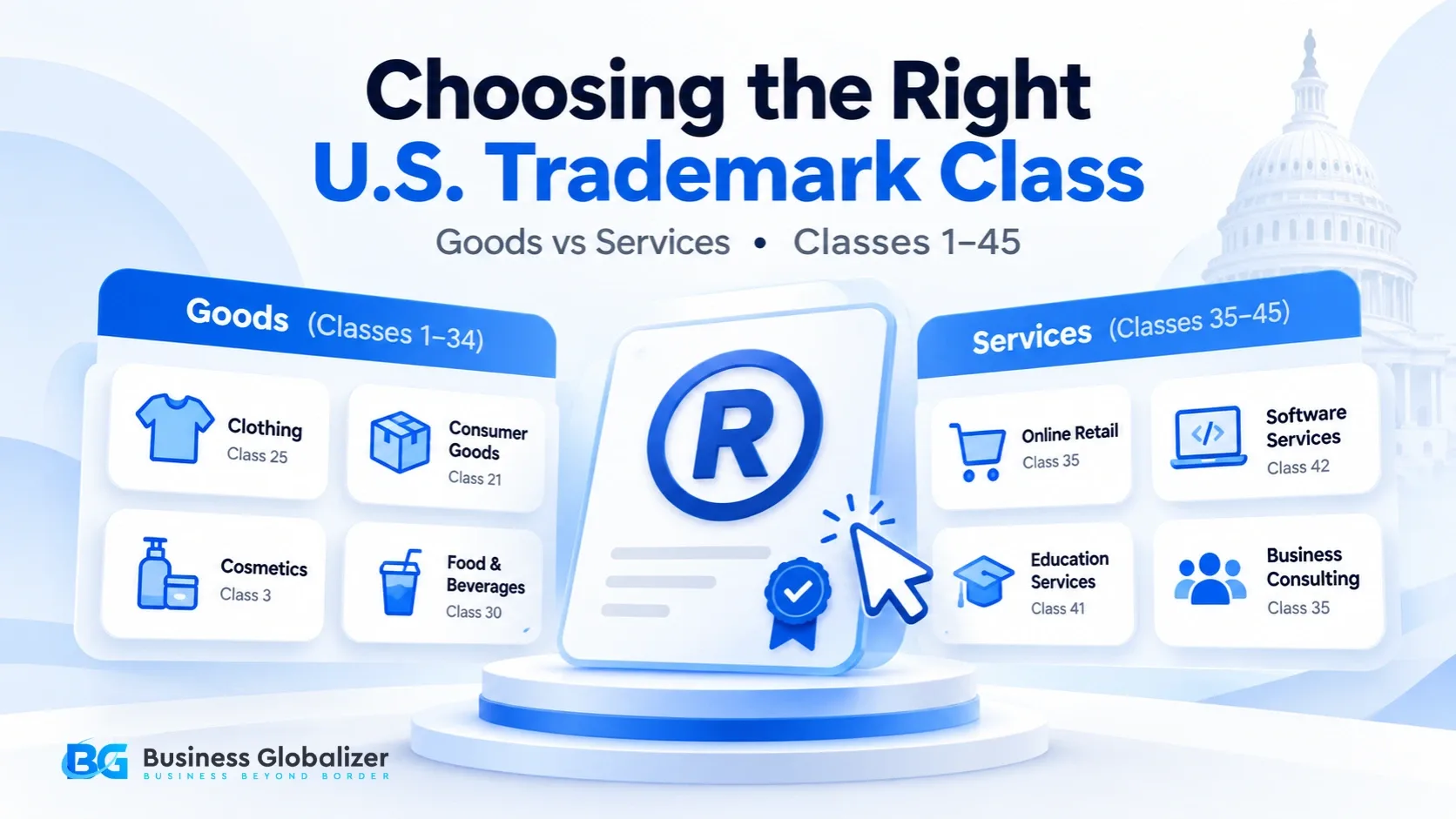
- Identify Goods, Services, and Classes
It is required that your application specifies the particular products or services linked to the trademark. These fall into trademark classes, and each class has a separate fee. The base filing fee is $350 per class. Extra costs may apply depending on the filing and later requirements. Attorney fees are separate.
Be precise; too narrow limits protection, too broad can cause refusals.
- Choose the Correct Filing Basis
The filing basis explains your legal right to apply:
- Use in commerce: The mark is already being used within the U.S.
- Intent to use: Planning to use it soon
- Foreign application: Based on an earlier foreign filing
- Foreign registration: Based on a home-country registration
- Madrid Protocol: International registration route
Each basis has different evidence and deadlines, and the USPTO treats them separately.
- Prepare and File the Application
The application is submitted by your attorney through the USPTO Trademark Center. Typical materials include:
- Owner and domicile details
- Attorney information
- Mark drawing
- Goods/services and classes
- Filing basis
- Specimen (if required)
- Dates of use
- Declarations
- Fees
Errors or missing details can delay filing or trigger an Office Action.
- Follow USPTO Examination
Once filed, the USPTO assigns a serial number and an examining attorney. They review legal requirements, search for conflicts, and check all documents. If issues arise, they issue a Trademark Office Action.
Most responses are due within three months, with a possible paid extension. Madrid filings usually allow six months without extension. If approved, the application moves to publication, where others may oppose registration.
Expert Note: Trademark filings can become complex and error-prone, especially for non-residents, where small mistakes may lead to delays or refusals. Working with experienced professionals like BG helps ensure accurate filing, proper classification, and smooth USPTO communication for a more efficient approval process.
Common Mistakes Non-Resident Applicants Should Avoid
A non resident trademark application in the U.S. can go off track for reasons that have little to do with nationality.
Common mistakes include:
- Listing the wrong individual or company as owner.
- Using a registered-agent address, virtual office, or P.O. box as a false domicile.
- Hiring a filing service that is not authorized to practise U.S. law.
- Searching only for exact trademark matches.
- Selecting the wrong filing basis.
- Filing goods or services that do not match the business.
- Submitting a specimen that does not show genuine trademark use.
- Assuming a U.S. LLC removes the attorney requirement.
- Missing a USPTO deadline.
- Believing registration is permanent without maintenance filings.
The USPTO has specifically reported enforcement action involving fake U.S. addresses and misuse of attorney credentials, so treating domicile and representation casually can put the entire application at risk.
The safest approach is simple: tell the truth about where the owner is based, identify the real trademark owner, and build the filing around the business as it actually operates.
How Can Business Globalizer Help?
Registering a trademark from another country brings a few extra questions into the room. Who should own the mark? Does the applicant need a U.S. company? Which filing basis fits? And who will deal with the USPTO if an issue comes up?
Business Globalizer helps non-U.S. founders understand the practical side of preparing a U.S. trademark application, including:
- Reviewing the proposed owner and business structure
- Coordinating trademark search and filing support
- Identifying goods, services, and relevant classes
- Preparing the required business and application information
- Connecting the applicant with qualified U.S. trademark counsel
- Supporting U.S. company formation when it serves the wider business plan
- Assisting with EIN services, ITIN application support through our IRS Certified Acceptance Agent (CAA), tax guidance, and ongoing compliance services
- Providing DUNS number support for business credibility and verification needs
- Assisting with e-commerce business registration for founders building online operations in the U.S.
Because a foreign-domiciled applicant must be represented before the USPTO by a U.S.-licensed attorney, proper legal involvement cannot be replaced by an ordinary filing service.
The goal is not to make promises about approval. It is to help the applicant begin with accurate ownership, a sensible filing strategy, and fewer avoidable mistakes. So, reach out today to start with proper clarification.
Closing Thoughts
That founder in Dhaka, Dubai, London, or Lagos does not need to relocate to the United States to protect a brand there. What matters is structure.
Understanding the concept of “how to register a U.S. trademark for non-residents” comes down to confirming the true owner, correctly stating domicile, selecting the right goods and services, and working with qualified U.S. counsel for USPTO steps.
Filing from abroad is allowed but does not lower legal standards and often requires more careful preparation to avoid refusals or delays. After filing, the process continues: monitor the application, meet deadlines, and maintain the registration through continued use and required filings.
To put it simply, achieving success relies on securing three core elements: true ownership, precise accuracy, and sustained long-term compliance.
Key Insights
- U.S. citizenship, residency, or a U.S.-registered company is not a general prerequisite for owning a federal trademark registration.
- A foreign domiciled applicant trademark filing must generally be handled before the USPTO by a qualified U.S.-licensed attorney.
- Non-residents may apply directly to the USPTO or, when eligible, seek protection in the United States through the Madrid Protocol.
- The correct applicant must be the person or legal entity that genuinely owns the trademark.
- Applicants must identify their domicile, goods or services, filing basis, trademark classes, and the exact mark they want to register.
- A search of the federal Trademark Database should happen before filing, but an exact-match search alone is not enough.
- Registering a company in the United States does not automatically remove the attorney requirement if the company’s true principal place of business remains outside the country.
- A U.S. trademark registration does not automatically protect the brand worldwide.
FAQs on US Trademark for Non-Residents
Can a foreigner register a trademark in the United States?
Answer: Yes. A foreign individual or company can own and apply for a U.S. trademark. U.S. citizenship or residency is not required. However, applicants domiciled outside the U.S. must generally be represented by a U.S.-licensed attorney before the USPTO.
Is a U.S. company required for a foreign applicant trademark USA filing?
Answer: No. A foreign individual or company can own a foreign applicant trademark USA filing. The owner must be the true trademark owner. A U.S. company is optional and only needed for broader business reasons, not for filing itself.
Can I register a US trademark from outside the U.S. without travelling there?
Answer: Yes. You can register a U.S. trademark from outside US without travelling. The process is fully online. A foreign-domiciled applicant must appoint a U.S.-licensed attorney to handle USPTO matters.
Does every foreign domiciled applicant trademark filing need an attorney?
Answer: Generally, yes. A foreign domiciled applicant trademark filing requires a U.S.-licensed attorney. For Madrid Protocol cases, the U.S. attorney becomes necessary when responding to USPTO refusals or making official submissions.
What is the requirement of a U.S.-licensed trademark attorney?
Answer: This requirement means foreign-domiciled applicants and related parties must use a qualified U.S.-licensed attorney for USPTO trademark matters. The attorney must be active and in good standing with a U.S. bar.
How much does a non resident trademark application in the U.S. cost?
Answer: A non resident trademark USA application has a USPTO base fee of $350 per class. Additional fees may apply for intent-to-use filings, extensions, custom descriptions, maintenance, or later actions. Attorney fees are separate.
Can a non-resident apply before using the trademark in the United States?
Answer: Yes. An applicant with a real intent to use the mark in U.S. commerce may file on an intent-to-use basis. Registration is issued only after proof of use and required fees are submitted. Other filing bases may include a foreign application, foreign registration, or the Madrid Protocol.
How long does a U.S. trademark last for a non-resident?
Answer: A U.S. trademark can last indefinitely if properly maintained and used in commerce. For most registrations, maintenance filings are due between years 5–6, 9–10, and every 10 years after that. Madrid-based registrations follow different rules.