Quick Answer
US Trademark Classes are categories used by the USPTO to organize goods and services. Choosing the correct class ensures your trademark protects the products or services your business actually offers.
Imagine two businesses using exactly the same brand name. One sells coffee. The other develops accounting software. Surprisingly, both businesses might legally coexist because they operate in completely different trademark classes.
That is where many founders first discover US Trademark Classes, especially when going through the process of U.S. Trademark registration.
A trademark is not registered in a vacuum. It is registered for specific goods or services. Choosing the right class is just as important as choosing the right brand name. File under the wrong class, and even a strong trademark application can become more complicated than it needs to be.
Let’s break it down in simpler words.
What Are US Trademark Classes?
The USPTO organizes trademarks using a classification system for goods and services. Instead of reviewing every trademark as if it covers every possible business, the USPTO asks a simple question:
“What does this business actually sell or provide?”
The answer determines the trademark class.
Every application is connected to one or more classes based on the products or services identified in the application. Think of trademark classes as folders. The trademark goes into the folder that best matches the business activity it protects.
If you’re new to trademarks, it’s worth understanding the basics of U.S. Trademark protection before diving into classes. Trademark classes decide the scope of protection; they don’t replace the trademark itself.
Trademark Classes Explained: Goods vs Services
One of the easiest ways to understand USPTO trademark classes is to divide them into two groups.
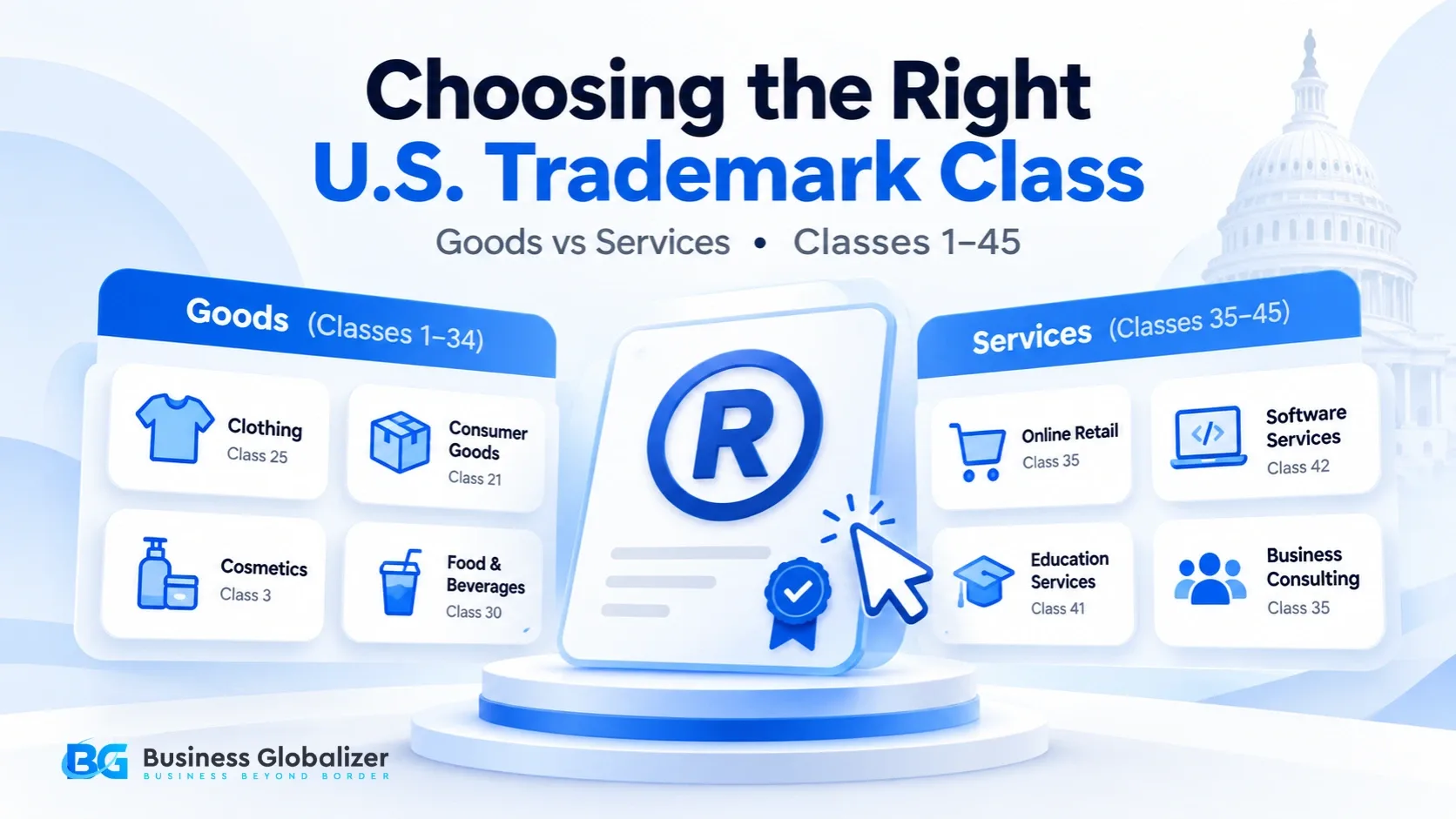
Goods Classes (Classes 1–34)
Goods are physical products. If your business manufactures, sells, or distributes products, your trademark will usually fall within one or more of these classes.
Examples include:
- Clothing
- Cosmetics
- Software sold as a product
- Furniture
- Food products
- Medical devices
- Electronics
The exact class depends on the type of product rather than the industry itself.
Service Classes (Classes 35–45)
Services involve work performed for customers rather than physical products. Examples include:
- Marketing services
- Accounting services
- Restaurant services
- Legal services
- Education
- Software as a Service (SaaS)
- Financial services
Even if two companies share a similar name, they may qualify for registration if they operate in very different classes and there is little chance of customer confusion.
Goods Classes 1–34 vs Service Classes 35–45
Instead of memorizing all 45 classes, start with this simple comparison.
| Category | Trademark Classes | Covers |
| Goods | Classes 1–34 | Physical products |
| Services | Classes 35–45 | Services performed for customers |
This comparison answers one of the first questions the USPTO asks during the application process.
Common Examples of US Trademark Classes
Here are a few common examples.
| Business | Typical Trademark Class* |
| Clothing brand | Class 25 |
| Cosmetics | Class 3 |
| Computer software | Class 9 |
| Advertising agency | Class 35 |
| Restaurant | Class 43 |
| Educational services | Class 41 |
| Legal services | Class 45 |
*These are common examples only. The appropriate class always depends on the specific goods or services described in the application.
Why Trademark Classes Matter
Choosing the correct class affects much more than paperwork. It determines:
- What products or services receive protection.
- Which existing trademarks the USPTO compares your application against.
- How much your filing may cost.
- Whether future expansion might require additional filings.
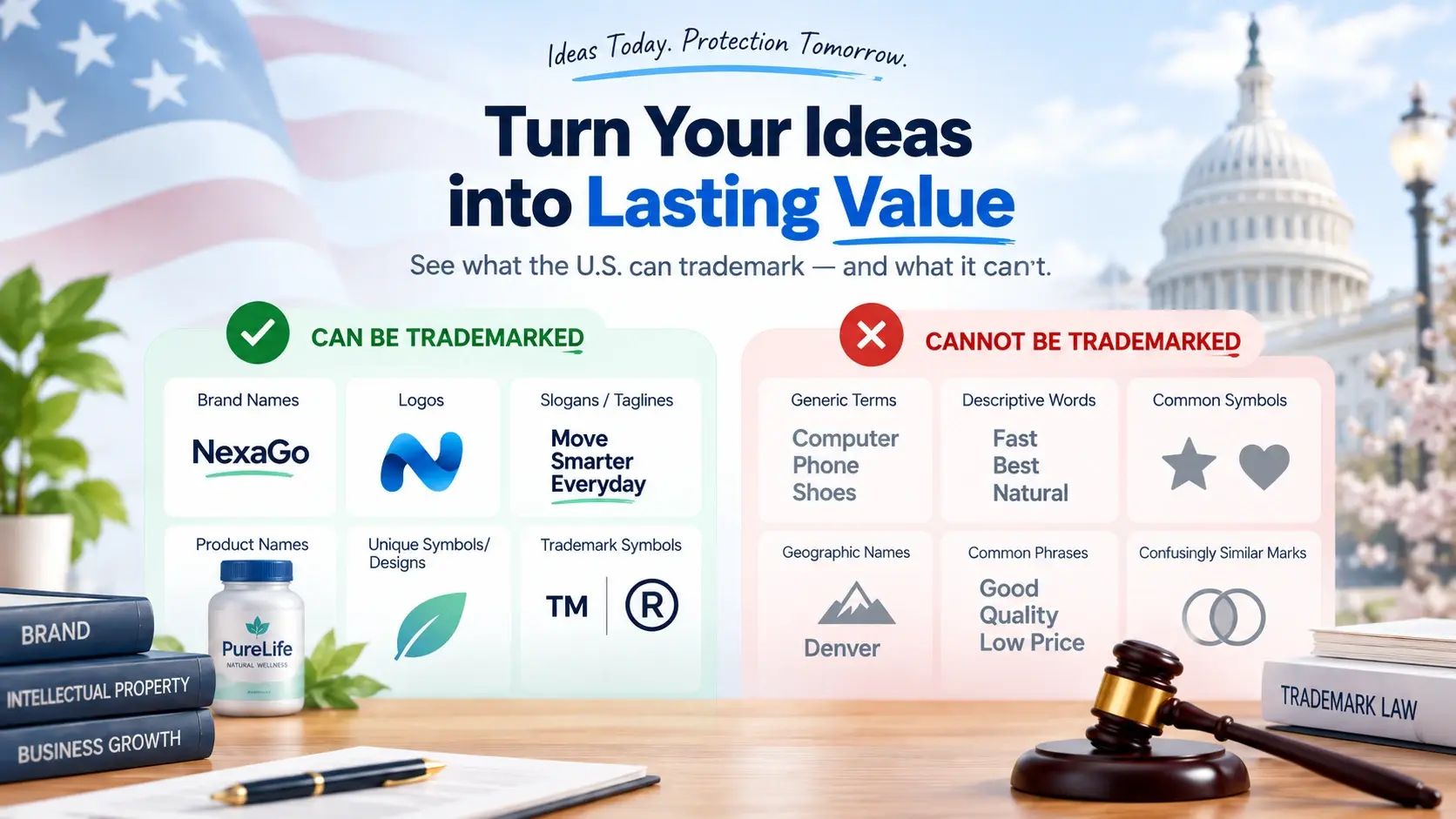
However, before focusing on classes, verify that your brand itself qualifies for legal protection. That’s why grasping what can be trademarked in the U.S. and what cannot be is quite mandatory before selecting a class.
How to Choose Trademark Class
Choosing the right class starts with one honest question:
What are you actually selling or providing under the mark?
Not what you might sell someday. Not what sounds more impressive. What the mark is actually connected to.
A clothing brand selling T-shirts may belong in one class. A company offering marketing services belongs in another. A software company may fall into a different class depending on whether it sells downloadable software or provides online software services. This is why guessing the class is risky.
A good class selection should consider:
- What the business currently sells or provides.
- How customers receive the product or service.
- Whether the mark is used for goods, services, or both.
- Whether future expansion needs a separate filing later.
- Whether the goods or services are described clearly enough for USPTO review.
Choosing the right trademark class is not about picking the broadest category. It is about choosing the most accurate category.
How to Choose Trademark Class by Business Type
Let’s make this more practical.
| Business Type | Possible Class Direction |
| Clothing brand | Usually goods, often Class 25 |
| Cosmetics brand | Usually goods, often Class 3 |
| Food product brand | Usually goods, depending on product type |
| Restaurant | Usually services, often Class 43 |
| Advertising or marketing agency | Usually services, often Class 35 |
| Online education provider | Usually services, often Class 41 |
| Downloadable software | Usually goods, often Class 9 |
| SaaS platform | Usually services, often Class 42 |
| Legal services | Usually services, often Class 45 |
These are examples, not final answers.
The correct class depends on the exact goods or services listed in the application. Two businesses in the same general industry can still need different classes if their offerings are different.
Why Goods and Services Descriptions Matter
The trademark class is only part of the filing. The goods or services description matters just as much. For example, saying “clothing” may be too broad depending on the filing context. Saying “T-shirts, hoodies, and caps” may give a clearer picture of what the mark actually covers.
Your trademark is evaluated by the USPTO against existing marks based on the specific goods or services detailed in your application. So if the description is vague, inaccurate, or too broad, it can cause delays or objections.
A clean description helps the application say exactly what protection you are asking for.
Multiple Class Trademark Application Explained
Sometimes one class is not enough. A multiple-class trademark application is used when one mark covers goods or services in more than one class.
For example:
- A brand sells skincare products and also offers beauty training services.
- A software company provides downloadable software and online SaaS access.
- A clothing brand sells apparel and also operates a retail store.
- A restaurant sells packaged food products and provides restaurant services.
In these cases, one trademark may need more than one class because the business is using the mark in different ways. That does not mean every business should file in several classes. More classes can mean more cost and more complexity.
The smarter question is:
Which goods or services do you actually need protected right now?
Trademark Cost Per Class
Trademark filing fees are usually charged per class. That means if you file in one class, you pay for one class. If you file in two classes, you generally pay for two. If you file in three, the cost increases again.
This is why class selection affects budget. A multiple-class trademark application may be necessary for some brands, but filing in extra classes “just in case” can waste money and create unnecessary filing pressure.
A practical approach is to match your filing to your actual business activity and realistic near-term plans.
Should You File in Extra Classes for Future Products?
Sometimes founders want to file broadly because they may expand later. That sounds logical, but trademark filings are not meant to cover imaginary business ideas with no real use or intent.
When filing an application based on actual use, you must demonstrate proper usage of the mark for the specific goods or services listed. If you are filing based on intent to use, you need a real intention to use the mark for those goods or services.
So yes, future plans matter. But they should be real plans, not random possibilities.
How Trademark Classes Fit into the US Trademark Registration Process
Trademark classes are one part of the larger filing process. Before choosing a class, make sure the mark itself is protectable. After choosing the class, the goods or services must be written correctly in the application.
This is why class selection connects directly with the U.S. trademark registration process. A good application is not just about having a strong name. It is about matching the right mark with the right owner, the right goods or services, and the right class.
Common Class Selection Mistakes & How to Avoid Them
Here are a few mistakes founders often make, along with how to avoid them:
- Choosing a class based only on the business industry, not the actual goods or services.
To prevent this mistake, focus on the specific items or services you actually offer under the trademark rather than relying strictly on a broad industry label.
- Filing in too many classes without a real need.
Avoid this by limiting your filing to goods or services you currently offer or have a clear, near-term plan to launch.
- Filing in too few classes and leaving important services uncovered.
Avoid this by reviewing all core offerings tied to the mark and making sure each one is properly represented.
- Confusing downloadable software with SaaS services.
Avoid this by identifying how users access your product: downloaded software and online services often fall into different classes.
- Treating retail services and product sales as the same thing.
Avoid this by recognizing that selling products and operating a retail service can require separate class considerations.
- Assuming one class protects the brand for every future business idea.
Avoid this by understanding that trademark protection is tied to specific goods or services, not unlimited future expansion.
- Forgetting that more classes usually mean more fees.
Avoid this by balancing protection needs with budget and filing only where it makes practical sense.
Business Globalizer: Helping You Choose the Right Trademark Class
One of the most common reasons trademark applications run into problems isn’t the brand name. It’s the application itself. Choosing the wrong class, describing goods or services too broadly, or filing in unnecessary classes can slow the process and increase costs.
At Business Globalizer, we help founders understand the U.S. Trademark Registration Process. We are beside you during every phase of the process, from verifying if your name, logo, or slogan is prepared for the USPTO to directing you through brand searches and the official application. We also provide hands-on support for setting up your U.S. company, registering your e-commerce business, and handling essentials like ITIN, EIN, and DUNS numbers. Plus, we offer guidance on U.S. taxes and compliance for entrepreneurs looking to grow their reach in the States.
Our goal is simple: we want founders to file with confidence and bypass those common mistakes that are so much easier to prevent than they are to fix later on.
Closing Thoughts
A trademark class might look like a small detail on an application. It isn’t.
The class determines what your registration actually protects. Choose it carefully, and your trademark works alongside your business. Choose it poorly, and you may end up paying more, filing again, or leaving part of your brand unprotected.
That’s why understanding US Trademark Classes is about more than memorizing class numbers. It’s about matching your trademark to the products or services that matter most to your business today, while keeping one eye on where you’re heading tomorrow.
A well-chosen class won’t guarantee registration, but it gives your application a much stronger foundation.
Key Insights
- US Trademark Classes organize goods and services for trademark registration.
- The USPTO follows 45 international trademark classes.
- Classes 1–34 cover goods, while Classes 35–45 cover services.
- Choosing the wrong class can delay or weaken your trademark application.
- A business may need more than one trademark class depending on what it sells.
- Every additional class usually requires an additional government filing fee.
- A multiple-class trademark application can simplify filing when one brand covers different products or services.
- Trademark classes do not determine whether a mark is registrable; they determine what the registration protects.
- A careful review of your current and planned business activities helps you choose the correct class.
- Filing in unnecessary classes increases costs without adding meaningful protection.
FAQs on US Trademark Classes
What are US Trademark Classes?
Answer: US Trademark Classes are categories used by the USPTO to organize goods and services. Every trademark application is filed in one or more classes depending on what the business sells or provides.
How are USPTO trademark classes divided?
Answer: USPTO trademark classes are divided into 45 international classes:
- Classes 1–34 cover goods.
- Classes 35–45 cover services.
This system helps determine what products or services a trademark registration protects.
How to choose a trademark class?
Answer: The best way to choose a trademark class is to identify the actual goods or services offered under the trademark. Rather than simply reflecting the general industry of your business, the trademark class must align directly with the specific way customers receive your products or services.
What are goods classes 1–34?
Answer: Goods classes 1–34 cover physical products such as clothing, cosmetics, electronics, food products, furniture, medical devices, and many other manufactured goods.
What are service classes 35–45?
Answer: Service classes 35–45 cover services rather than physical products, including advertising, education, restaurants, legal services, financial services, software services, and many other business activities.
What is a multiple-class trademark application?
Answer: A multiple-class trademark application allows one trademark application to cover more than one trademark class when the same mark is used for different goods or services.
Does every trademark need more than one class?
Answer: No. Many businesses only need one class. Applying for multiple classes is typically only relevant when a single trademark is legitimately used for various categories of products or services.
How does trademark cost per class work?
Answer: The USPTO generally charges filing fees per class. Adding more classes usually means paying additional government fees, so businesses should file only in the classes that genuinely reflect their products or services.
Can I change my trademark class after filing?
Answer: Some application details can be amended during examination, but changing the scope of goods or services is limited. Choosing the correct class before filing is usually much easier than trying to correct it later.
Do trademark classes protect my business in every industry?
Answer: No. Trademark protection is connected to the goods or services listed in the application. Registering a mark in one class does not automatically give protection across every product category or industry.