Some businesses reach a point where simply forming a UK company (e.g., a private limited company Ltd) starts feeling a bit too small for the ambition. Maybe the company needs serious investment. Maybe the founders want public credibility. Maybe the next step is raising money from a much wider pool of investors.
That’s where a public limited company enters the conversation.
But here’s the thing: a PLC is not just a private company with a louder name. It comes with heavier rules, more public attention, more shareholder pressure, and a much bigger compliance load.
So, let’s talk about Public Limited Company advantages and disadvantages in very simple and easier terms: what it means, when it makes sense, and when it might be too much too soon.
Key Insights
- A public limited company is built for businesses that are ready for bigger funding, wider ownership, and heavier responsibility.
- The biggest advantage of a PLC is access to public capital, which can support expansion, acquisitions, and long-term growth.
- A PLC can be listed or unlisted, so public company status does not always mean stock exchange trading.
- Shareholders usually get limited liability, but directors still have serious legal and compliance duties.
- Public credibility can help a PLC gain trust from investors, banks, suppliers, and major business partners.
- More shareholders can bring more money into the business, but it can also reduce founder control.
- A PLC usually costs more to run because of audits, reporting, legal support, and governance requirements.
- Public scrutiny is part of the trade-off, especially when performance, shareholder decisions, and company actions are visible.
- A PLC may be too heavy for small or early-stage businesses that do not need public investment yet.
- The real decision is simple: a PLC gives your business a bigger stage, but that stage comes with brighter lights.
What Is a Public Limited Company?
A public limited company, usually written as PLC or plc, is a limited company that can offer its shares to the public. In the UK, it normally includes “public limited company” or “PLC” in its name. A PLC can be listed on a stock exchange, but being listed is not required for it to legally operate as a PLC.
Put simply, it’s a company structure designed for raising larger amounts of funding, bringing in more shareholders, and building stronger public credibility.
A PLC is still a separate legal entity, just like other UK limited company structures. It can own assets, sign contracts, borrow money, pay taxes, and continue even if shareholders change.
The major difference?
A PLC can raise money from the public by selling shares, while a private limited company cannot offer shares to the general public.
Types of Public Limited Company
Not every PLC looks the same from the outside. In the UK, you’ll usually hear about two practical types:
Listed Public Limited Company
This is the one most people think of first.
A listed PLC has its shares traded on a stock exchange, such as the London Stock Exchange. This means public investors can buy and sell shares through the market. This structure suits larger companies that want serious capital, public visibility, and market-based share liquidity.
Unlisted Public Limited Company
This one surprises people.
A company can be a PLC even if it isn’t listed on a stock exchange. It still holds public limited company status, but its shares aren’t traded publicly. This can suit businesses that want PLC status, wider shareholding options, or a more formal company setup without going all the way to a listed-company structure.
Simple way to remember it:
- Listed PLC = shares traded on a stock exchange
- Unlisted PLC = public company status, but not exchange-traded
Public Limited Company Examples
When people hear “PLC,” they often imagine large, household-name businesses, and honestly, that’s usually fair.
Common public limited company examples include:
- BP p.l.c.
- Shell plc
- Tesco PLC
- Barclays PLC
- Vodafone Group Plc
- Unilever PLC
But the concept is bigger than famous names. A PLC is simply a legal structure. Some are giants. Some are smaller public companies. Some are listed. Some are not.
The key point is that PLC status is designed for businesses ready for broader ownership and heavier accountability.
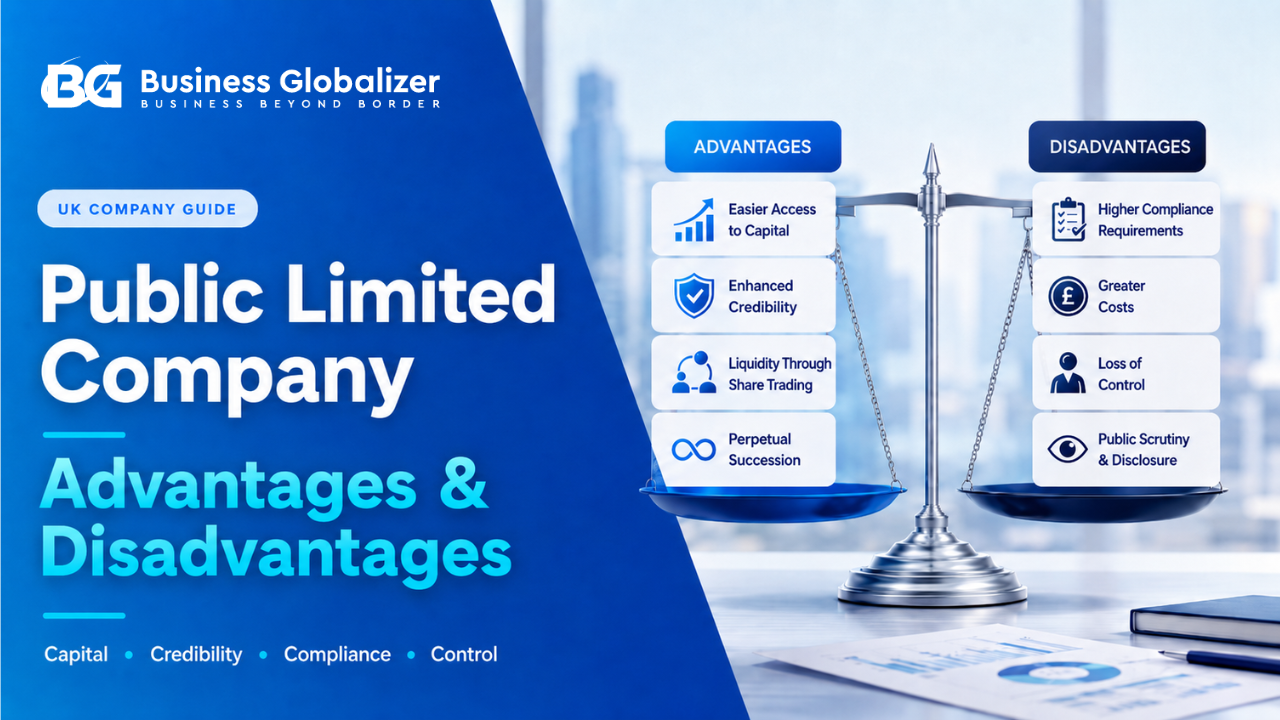
Public Limited Company Advantages and Disadvantages
A PLC can open doors that a private company simply cannot. But those doors come with locks, cameras, paperwork, and people watching.
So before we call a PLC “better,” let’s look at both sides properly.
Advantages of Public Limited Company
Here’s where the PLC structure starts looking powerful.
- Easier Access to Large Capital
This is the headline benefit.
A PLC can raise money by offering shares to the public. That gives the company access to a much larger funding pool than a private company usually has.
This can help with:
- Expansion
- New product lines
- Acquisitions
- Debt reduction
- Large infrastructure or technology investment
For businesses with big growth plans, this is one of the strongest advantages of public limited company status.
- Stronger Public Credibility
A PLC often looks more established to investors, banks, suppliers, and large corporate partners. Why? Because PLCs usually face more regulation, reporting, governance, and shareholder accountability. That public structure can create trust.
Of course, credibility is not automatic. A poorly run PLC can still lose confidence fast. But the structure itself carries weight.
- Share Liquidity for Investors
In a listed PLC, shareholders can usually sell their shares more easily than shareholders in a private company. That makes the company more attractive to investors because they are not locked in forever.
From an investor’s point of view, liquidity matters.
From a company’s point of view, investor interest matters too.
- Better Growth and Acquisition Options
A PLC can use shares as part of business deals. For example, it may issue shares to raise funds or use shares in acquisition arrangements. That gives the company more financial tools than a small private company usually has.
For ambitious companies, this flexibility can support faster growth.
- Business Continuity and Wider Ownership
A PLC does not depend on one founder or a small group of owners. Shareholders can change, directors can change, and the company can continue operating. That makes PLCs suitable for businesses that want to outgrow their original founding team and operate with a long-term institutional structure.
Disadvantages of Public Limited Company
Now the part founders need to take seriously.
- More Rules and Compliance
A PLC carries heavier legal and compliance obligations than a private limited company.
In the UK, a PLC must meet higher capital requirements before trading. Public limited companies must have at least £50,000 allotted share capital, with at least a quarter paid up before they can start business.
That alone makes a PLC unsuitable for many small businesses. On top of that, there are stricter reporting, governance, audit, and shareholder rules.
- Higher Running Costs
A PLC is more expensive to run. You may need:
- More advanced accounting support
- Auditors
- Legal advisers
- Company secretarial support
- Investor relations support
- Public reporting systems
This is one of the biggest disadvantages of a PLC for smaller founders. The structure may look impressive, but the maintenance costs are not light.
- Less Control for Founders
When more people own shares, more people have a voice.
That can be healthy. It can also be frustrating.
Founders may face pressure from shareholders who care more about short-term returns than long-term vision. In listed companies, market expectations can influence decisions heavily.
So yes, you may raise more money. But you may also lose some freedom.
- More Public Scrutiny
A PLC lives under a brighter light. Financial results, shareholder decisions, director actions, governance issues, and market performance can all attract attention.
For some businesses, that transparency builds trust.
For others, it becomes a constant pressure.
If you prefer privacy and quiet decision-making, PLC life may feel uncomfortable.
- Risk of Takeover Pressure
Because PLC shares can be widely held and traded, listed public companies can become vulnerable to takeover attempts. This does not mean every PLC is constantly under attack. But public ownership can make control more complicated than in a private company.
That’s one of the trade-offs: easier share transfer can also mean less control over who ends up owning a major stake.
Public Limited Company Advantages and Disadvantages: Quick Table
| Advantages of PLC | Disadvantages of PLC |
| Can raise significant capital by selling shares to the public. | More regulation, reporting, audit, and governance obligations. |
| Often carries stronger credibility with banks, investors, and major partners. | Higher setup and running costs compared with private companies. |
| Listed PLC shares can be easier for investors to buy and sell. | Founders may lose some control as more shareholders come in. |
| Can support major expansion, acquisitions, and long-term growth plans. | Public scrutiny can create pressure around performance and decisions. |
| The company continues even as shareholders and directors change. | Listed PLCs may face market pressure or takeover risk. |
| Wider ownership can make fundraising easier than in a private company. | The structure is usually too heavy for small or early-stage businesses. |
When a Public Limited Company Makes Sense, And When It Doesn’t
So, should a business become a PLC? Not automatically.
A PLC makes sense when the business is already mature enough to handle public-level responsibility. It may be a strong choice when the company needs major capital, has a clear growth plan, and can afford the compliance load.
Choose a public limited company if:
- You want to raise large-scale public investment
- You are preparing for a stock market listing
- You need stronger institutional credibility
- Your company has mature governance and accounts
You can manage public reporting and shareholder pressure
Think twice if:
- You are still testing the business model
- You want simple ownership and low admin
- You are not ready for audits and formal governance
- You want to keep control tightly with founders
- Your company does not need public capital yet
That’s really the balance: more capital and credibility on one side, more exposure and responsibility on the other.
Business Globalizer: Helping Founders Pick the Right UK Structure
A PLC is not something to choose just because it sounds bigger.
At Business Globalizer, we help founders with UK company formation, structure selection, registered office support, annual filings, tax guidance, company restoration, dissolution, and compliance help.
So if you’re deciding between a private limited company and a public limited company, we help you choose the one that makes the most sense for your stage, risk level, and growth goals. The right structure should support your business, not bury it in paperwork before it’s ready.
Closing Thoughts
Choosing between a private company and a PLC is not just a name decision. It shapes how you raise money, how much control you keep, how much you report, and how many people you answer to.
That’s why knowing the advantages and disadvantages of a public limited company matters before moving forward. A PLC can give your business a bigger stage. More capital. More credibility. More room to grow.
But bigger stages come with brighter lights.
If your company is ready for public investment and serious governance, becoming a PLC can be a strong move. If not, staying private may be the smarter, cleaner choice for now.
FAQ
- What is a PLC in the UK?
Answer: A PLC is a public limited company. It is a UK company structure that can offer shares to the public and may be listed on a stock exchange.
- What is a public limited company in simple words?
Answer: A public limited company is a business that can raise money from public investors by selling shares. It has limited liability, but also heavier rules than a private company.
- What are some public limited company examples?
Answer: Common public limited company examples include BP, Shell, Tesco, Barclays, Vodafone, and Unilever.
- What are the main advantages of public limited company status?
Answer: The main advantages are access to public capital, stronger credibility, share liquidity, growth funding, and long-term business continuity.
- What are the main disadvantages of a PLC?
Answer: The main disadvantages are higher costs, more regulation, less privacy, shareholder pressure, and possible loss of founder control.
- Is a PLC better than a private limited company in the UK?
Answer: Not always. A PLC is better for larger companies needing public capital. A private limited company is usually better for small businesses and early-stage founders.
- Can a PLC be privately owned?
Answer: Yes. A PLC can be unlisted and privately held, but it still has public company status and must meet PLC requirements.
- Does every PLC have to be listed on a stock exchange?
Answer: No. A PLC can be listed or unlisted. The key legal point is that it has public company status and can offer shares to the public.