Quick Answer
There is no universal best state. For nonresidents, the best state depends on your operating plan, banking, insurance, signatory support, taxes, and vendor requirements.
Choosing a state for a normal online LLC is already confusing. Choosing one for a property preservation business is a different little puzzle. You are not just forming a company and calling it a day. This business may need insurance, U.S. physical banking, check-deposit capability, background checks, vendor paperwork, and an authorized signatory in the U.S. who can support banking, documentation, or other business requirements.
That is why the best state for property preservation business setup is not always the state with the lowest filing fee or the nicest YouTube reputation. For a nonresident, the smarter question is: “Which state fits how this business will actually work?” Let’s break that down without turning it into a legal maze.
Why State Selection Matters for a Nonresident Property Preservation Business
A property preservation business usually works with vacant, abandoned, foreclosed, or REO-type properties. The work can include inspections, securing properties, lawn care, debris removal, winterization, repairs, and basic upkeep.
That means the business is tied to real property and real field activity. Even if the owner is outside the U.S., the work happens somewhere in the U.S.
State selection matters because it may affect:
- LLC formation cost
- Annual state compliance
- State tax treatment
- Registered agent needs
- U.S. business banking with check-deposit support
- Insurance underwriting
- Whether foreign registration is needed
- Vendor or client expectations
- Whether a U.S.-based authorized signatory is needed for practical business support
- Whether the company can maintain a workable U.S. operating structure
Business registration, taxes, licenses, and permits can depend on your business structure and location. So the state is not just a name on the Articles of Organization. It can shape the whole setup.
Formation State vs. Operating State
This is the part many nonresident founders miss. Your formation state is where you create the LLC. Your operating state is where the business actually conducts work or has business activity.
For example:
| Scenario | What It Means |
| You form in Wyoming and only coordinate remotely | Wyoming may be the formation state, but operating-state duties still depend on where work happens |
| You form in Florida and your field work is in Florida | Florida may be both formation and operating state |
| You form in Delaware but work in Texas | Delaware is the formation state, but Texas registration or tax rules may still matter |
| You operate across multiple states | You may need to review each state where real work, contractors, or business activity exists |
Several states require foreign entities to register before transacting business there. Texas, for example, says a foreign entity must register with the Secretary of State to transact business in Texas. California also states that domestic and foreign LLCs doing business in California are required to register with the California Secretary of State.
So forming in a “cheap” state does not automatically avoid the rules of the state where the business operates. Nice try, internet. The states thought of that one.
The “Tax-Free State” Question
Many nonresident founders ask about tax-free states. It is a fair question. Nobody wants to pay extra tax just for fun.
But “tax-free” can be misleading. A state with no individual income tax may still have:
- LLC annual fees
- Franchise tax
- Gross receipts tax
- Business license requirements
- Registered agent costs
- Foreign registration fees
- State-level reporting
- Sales or local taxes, depending on activity
- Insurance requirements tied to work performed there
- Banking and authorized signatory requirements that are not solved by formation alone
Tax Foundation’s 2026 state income tax data notes that several states do not levy individual income tax. That can matter for pass-through income planning, but it is not the whole picture.
For a nonresident property preservation setup, you also need to think about where the properties are, where contractors work, where vehicles are used, what the vendor/client asks for, and whether your banking arrangement requires an authorized signatory in the U.S.
So yes, tax matters. But it should not drive the entire decision alone.
Popular States People Ask About
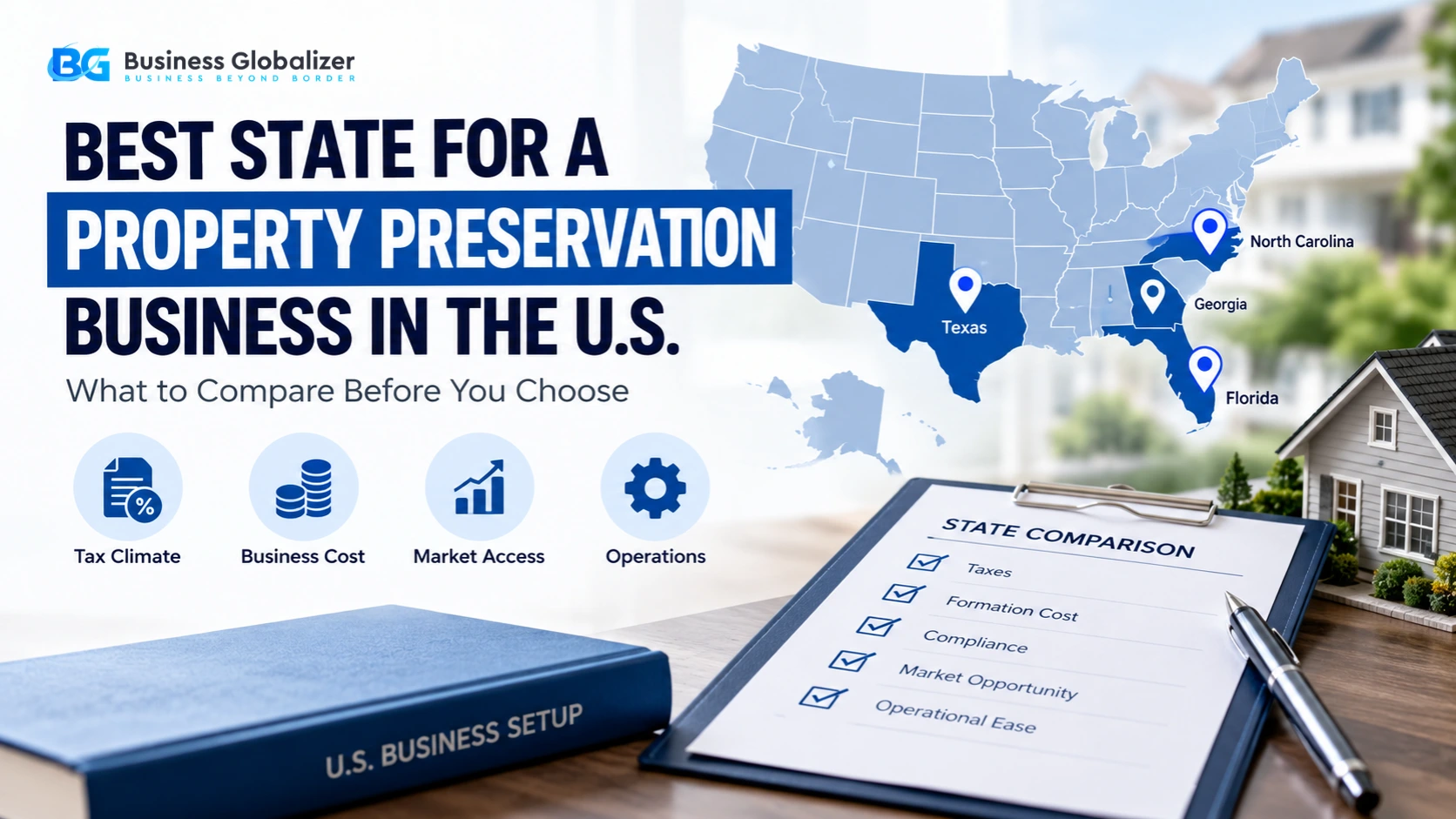
Here is a simple, practical look at states people often mention. This is not a ranking. It is a decision guide.
| State | Why People Consider It | What to Watch |
| Wyoming | Popular for LLC formation and simple business setup | If work happens elsewhere, foreign registration may still matter; physical banking and U.S. signatory needs still require separate planning |
| Delaware | Known for business law and entity formation | Delaware LLCs have an annual tax; as of current Delaware guidance, LLCs/LPs/GPs pay a $400 annual tax |
| New Mexico | Often discussed for lower-maintenance LLC setup | Not always best if your work, physical banking, U.S. authorized signatory, or vendor activity points elsewhere |
| Florida | No state individual income tax and active real estate market | Florida LLC annual report fee is $138.75, and late annual reports can trigger a $400 late fee |
| Texas | No state individual income tax and large property market | Texas LLC formation fee is $300; franchise tax/reporting rules still matter |
| Your actual work state | Often the cleanest from an operations angle | May be less “famous,” but it can reduce mismatch between setup, physical banking, authorized signatory support, and activity |
If your main goal is choosing the best state for a property preservation LLC for non-resident owners, the real answer is usually not a trendy state name. It is the state that matches your physical banking, insurance, field operations, U.S.-based authorized signatory plan, vendor plan, and compliance path.
Which State Is Usually Best for a Nonresident?
The answer depends on the business model.
If You Already Know Where the Work Will Happen
If most properties, contractors, and work orders will be in one state, forming in that operating state may be the most straightforward approach. It can reduce the mismatch between the LLC’s formation state and the state where the business actually operates.
This does not automatically eliminate every registration, tax, insurance, or licensing requirement, but it may make the structure easier to explain to banks, insurers, vendors, and clients.
If You Do Not Yet Have a Fixed Operating State
If you are building a national coordination business and do not yet know where most work will occur, you may compare states commonly used for LLC formation.
In that situation, the decision should focus on:
- Annual state cost
- Physical banking practicality
- Availability of U.S.-based authorized signatory support
- EIN application process
- Insurance availability
- Vendor onboarding expectations
- Registered agent requirements
- Likelihood of foreign registration later
- Whether the state fits your expected business activity
This is where Wyoming, New Mexico, Florida, and Texas may enter the discussion. But none of them is automatically the best state for every nonresident.
If Physical Checks and Banking Are Central to the Business
If the business expects physical checks or requires check-deposit capability, banking should be evaluated before choosing the formation state.
A state may look attractive on paper but be less practical if the nonresident owner cannot complete the required banking process or if the business needs a U.S.-based authorized signatory for approved banking tasks.
In that situation, the best state is the one that supports a workable banking and documentation structure, not simply the one with the lowest annual fee.
LLC and EIN: The Correct Order
A property preservation LLC usually comes before the EIN.
The IRS says if you are creating a legal entity such as an LLC, partnership, or corporation, you should register the entity with the state before applying for an EIN. That matters because the EIN application should match the legal entity name and structure.
For a nonresident, the EIN for a property preservation business setup needs extra care because IRS rules limit who can use the online EIN application. The IRS instructions say that if you have no legal residence, principal place of business, principal office, or agency in the U.S. or U.S. territories, you cannot use the online EIN application.
So the basic order is usually:
- Choose the state
- Form the LLC
- Prepare company documents
- Apply for EIN
- Arrange physical banking and confirm whether a U.S.-based authorized signatory is needed
- Move toward insurance and compliance setup
This is also where many people get stuck when starting a property preservation business. They want the fastest state, but the better move is choosing the state that will not create headaches in the next five steps.
State Selection and U.S. Business Banking
For property preservation, U.S. business banking deserves special attention, especially if clients pay by physical check.
Your business may receive physical checks, ACH transfers, or other payment types. A property preservation business may need a suitable U.S. business banking solution with check-deposit capability, not merely an online payment account.
So state selection should not be separated from physical banking or authorized signatory planning.
A bank may look at:
- Where the LLC was formed
- Where the business operates
- Who the authorized signer is
- Whether there is an authorized signatory in the U.S.
- Business address
- Company documents
- EIN
- Nature of business
- Expected payment methods
- Who can complete required banking or check-deposit procedures
Banks commonly ask for business information and formation-related documents when opening a business bank account.
For a nonresident property preservation business, the goal is not simply “form an LLC anywhere.” The goal is to build a company that can actually receive and manage business payments, with appropriate physical banking access and authorized signatory support in the U.S. when needed.
Insurance and Operating State
Insurance is another reason state choice matters. Property preservation work may involve property access, field workers, vehicles, tools, client instructions, and contractor coordination. Your insurance needs may include:
- General Liability Insurance
- Errors & Omissions Insurance
- Workers’ Compensation
- Commercial Auto Insurance
- Umbrella or Excess Liability
- Client or vendor-specific coverage
Your source document lists General Liability, E&O, Workers’ Compensation, and Commercial Auto as part of the property preservation setup.
Workers’ compensation is especially state-sensitive. The U.S. Department of Labor explains that workers employed by private companies or state and local governments are generally covered under state workers’ compensation programs.
So if your field team works in Georgia, Texas, Florida, or New York, the insurance conversation may follow that work state, not just your formation state.
What About BOI Reporting?
This is one of those legal updates that can quietly ruin old articles.
FinCEN finalized its BOI reporting rule in August 2026, and the final rule became effective on August 14, 2026. Under the updated rule, U.S. companies are exempt from BOI reporting requirements and are no longer required to file BOI reports.
FinCEN also states that reporting companies do not need to report BOI for U.S. person beneficial owners or U.S. person company applicants. Foreign entities that meet the updated definition of a reporting company and do not qualify for an exemption may still need to report BOI under the applicable deadlines.
So if you see older content saying every new U.S. LLC must file BOI, treat it carefully. That was not always wrong at the time, but the rule has changed.
Still, BOI is only one compliance item. State annual reports, registered agent obligations, tax filings, insurance renewals, and vendor compliance may still apply.
So, What Is the Best State?
Here is the practical answer. The best state for property preservation business setup is usually one of these:
| Your Situation | Better State Logic |
| You will mainly operate in one state | Consider forming in that operating state |
| You have no fixed operating state yet | Choose based on banking, signatory support, state fees, tax position, and vendor plan |
| You are choosing only for “tax-free” reasons | Pause and compare actual business activity, foreign registration, and insurance needs |
| You will work through U.S. contractors in multiple states | Review where work orders, contractors, and client requirements will concentrate |
| You need a clean nonresident setup | Prioritize practical banking, EIN, signatory, and compliance support over internet-famous states |
If you are researching how to start a property preservation business as a non-resident, state selection should be part of the full setup plan, not a standalone decision.
Property Preservation Startup Cost and State Choice
Your property preservation startup cost can change by state, but state filing fees are not the only cost.
You will need to budget for:
- LLC formation
- Registered agent
- EIN support
- State annual compliance
- Foreign registration, if needed
- U.S. physical banking support
- Insurance
- U.S. signatory or authorized person support
- Background check or ShieldID-related guidance
- Vendor registration preparation
- Website or business documentation
A state with a lower LLC fee can still become more expensive if it creates a mismatch with the operating state, banking needs, or vendor requirements. That is why the cheapest state is not always the best state.
Where Does Business Globalizer Fit?
Business Globalizer helps nonresident founders plan the U.S. setup for a property preservation business instead of guessing from random state recommendations.
Depending on the founder’s setup, support may include:
- U.S. company formation
- State selection guidance based on your business model
- Property preservation company setup
- U.S. Trademark filing support
- EIN for property preservation business support
- U.S. physical banking guidance
- Business documentation
- Registered agent support
- U.S. federal & state tax filing
- U.S. authorized signatory support
- Insurance coordination guidance
- Background check and compliance guidance
- Ongoing compliance support
The goal is not to promise that one state will magically solve everything. The goal is to help you choose a setup that makes sense for the way your business will actually operate.
Final Words Before You Pick a State
The best state question is a bit like choosing a garage before buying the work truck. It matters, yes. But it only makes sense when you know what kind of work you will actually do.
For a property preservation business, the right state should fit your LLC, EIN, physical banking, insurance, authorized signatory support, vendor plan, and field operations.
So, before you pick the best state for property preservation business setup, ask one better question first: “Where will this business actually need to function, and who will handle the U.S.-based banking and signing requirements?”
That answer will usually tell you more than any tax-free state list.
Key Insights
- There is no one-size-fits-all best state for property preservation business setup. The right answer depends on where the business will operate, not only where the LLC is formed.
- For a nonresident, the best state must be evaluated together with physical banking, U.S.-based authorized signatory support, insurance, EIN procedures, vendor onboarding, and operating-state compliance.
- A “tax-free state” usually means no state individual income tax, not zero business cost, zero compliance, or zero tax exposure.
- A property preservation LLC may need foreign registration if it is formed in one state but actually does business in another state.
- The IRS says legal entities such as LLCs should generally be registered with the state before applying for an EIN.
- For nonresidents without a U.S. legal residence, principal place of business, office, or agency, the IRS says the online EIN application cannot be used.
- Texas has a 2026 no-tax-due franchise tax threshold of $2.65 million, but entities may still have reporting obligations.
- As of FinCEN’s August 11, 2026 final rule, U.S. companies are no longer required to report BOI to FinCEN, while some foreign entities registered in the U.S. may still have BOI duties.
- For a nonresident property preservation setup, physical banking, insurance, a U.S.-based authorized signatory, and vendor requirements can matter more than a low filing fee.
FAQ
What is the best state for property preservation business setup as a nonresident?
Answer: There is no single best state for every nonresident founder. If the business will mainly operate in one state, forming there may be the most practical option. If the business has no fixed operating state, compare formation states based on physical banking, U.S.-based authorized signatory support, insurance, annual costs, EIN procedures, vendor requirements, and future foreign registration exposure.
Is a tax-free state always better for a property preservation LLC?
Answer: No. A tax-free or no-income-tax state may reduce one type of tax exposure, but it does not remove annual fees, franchise tax, foreign registration, insurance requirements, physical banking requirements, authorized signatory needs, or operating-state obligations.
What is the best state for a property preservation LLC for non-resident owners?
Answer: The best state for a property preservation LLC for non-resident owners is usually the state that supports the full setup: LLC, EIN, physical banking, insurance, authorized signatory, and vendor readiness. It may or may not be a popular tax-free state.
Do I need an EIN for property preservation business setup?
Answer: Yes, an EIN for property preservation business setup is generally needed for banking, tax, vendor paperwork, and business documentation. For an LLC, the entity should generally be formed first before applying for the EIN.
Can I form in Wyoming but operate in another state?
Answer: You can form in Wyoming, but if your company transacts business in another state, that state may require foreign registration, taxes, licenses, or other compliance. The operating state still matters.
Does state choice affect property preservation startup cost?
Answer: Yes. Property preservation startup costs can change because state filing fees, annual reports, franchise tax, registered agent fees, foreign registration, insurance, and compliance needs vary by state.
Is Delaware the best state for a property preservation business?
Answer: Delaware can be useful for certain business structures, but it is not automatically best for property preservation. If your work, contractors, insurance, or clients are in another state, that state may matter more.
How do I choose a state if I want to start a property preservation business as a nonresident?
Answer: Start by deciding where the work will happen, whether you need physical banking support, what insurance is required, whether you need U.S.-based authorized signatory support, and which vendor platforms or clients you plan to approach. Then compare the formation state with the states where the business will actually operate.