A private limited company gives you legal protection, tax flexibility, and real credibility — but it also comes with annual filings, director responsibilities, and more admin than simpler structures. Whether the trade-off works depends entirely on where your business is headed.
Starting a business in the UK feels simple until the business starts growing teeth. Bigger clients ask for proper invoices. Banks ask for structure. Partners want shares. And suddenly, that casual little setup starts looking a bit too fragile.
That’s usually when founders begin looking at the most popular business structure in the UK: a private limited company.
A private limited company can provide your business with greater protection, credibility, and tax-planning flexibility. But let’s not pretend it’s all sunshine and neat paperwork. There are filings, public records, director duties, and more admin than a sole trader ever wants to see.
So, let’s break down the Advantages and Disadvantages of a Private Limited Company without making it feel like a law lecture.
What Is a Private Limited Company?
A private limited company, usually written as Ltd, is a separate legal business entity in the UK that is registered with Companies House. That means the company exists separately from its owners, directors, and shareholders.
Simply said: the company can own assets, enter contracts, make profits, owe debts, and pay taxes in its own name.
Most UK private limited companies are limited by shares, where shareholders own the company and their liability is usually limited to the unpaid value of their shares. Private limited companies cannot offer shares to the general public, unlike public limited companies.
This is why many founders choose the Ltd route once the business starts looking serious.
Types of Private Limited Companies Ltd
Not every Ltd company is built the same way. In the UK, the two common types are:
Private Company Limited by Shares
This is the classic setup for trading businesses.
It suits:
- Agencies
- E-commerce brands
- Consultants
- Startups
- Family-owned businesses
- Service-based companies
Shareholders own shares, directors run the company, and profits can be paid as salary, dividends, or reinvested.
Private Company Limited by Guarantee
This is usually used for non-profit-style organisations, clubs, associations, charities, and community projects. Instead of shareholders, it has members who agree to contribute a set amount if the company is wound up.
Simple way to remember it:
- Limited by shares = profit-focused business
- Limited by guarantee = purpose-focused organisation
Private Limited Company Examples
When people hear “limited company,” they often imagine huge corporate buildings. But in reality, private limited company examples can be very normal businesses.
For example:
- A small digital marketing agency registered as an Ltd
- A family-owned restaurant operating under a company name
- A UK e-commerce brand selling through Shopify or Amazon
- A consulting firm with two shareholders
- A local property management business
That’s the beauty of this structure. It works for both small businesses and companies planning serious growth.
Advantages and Disadvantages of a Private Limited Company
An Ltd company offers several valuable protections and opportunities, but it also comes with obligations that many first-time founders don’t expect. Let’s look at both.
Advantages of Private Limited Company
Here’s where the Ltd structure starts looking attractive.
- Limited Liability Protection
This is the big one.
A private limited company helps separate your personal finances from business debts. If the company gets into financial trouble, shareholders are usually only responsible for the amount unpaid on their shares.
That doesn’t mean directors can act carelessly. Personal guarantees, fraud, unpaid taxes, or wrongful trading can still create personal risk.
But for normal business risk? This protection matters.
- More Professional Image
Let’s be honest, “ABC Studio Ltd” often feels more established than “John working from his laptop.”
Clients, suppliers, banks, and investors often take limited companies more seriously because the structure is formal, registered, and traceable through Companies House. That credibility can help when you’re pitching bigger clients or opening business accounts.
- Easier to Bring in Shareholders or Investors
If you want to grow with partners or investors, a private limited company gives you a cleaner structure. You can issue shares, define ownership percentages, and bring people into the business without turning everything into a handshake agreement.
This is one of the strongest advantages of private limited company formation for founders with growth plans.
- Tax Planning Flexibility
Private limited companies pay Corporation Tax on company profits. For the 2026 financial year, the UK Corporation Tax system includes a 19% small profits rate up to £50,000 and a 25% main rate above £250,000, with marginal relief between those levels.
Directors may also take money through a mix of salary and dividends, depending on the company’s profit and personal tax position.
This needs proper accounting, of course. But compared with a simple sole trader setup, there is more room to plan.
- Business Continuity
A private limited company does not disappear just because a shareholder leaves or a director changes.
The company has its own legal identity, so ownership can transfer through shares, and the business can continue beyond the original founder.
For long-term brands, this is a quiet but powerful benefit.
Disadvantages of Private Limited Company
Now the less glamorous side.
- More Admin and Filing Work
A limited company comes with annual responsibilities.
You usually need to file:
- Company accounts
- Corporation Tax return
- Confirmation statement
- Director/shareholder updates when details change
Companies must file annual accounts with Companies House, and confirmation statements are required to confirm that company information remains correct.
So yes, the structure is stronger. But it also asks more from you.
- Less Privacy
Your company details become public.
Companies House records can show company name, registered office, directors, filing history, accounts, and shareholder information.
For many founders, this is fine. For others, especially home-based founders, it can feel uncomfortable.
A registered office service can help protect your home address, but the public-record element still exists.
- Higher Setup and Running Costs
Compared with being a sole trader, a private limited company usually costs more to maintain.
You may need:
- Formation fees
- Accountant support
- Confirmation statement filing
- Payroll setup
- Corporation Tax filing
- Registered office service
It is not necessarily expensive, but it is not “zero-admin free” either.
- Director Responsibilities Are Serious
As a director, you are legally responsible for running the company properly.
That includes keeping records, filing on time, paying taxes, acting in the company’s best interest, and following Companies House and HMRC rules.
This is one of the disadvantages of private limited company setups that people underestimate. You are not just “the owner” anymore. You are an officer of the company.
5. Money Is Not Automatically Yours
This one surprises many founders.
If the company earns £10,000, that does not mean you personally earned £10,000. The money belongs to the company first. You then take money out properly through salary, dividends, expenses, director’s loan arrangements, or other compliant routes.
Mixing personal and company money is where things get messy fast.
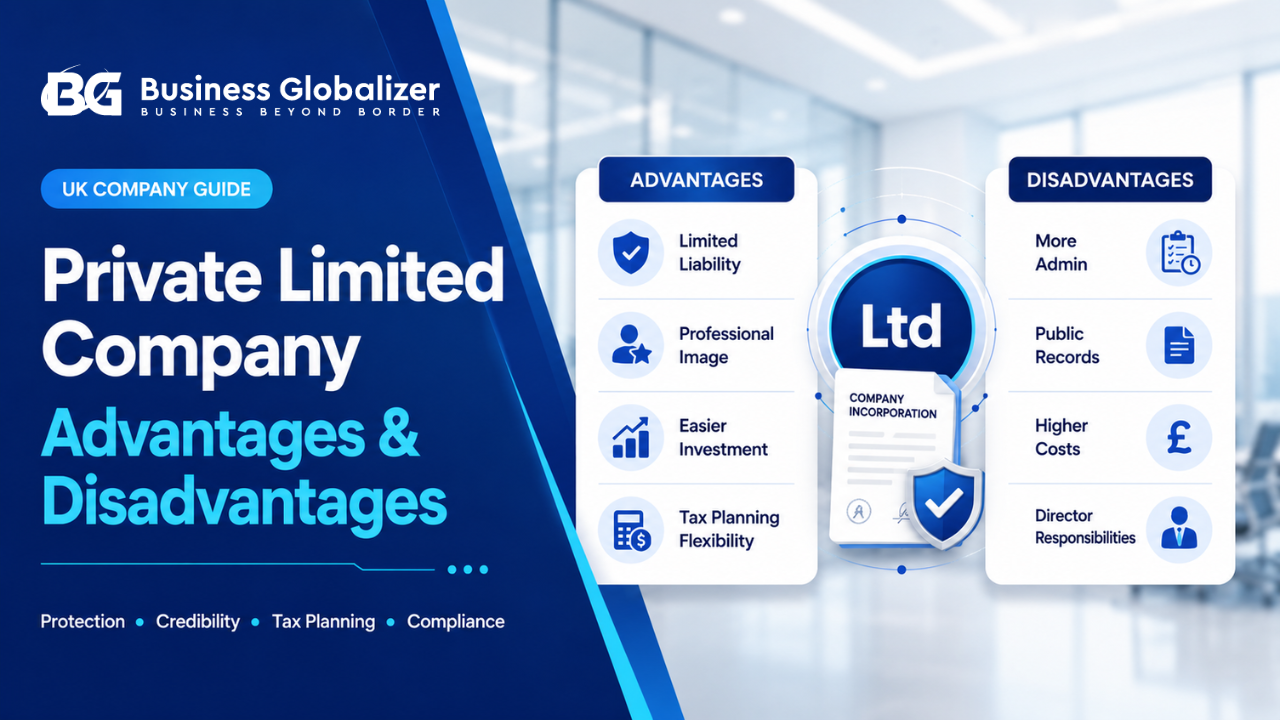
Advantages and Disadvantages of a Private Limited Company: Quick Table
| Advantages of private limited company | Disadvantages of private limited company |
| Owners usually get limited liability protection, so personal assets are safer from normal business debts. | Directors still carry legal duties, and personal guarantees or wrongful actions can create personal risk. |
| The business gets a more professional and credible image with clients, banks, and suppliers. | Company details become public through Companies House, so privacy is lower than sole trader status. |
| It is easier to bring in shareholders, partners, or investors through share ownership. | More admin is required, including accounts, confirmation statements, and company record updates. |
| The company continues even if a director or shareholder changes. | Running costs are usually higher because of accounting, filing, and compliance support. |
| There may be more room for tax planning through salary, dividends, and retained profits. | Company money is not automatically the owner’s personal money and must be withdrawn properly. |
| The Ltd structure can support long-term growth, contracts, and brand value. | It may be too much structure for a tiny side hustle or very simple business. |
When a Private Limited Company Makes Sense, And When It Doesn’t?
So, should you do it?
A private limited company makes sense when your business needs protection, credibility, cleaner ownership, or room to grow. It may not be ideal if you are testing a tiny side hustle, hate admin, or want the simplest possible tax setup.
So, what does all of this mean when you’re actually choosing a structure?
Choose a private limited company if:
- You want limited liability
- You work with bigger clients
- You plan to bring in partners or investors
- You want a more formal business structure
- You can handle filings and accounting
Think twice if:
- You want almost no admin
- Your income is very small or irregular
- You do not want public company records
- You are not ready for director responsibilities
That’s really the balance every founder has to weigh: more protection and flexibility on one side, more obligations and paperwork on the other.
Business Globalizer: Helping Founders Set Up the Right Way
A private limited company is only useful when it is set up and maintained properly.
At Business Globalizer, we help founders with UK company formation, registered office address support, director’s service address, PSC, annual filings, tax guidance, company restoration, dissolution, and compliance help.
So if you are planning a private limited company UK setup, we help you avoid the messy part: wrong structure, missed filings, and unclear obligations. Just reach out to us.
Because forming a company is easy. Keeping it clean is where the real work begins.
A private limited company gives your business its own legal identity, which means the company and the owner are not the same thing.
Limited liability is often the biggest reason founders choose an Ltd structure, but it does not remove every personal risk.
The word “Ltd” can add credibility when dealing with clients, suppliers, banks, and potential business partners.
Bringing in shareholders is usually much easier with a limited company than with a sole trader business.
A private limited company can offer more flexibility around profit extraction and long-term tax planning.
The biggest surprise for many new directors is that company money belongs to the company first, not automatically to them.
More protection usually comes with more paperwork, which is why annual filings and compliance matter so much.
Public records are part of the trade-off, so founders should be comfortable with a lower level of privacy.
A limited company often makes more sense as a business grows, takes on risk, or plans for long-term expansion.
The real decision is not whether a limited company is good or bad; it is whether the extra structure is worth the extra responsibility for your situation.
FAQ
- What is a private limited company UK?
Answer: A private limited company UK is a business registered with Companies House as a separate legal entity. It is usually owned by shareholders and managed by directors.
- What are the main Advantages of private limited company formation?
Answer: The main advantages are limited liability, stronger credibility, tax planning options, easier ownership transfer, and a better structure for growth or investment.
- What are the main Disadvantages of private limited company setup?
Answer: The main disadvantages are more admin, public records, filing duties, accounting costs, and legal responsibilities for directors.
- What are some private limited company examples?
Answer: Common examples include small agencies, e-commerce companies, consulting firms, family businesses, property businesses, and startups registered as Ltd companies.
- Is a private limited company better than being a sole trader?
Answer: It depends. A limited company offers more protection and structure, while a sole trader setup is simpler and cheaper to run.
- Do private limited companies (Ltd) pay Corporation Tax?
Answer: Yes. UK limited companies normally pay Corporation Tax on company profits; then directors or shareholders may pay personal tax on salaries or dividends.
- Is it hard to close a private limited company?
Answer: Not always, but it must be done properly. A company can usually be closed through voluntary strike-off if eligible, or through liquidation if debts or complex issues exist.
Closing Thoughts
Choosing a business structure is not just a paperwork decision. It shapes how protected you are, how professional you look, how you pay tax, and how much admin you carry.
That is why understanding the advantages and disadvantages of a private limited company matters before you register one.
If your business is growing, dealing with bigger clients, or planning long-term expansion, an Ltd can be a smart move. But if you want total simplicity, you need to be honest about the extra responsibility. A private limited company gives your business a proper jacket.
Just remember: once you wear the jacket, you have to keep it buttoned properly.