Quick Answer
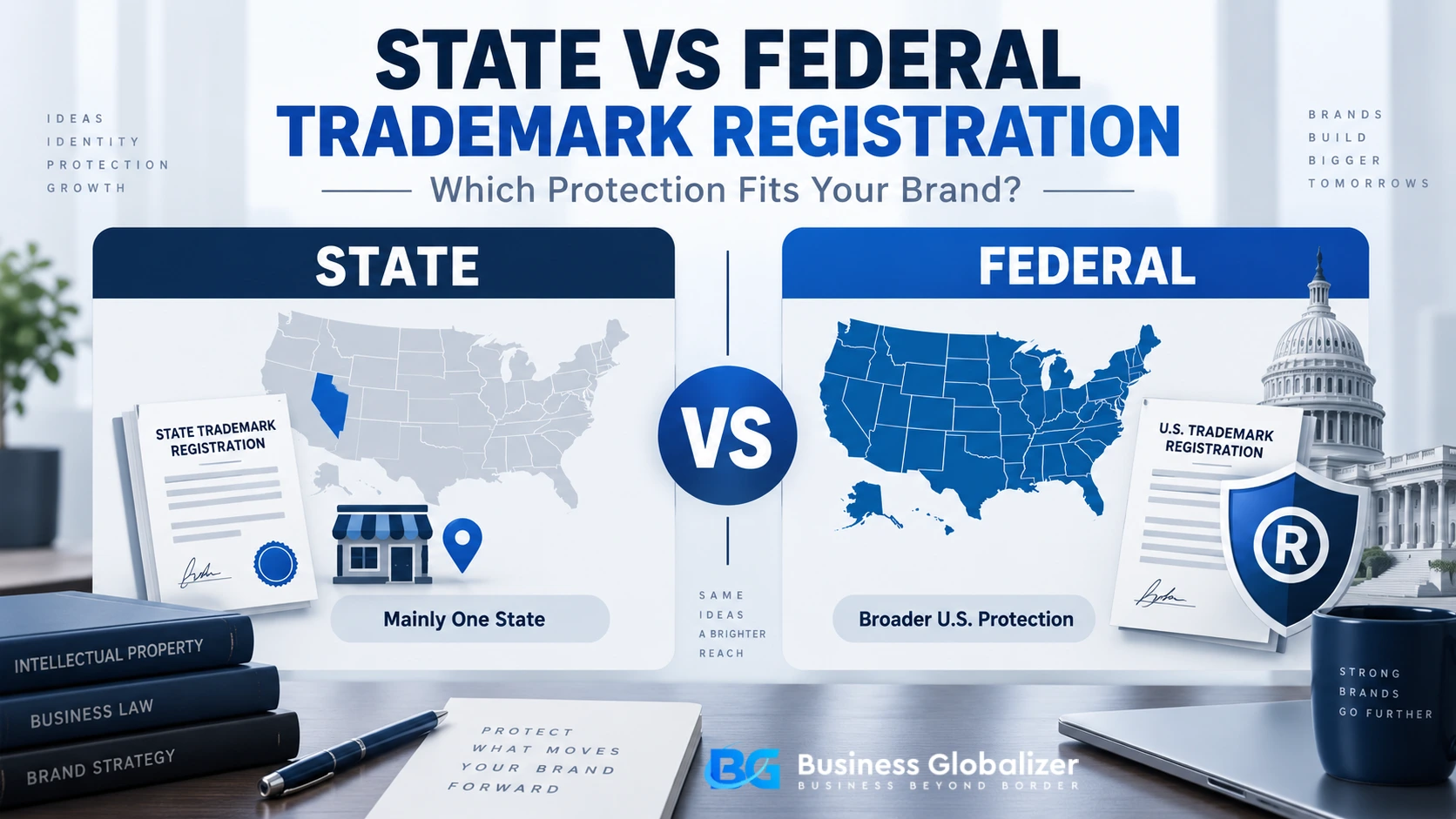
State vs Federal Trademark Registration comes down to coverage. State registration protects mainly within one state, while federal trademark registration through the USPTO can provide broader protection across the United States.
Someone forms an LLC in Florida, buys the domain, prints the logo, opens Instagram, and proudly says, “The name is protected now.”
Well… not exactly!
That setup may protect the business record in one state. It may help with banking, tax, or legal formation. But brand protection is a different room with a different lock, and that’s where U.S. trademark registration starts to come into the picture, making State vs Federal Trademark Registration an important distinction to understand.
A business name, state filing, domain name, and trademark are not the same thing. They may work together, but they do different jobs. If your brand matters beyond one local area, you must understand which type of trademark protection actually fits your business.
Let’s make it clear without turning this into a courtroom nap.
A short note: If you’re quite new to U.S. Trademark, start with our dedicated guide on it before deciding which level of protection fits your business.
What Is State vs Federal Trademark Registration?
At the simplest level, differences between state and federal trademark registration compare two ways of formally registering a trademark in the United States. A state trademark is registered with a state authority and usually protects the mark within that state.
You file a federal trademark through the USPTO (the United States Patent and Trademark Office) to get nationwide protection for your brand. Here’s the catch: Neither one is the same as registering a company name.
A state may allow you to form an LLC under a business name, but that does not automatically give you strong trademark rights over that name. Company formation and trademark protection solve different problems.
U.S. Trademark Protection Options
Before comparing state and federal filings, it helps to see the full ladder of trademark protection. Not every business starts at the same level. Some brands begin with local use. Others need national protection from day one. Some eventually need international coverage.
Common Law Trademark
A common law trademark can arise from actual use of a mark in business.
That means you may have some rights simply by using a brand name, logo, or slogan in connection with goods or services. However, those rights are usually limited to the specific geographic area where the mark is actually used and recognized.
So yes, common law rights can exist. But they are often harder to prove, harder to enforce, and much narrower than federal registration.
State Trademark Registration
You usually handle a state trademark through your Secretary of State’s office. It’s a solid choice for businesses that stay close to home; think of your local coffee shop, neighborhood salon, or a small family-run bakery.
Keep in mind, though, that this protection stops at the state line. If you eventually decide to sell online or branch out into other regions, you might find that state-level coverage doesn’t quite cover the ground you need anymore.
Federal Trademark Registration
Federal trademark registration is handled by the USPTO. This is the stronger option for many businesses because it can provide nationwide benefits, public notice of ownership, and the right to use the ® symbol after registration.
Federal registration is often the better fit for:
- E-commerce brands
- Amazon sellers
- SaaS companies
- National service providers
- Franchises
- Businesses selling across state lines
- Brands planning licensing or expansion
For many founders, this is where serious brand protection begins.
International Trademark Registration
International trademark registration is the next layer, but it is often misunderstood. There is no single “worldwide trademark” that automatically protects your brand everywhere. Instead, trademark protection is territorial. That means protection usually depends on the country or region where the mark is registered or recognized.
For international growth, businesses may file directly in selected countries or use systems like the Madrid Protocol trademark route where available.
Trademark Protection at a Glance
| Protection Type | Main Coverage | Registration Needed? | Best Fit |
| Common Law Trademark | Limited area where the mark is actually used | No formal registration required | Very local use, early-stage brand testing |
| State Trademark | Usually one state | Yes, with the state | Local businesses operating mainly in one state |
| Federal Trademark Registration | United States-wide benefits | Yes, with the USPTO | Online, multi-state, national, or growing brands |
| International Trademark Registration | Selected foreign countries or regions | Yes, through national filings or systems like the Madrid Protocol | Brands expanding outside the U.S. |
Think of this table as a map. Your brand does not need every layer on day one, but it does need the layer that matches where the business is actually going.
Common Law Trademark vs Federal Trademark Registration
One of the biggest misconceptions is that every trademark starts with a government registration. It doesn’t.
Some businesses begin with common law trademark rights simply by using a brand name in commerce. Others choose federal trademark registration through the USPTO from the start. Both offer protection, but they are far from equal.
Common Law Trademark
Rather than being established by filing an application, a common law trademark is created through the actual commercial use of a mark. If you consistently use a unique business name, logo, or slogan to sell your goods or services, you may build common law rights in the areas where customers recognize your brand.
Those rights can be valuable, but they are usually limited to the geographic area where the mark is actually used. They can also be more difficult to prove if you ever end up in a legal dispute.
Federal Trademark Registration
Federal trademark registration is obtained by filing a USPTO trademark application and successfully completing the registration process.
Once registered, the trademark enjoys broader legal benefits, including a nationwide presumption of ownership for the listed goods or services, the right to use the ® symbol, and stronger tools for enforcing your rights.
For businesses planning long-term growth, this is often the more practical option.
Common Law Trademark vs Registered Trademark
| Feature | Common Law Trademark | Federal Trademark Registration |
| How rights begin | Through actual use in commerce | Through successful USPTO registration |
| Geographic protection | Usually limited to the area of use | Broader protection across the United States |
| Public record | No central federal register | Listed on the USPTO register |
| Right to use ® | No | Yes, after registration |
| Enforcement | Generally more difficult | Usually stronger legal position |
| Best suited for | Very local businesses | Businesses planning wider growth |
The important thing to remember is that common law rights are not “bad.” They are simply more limited than a registered federal trademark.
State Trademark vs Federal Trademark
Now let’s compare the two registration systems directly. Both involve an official filing, but they serve different business needs.
A state trademark is usually intended for businesses operating within one state. A federal trademark registration is generally designed for businesses involved in interstate commerce or those planning to expand beyond one state’s borders.
State Trademark vs Federal Trademark: At a Glance
| Feature | State Trademark | Federal Trademark Registration |
| Filing authority | State government | United States Patent and Trademark Office (USPTO) |
| Coverage | Primarily one state | Broader protection throughout the United States |
| Best for | Local businesses | Regional, national, and online businesses |
| Public search | State records | USPTO trademark database |
| ® symbol | No | Yes, after registration |
| Interstate protection | Limited | Yes, subject to trademark law and registration scope |
Neither option is automatically “better.” The right choice depends on how and where your business operates.
When Is State Trademark Registration Enough?
Not every business needs federal registration on day one. State trademark registration may be appropriate if your business:
- Operates entirely within one state.
- Serves local customers only.
- Has no immediate plans to expand into other states.
- Does not sell products or services across state lines.
Think of a neighbourhood bakery, a local plumbing company, or a family-owned restaurant serving one community.
For businesses with genuinely local ambitions, state registration may provide a reasonable starting point. The key question isn’t where your business is today. It’s where you expect it to be in the next few years.
When Does Federal Trademark Registration Make More Sense?
Federal registration becomes increasingly valuable once a business grows beyond one local market.
It is often the better option if you:
- Sell products online across different states.
- Operate an Amazon, Shopify, or other e-commerce business.
- Plan to franchise or license your brand.
- Want stronger nationwide protection.
- Expect your business to expand into multiple states.
- Want your mark listed in the USPTO trademark database.
Many founders begin locally but grow nationally. Planning ahead can prevent expensive branding problems later.
Can You Have Both a State and Federal Trademark?
Yes. A business may hold both a state trademark registration and a federal trademark registration for the same mark. However, in many situations, businesses that qualify for federal protection find that the broader coverage makes federal registration the more valuable long-term asset.
Whether both registrations make sense depends on your business goals, where you operate, and your overall brand strategy. Rather than asking, “Can I have both?”, a better question is: Which level of protection actually matches where my business is heading?
State Trademark vs Federal vs International Trademark
Once a brand starts growing, the question becomes bigger than state or federal protection. It might also be necessary to take international coverage into consideration. Here is the simple version:
| Trademark Option | Main Protection Area | Best For |
| State Trademark | One U.S. state | Local businesses |
| Federal Trademark Registration | United States | Online, multi-state, and national brands |
| International Trademark Registration | Selected foreign countries or regions | Brands expanding outside the U.S. |
A U.S. trademark does not automatically protect your brand in every country. Trademark rights are usually territorial, which means protection depends on where the mark is recognised or registered.
So if your business sells only in one U.S. state, international filing may be unnecessary. But if your brand is moving into Canada, the UK, Europe, or other markets, international protection becomes part of the conversation.
Madrid Protocol Explained for International Trademark Protection
The Madrid Protocol trademark system is an international filing route that lets you seek protection in multiple member countries through one application.
In simple terms:
- One international filing route
- Choose multiple countries
- Each country reviews it separately
- Not a worldwide trademark
It can be useful, but it needs careful planning.
Which Trademark Option Fits Your Business?
Here’s a practical way to think about it.
| Business Type | Better Fit |
| Local restaurant serving one city | Common law or state trademark may be enough at first |
| Local service business working only inside one state | State trademark may be reasonable |
| Shopify or Amazon seller | Federal trademark registration usually makes more sense |
| SaaS business serving customers across states | Federal trademark registration |
| Brand planning, licensing, or franchising | Federal trademark registration |
| U.S. brand expanding abroad | Federal trademark registration plus international strategy |
| Global e-commerce brand | Federal registration plus selected international filings |
No table can replace proper legal review, but this gives you the basic direction. The more your brand crosses borders—state lines or national borders—the more local-only protection starts looking thin.
Common Mistakes and How to Avoid Those
Most trademark mistakes happen because founders mix up different types of protection. Here are the common ones, along with steps to prevent them:
- Thinking LLC registration protects the brand name.
Avoid this by understanding that LLC registration only secures your business name at the state level, not trademark rights.
- Assuming a domain name means the trademark is safe.
Avoid this by checking trademark availability separately, since domain ownership does not grant trademark protection.
- Believing state registration protects the mark nationwide.
Avoid this by choosing federal trademark registration if your business operates across multiple states or online.
- Skipping the trademark search before filing.
Avoid this by conducting a proper trademark search to reduce the risk of rejection or legal conflicts.
- Using the ® symbol before federal registration.
Avoid this by using ™ until your trademark is officially registered with the USPTO.
- Assuming federal trademark registration protects the brand internationally.
Avoid this by planning separate international filings if you intend to expand outside the U.S.
- Waiting until the brand is already copied before taking trademark seriously.
Avoid this by securing your trademark early, before your brand gains traction.
None of these mistakes are rare. That is exactly why understanding State vs Federal Trademark Registration early can save a lot of cleanup later.
Business Globalizer: Helping You Choose the Right Trademark Path
Trademark protection is not just about filing a form. It is about choosing the right level of protection for where your brand is today and where it is going next.
At Business Globalizer, we help founders with U.S. trademark registration, trademark guidance, U.S. company formation, e-commerce business registration in the U.S., ITIN application support, EIN services, DUNS number, U.S. taxation, and ongoing compliance support for entrepreneurs expanding into the United States.
Whether you are building a local brand, launching an online store, or preparing for broader trademark registration, we help you avoid the confusion before it becomes expensive.
Closing Thoughts
Coming back to that founder who said, “My LLC is registered, so the name is protected.” The reality is: not quite. Business registration, state trademark registration, federal trademark registration, and international trademark registration each serve different roles.
The real question is not just whether you need a trademark, but what level of protection actually fits your business.
That is why understanding state vs. federal trademark registration matters. If your brand stays local, state protection may be enough. If your business sells online or plans to grow, federal protection is usually the stronger choice.
Brands can scale faster than expected, so it is smarter to protect them early.
Key Insights
- State vs Federal Trademark Registration is really a question of how far your brand protection needs to reach.
- Common law rights can start from real business use, but they are usually limited by geography.
- State trademark registration protects a mark within one state, not across the whole United States.
- Federal trademark registration through the USPTO gives broader protection across the U.S.
- Registering an LLC or business name with a state is not the same as owning a trademark.
- A federal trademark can be more useful for e-commerce, Amazon sellers, franchises, licensing, and multi-state businesses.
- International trademark registration is not one worldwide trademark; protection still depends on selected countries.
- The Madrid Protocol trademark system can help applicants seek protection in multiple countries through one international filing route.
- Many brand problems start when founders assume one type of registration protects everything.
- The right option depends on where you sell, where you plan to grow, and how serious the brand is.
FAQ
What is State vs Federal Trademark Registration?
Answer: State vs Federal Trademark Registration compares two levels of trademark filing in the U.S. State registration usually protects a mark within one state, while federal registration through the USPTO can offer broader protection across the United States.
Is state trademark registration enough?
Answer: It can be enough for a very local business that operates only within one state. But if your business sells online, works across state lines, or plans to grow nationally, federal trademark registration is usually the stronger option.
What is common law trademark vs registered trademark?
Answer: A common law trademark can arise from actual business use, usually with limited geographic protection. A registered trademark, especially a federal one, gives stronger public notice, broader protection, and better enforcement tools.
What is state trademark vs federal trademark in simple words?
Answer: A state trademark is mainly for protection inside one state. A federal trademark is registered through the USPTO and can provide broader U.S.-wide protection for the goods or services listed in the registration.
Does registering an LLC protect my trademark?
Answer: No. Registering an LLC protects or reserves a business name for state business-registration purposes. It does not automatically give you trademark rights or stop another business from using a similar brand name.
Can I have both state and federal trademark registration?
Answer: Yes. A business can have both, but many growing brands find federal registration more valuable because it provides broader protection and recognition through the USPTO trademark system.
What is international trademark registration?
Answer: International trademark registration means seeking trademark protection outside the U.S. There is no single worldwide trademark, so protection usually depends on filing in selected countries or using systems like the Madrid Protocol where available.
What is the Madrid Protocol trademark system?
Answer: The Madrid Protocol trademark system lets eligible applicants seek protection in multiple member countries through one international filing route. Each country still reviews the request under its own trademark laws.
Does a federal trademark protect my brand worldwide?
Answer: No. A federal U.S. trademark protects rights within the United States. If you want protection in other countries, you usually need separate international filings or a Madrid Protocol strategy.
When should I choose federal trademark registration?
Answer: Federal trademark registration usually makes sense when your business sells across state lines, operates online, plans to scale nationally, uses Amazon or Shopify, or wants stronger long-term brand protection.