
 Quick Answer: Community Interest Companies are UK companies built for social purposes: they can trade and grow, but their profits and assets must mainly support community benefits.
Some businesses begin with a product. Some begin with a problem. And then there are the ones that start because someone looks at a local issue and thinks, “Surely, we can do better than this.”
When founders begin exploring UK company formation options for that kind of mission, Community Interest Companies often enter the conversation. They offer a way to build something sustainable while keeping community benefit at the centre of the business.
A CIC gives a social-purpose business a proper legal structure. It can trade, hire, earn, and grow, but it must keep community benefit at the centre. That sounds lovely, and often it is. But it also comes with rules, reporting, and limits on how money can be used.
So, let’s talk through Community Interest Companies like a founder would actually need to understand them.
What Is a CIC?
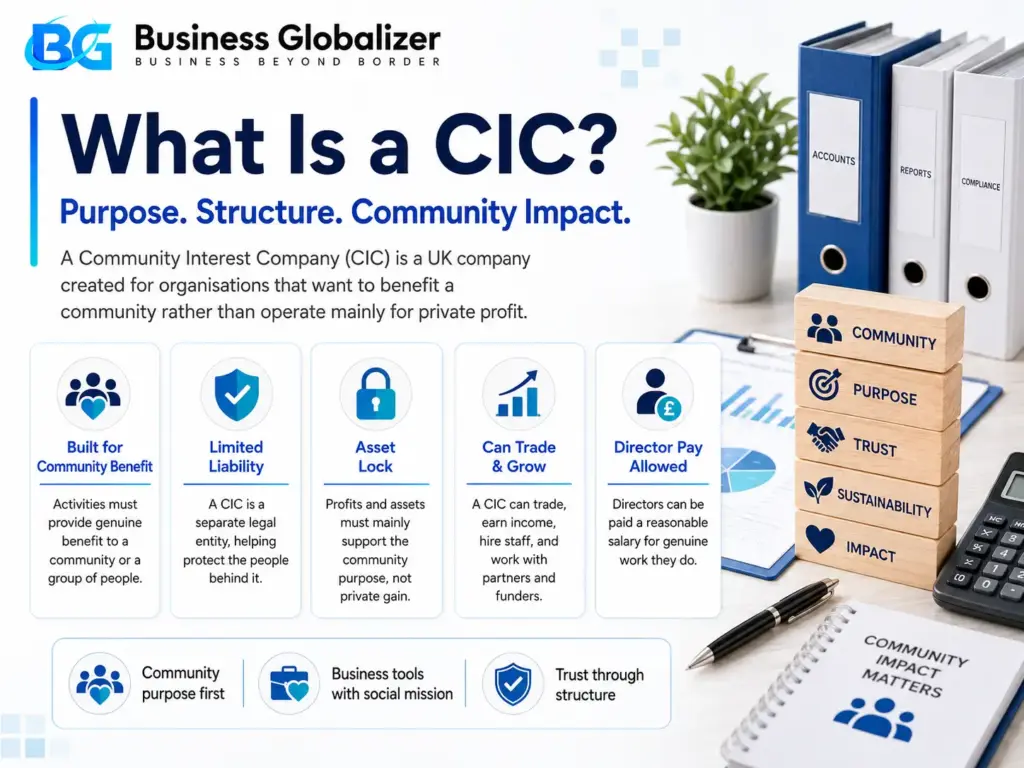
A Community Interest Company, or CIC, is a special type of UK limited company created for organisations that want to benefit a community rather than operate mainly for private profit. So if you are asking, what is a CIC, the simple answer is this: A CIC is a company with a social purpose written into its structure.
It is still a company. It can:
- Trade and earn income
- Own assets
- Sign contracts
- Employ staff
- Pay directors
- Deliver services
- Work with funders and partners
But it must pass the community interest test, meaning its activities should provide a genuine benefit to a community.
That community could be:
- A local area
- A group of people with shared needs
- People facing social or economic barriers
- A specific public-interest cause
That is the real CIC meaning: business tools, community purpose.
Community Interest Company UK: How It Works
A community interest company UK setup sits somewhere between a standard limited company and a charity-style organization.
It is more flexible than a charity in some ways because it can trade commercially and pay directors more straightforwardly. But it is more restricted than a normal private limited company because it has an asset lock and must keep its community purpose alive.
The asset lock is the big one.
It means the CIC’s assets and profits must mainly be used for its community purpose. The company cannot simply build value and then distribute everything privately like a normal profit-first company.
That is why funders, communities, and local partners often trust CICs. The structure itself says, “This organisation is not here just to enrich its owners.”
Types of CIC Company
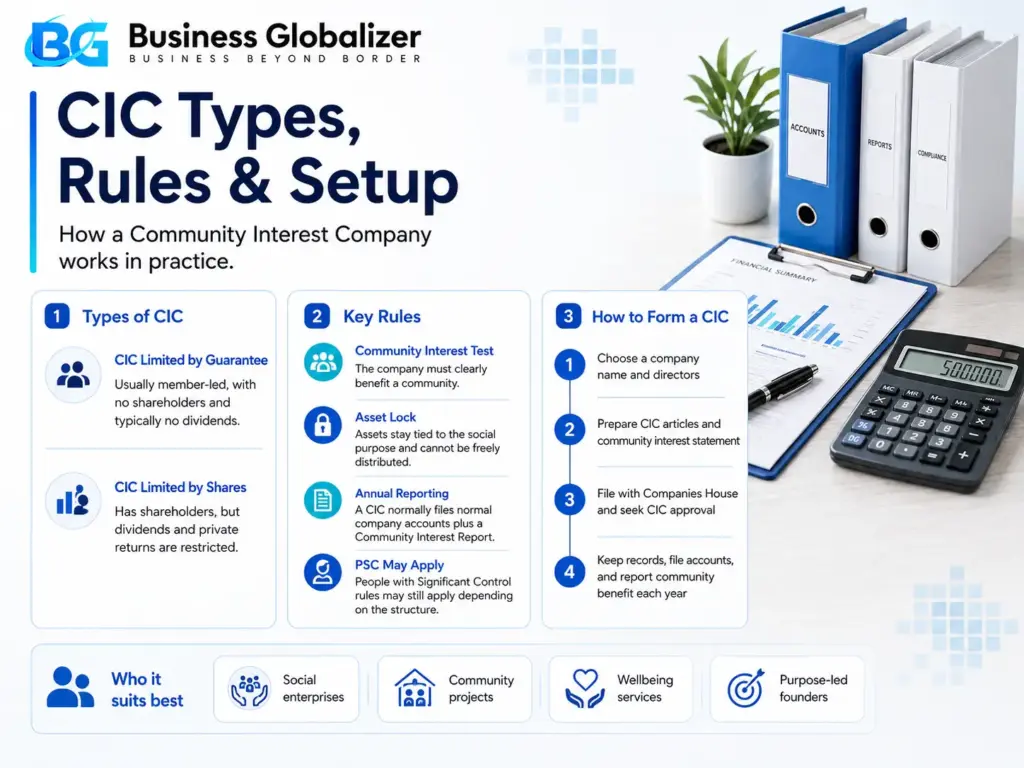
Not every CIC company is built the same way. In the UK, the two most common types are:
CIC Limited by Guarantee
This is often used for community projects, social initiatives, clubs, parent-carer forums, local services, and purpose-led organisations.
There are no shareholders. Instead, members agree to contribute a small amount, often £1, if the company is wound up. This structure usually suits CICs that do not plan to pay dividends.
CIC Limited by Shares
This type has shareholders and can issue shares. But it is not the same as a normal share company. Dividend payments are restricted, and the CIC still has to prioritise community benefit.
This structure may suit social enterprises that want some investment while still keeping the mission protected.
A quick way to remember it:
- Limited by guarantee = member-led, usually no dividends
- Limited by shares = shareholder structure, but with restricted returns
Community Interest Company Examples
Community Interest Companies can look very different in real life. Some are small local projects. Some are serious social enterprises. Some deliver public-facing services. Others sell products and use the income to fund community work.
Common community interest company examples include:
- A community café funding youth activities
- A mental health support service
- A local training project for unemployed people
- A transport service for elderly or disabled residents
- A parent-carer forum
- A social enterprise selling goods to fund community programmes
- A local sports or wellbeing project
The form does not matter as much as the purpose. If the activity genuinely benefits a community and the structure protects that purpose, a CIC may make sense.
Community Interest Company Advantages and Disadvantages: Quick Overview
We already have a separate deep-dive blog (Advantages and Disadvantages of a Community Interest Company) for this topic, so let’s keep this section useful and short.
Main Advantages
- Clear public-purpose identity: People can quickly understand that the organisation exists for community benefit.
- Limited liability: The CIC is a separate legal entity, so normal business risks are usually separated from the people behind it.
- Asset lock: Profits and assets stay tied to the community purpose, which helps build trust.
- Ability to trade: A CIC can sell services or products instead of relying only on donations or grants.
- Director pay is possible: Directors can be paid properly, as long as the pay is reasonable and transparent.
Main Disadvantages
- Profit use is restricted: You cannot treat a CIC like a personal profit machine.
- Extra reporting: A CIC must usually file a community interest report alongside normal company filings.
- Asset lock limits exits: You cannot easily convert a CIC into a normal private company later.
- Not ideal for high-return investors: Dividend restrictions and community-purpose rules may put off some investors.
- More public accountability: If the CIC claims to serve a community, it needs to show that properly.
CIC Formation: How It Works
CIC formation is not wildly complicated, but it does need care. To form a CIC, you usually need:
- A company name
- Directors
- Articles of association suitable for a CIC
- A community interest statement
- A clear explanation of who the CIC will benefit
- Companies House filing
- Approval from the CIC Regulator
The community interest statement is especially important. This is where you explain what the CIC will do, who it will help, and why the activities serve community benefit. This is not the place to be vague. A sentence like “we want to help people” is not enough. A stronger statement explains the community, the activities, and the actual benefit.
Do Community Interest Companies Need a PSC?
Yes, Community Interest Companies normally follow the same People with Significant Control (PSC) rules as other UK companies.
If an individual or legal entity has significant control over the CIC, such as through share ownership, voting rights, or other forms of influence, that information may need to be recorded and reported to Companies House.
The exact PSC position depends on whether the CIC is limited by shares or limited by guarantee, as well as how control is structured within the organisation.
How Do You Pay Yourself as a Director of a Community Interest Company?
A very common question is: how do you pay yourself as a director of a community interest company?
The short answer: usually through salary or director remuneration.
A CIC director can receive payment for legitimate work performed on behalf of the organisation. That could include running operations, managing projects, delivering services, handling administration, or leading the business.
But the payment should be:
- Reasonable
- Affordable for the CIC
- Properly recorded
- Justifiable based on the work done
- Consistent with the community purpose
Simply said: yes, you can pay yourself. But the amount should make sense. If a CIC exists to help a community but most of the money goes to directors, that will raise questions quickly.
Who Are Community Interest Companies Best For?
A CIC is best for founders who want to build something useful, sustainable, and community-focused. It can be a good fit for:
- Social enterprises
- Local community projects
- Training and employment initiatives
- Health and wellbeing services
- Youth support projects
- Parent-carer forums
- Environmental projects
- Local regeneration work
- Community transport or accessibility services
A CIC may not be the right fit if:
- Your main goal is private profit
- You want easy investor exits
- You want maximum control over company assets
- You do not want extra reporting
- You are not fully clear on the community benefit
That is the decision point.
A CIC is not “better” than a normal limited company. It is better for a certain kind of mission.
Common CIC Mistakes Founders Make
Most CIC mistakes do not happen because people have bad intentions. They happen because the structure sounds simpler than it really is.
Here are the common ones:
- Choosing a CIC before the business model is clear
- Writing a weak community interest statement
- Forgetting that the asset lock is long-term
- Treating CIC money like personal money
- Assuming a CIC is the same as a charity
- Ignoring the annual CIC report
- Promising community benefit but not tracking proof
- Paying directors without proper records or reasoning
If you are going to say the organisation benefits a community, keep evidence. Photos, reports, beneficiary feedback, service numbers, impact notes; these things make future reporting much easier.
Expert Tips Before Starting a CIC
Before setting up a CIC, ask yourself a few honest questions:
- Who exactly will benefit from this CIC?
- Is the community benefit clear enough for someone else to understand?
- Will the CIC earn income, receive grants, or both?
- Do you need shares, or is a guarantee structure enough?
- How will directors be paid?
- What happens to assets if the CIC closes?
- Can you handle annual reporting and accounts?
- Would a charity, private Ltd, or company limited by guarantee be a better fit?
That last question is important.
Sometimes a CIC is perfect. Sometimes it is just the structure people choose because it sounds socially credible. The better move is to choose the structure that fits the work.
Business Globalizer: Helping Founders Choose the Right UK Structure
A CIC can be a strong structure when the mission is clear. But if the setup is wrong, the problems show up later: unclear articles, weak community statements, filing mistakes, or a structure that does not match your funding plan.
At Business Globalizer, we help founders with UK company formation, registered office address support, annual filings, tax guidance, company restoration, dissolution, and compliance help.
If you are comparing a CIC, private limited company, charity, or another UK setup, we help you choose what actually fits your goal. Because a good mission still needs clean paperwork behind it.
Closing Thoughts
Coming back to where we started, Community Interest Companies are often born from a very human place: someone sees a problem and wants to build a proper answer to it. That is what makes a CIC powerful. It gives your mission a legal home. It lets you trade, pay people, work with partners, and grow without losing sight of community benefit.
But it also asks for honesty. If the purpose is real, the CIC structure can protect it beautifully. If the purpose is vague, the structure will feel restrictive very quickly. So before forming one, ask the simple question: Is community benefit truly at the heart of this business?
If the answer is yes, Community Interest Companies can be one of the most practical ways to turn good intentions into something durable.
Key Insights
- Community Interest Companies are designed for founders who want to combine business activity with a genuine community purpose.
- A CIC can trade, hire staff, own assets, and operate like a normal company while keeping community benefit at its core.
- The asset lock is one of the biggest reasons people trust CICs, but it also limits how profits and assets can be used privately.
- A CIC can be limited by shares or limited by guarantee, depending on how ownership and control should work.
- Community Interest Companies often suit social enterprises, community projects, and purpose-led organisations better than profit-first startups.
- Directors can usually be paid for their work, but the remuneration must be reasonable and properly documented.
- A CIC can make profits, but those profits should primarily support the organisation’s community mission.
- Most CICs have extra reporting responsibilities because they must demonstrate how they benefit the community.
- Depending on the ownership and control structure, a CIC may also need to maintain and report People with Significant Control (PSC) information.
- The strongest CICs balance two things equally well: community impact and proper business management.
FAQ’s on Community Interest Companies
What is a CIC?
Answer: A CIC (Community Interest Company) is a special type of UK company created to benefit a community rather than focus mainly on private profit. It can trade like a normal company, but it must use its assets and activities to support a clear social purpose.
What is the CIC meaning in simple words?
Answer: The simplest CIC meaning is “a business with a community mission.” It can earn money, hire staff, and grow, but community benefit must remain at the centre of what it does.
Is a community interest company the same as a charity?
Answer: No. A community interest company and a charity are different legal structures. A CIC has more flexibility to trade commercially, while charities usually operate under stricter charity-law requirements and governance rules.
What are some common community interest company examples?
Answer: Community interest company examples include community cafés, youth projects, employment-training programmes, wellbeing services, social enterprises, community transport schemes, and local support organisations. The common thread is that they exist to create community benefit.
How do you pay yourself as a director of a community interest company?
Answer: Directors can normally receive a salary or remuneration for genuine work carried out for the CIC. The payment should be reasonable, properly recorded, and aligned with the organisation’s resources and purpose.
What is the difference between a CIC limited by shares and limited by guarantee?
Answer: A CIC limited by shares has shareholders and can pay restricted dividends. A CIC limited by guarantee has members instead of shareholders and is often used for community-focused organisations that do not plan to distribute profits.
Can a CIC make a profit?
Answer: Yes. A CIC can absolutely make a profit. The difference is that profits and assets are generally expected to support the company’s community purpose rather than being freely distributed to owners.
Do Community Interest Companies need a PSC?
Answer: Sometimes, yes. Community Interest Companies generally follow the same People with Significant Control (PSC) rules as other UK companies. Whether a PSC exists depends on how ownership, voting rights, and control are structured within the CIC.
Is CIC formation difficult?
Answer: Not usually, but it does require careful planning. The community interest statement, company structure, and supporting documents should clearly show how the organisation will benefit a community.
Can a CIC receive grants and funding?
Answer: Yes. Many CICs receive grants, contracts, donations, or trading income. However, eligibility depends on the funder’s requirements, so a CIC should never assume every funding opportunity is automatically available.