 Quick Answer: A Small Company Accounts are simplified annual accounts available to qualifying UK companies. Eligibility depends on meeting the current size thresholds and complying with the applicable Companies House reporting requirements.
One year, your company feels tiny. The next, you’re hiring staff, winning bigger clients, and your accountant suddenly asks, “Do you still qualify as a small company?”
That’s usually when founders discover that not every UK business prepares the same annual accounts, even from the early stages after forming their UK company. Some qualify for Micro Entity Accounts. Others move into Small Company Accounts. Larger businesses may eventually prepare Full Accounts.
So, where does your company fit?
The answer depends on a few financial thresholds and understanding which reporting framework applies to your business. Once you know that, choosing the right accounts becomes much less confusing.
What Are Small Company Accounts?
Small Company Accounts are a simplified form of annual accounts available to UK companies that qualify as small under the Companies Act.
They are one of several types of limited company accounts, alongside Micro Entity Accounts and Full Accounts, each designed for businesses of different sizes and reporting requirements. They allow eligible businesses to meet their legal reporting obligations with fewer disclosure requirements than companies preparing Full Accounts.
Simplified does not mean optional. Directors are still responsible for preparing accurate accounts, keeping proper accounting records, and meeting all filing deadlines.
Who Can File Small Company Accounts?
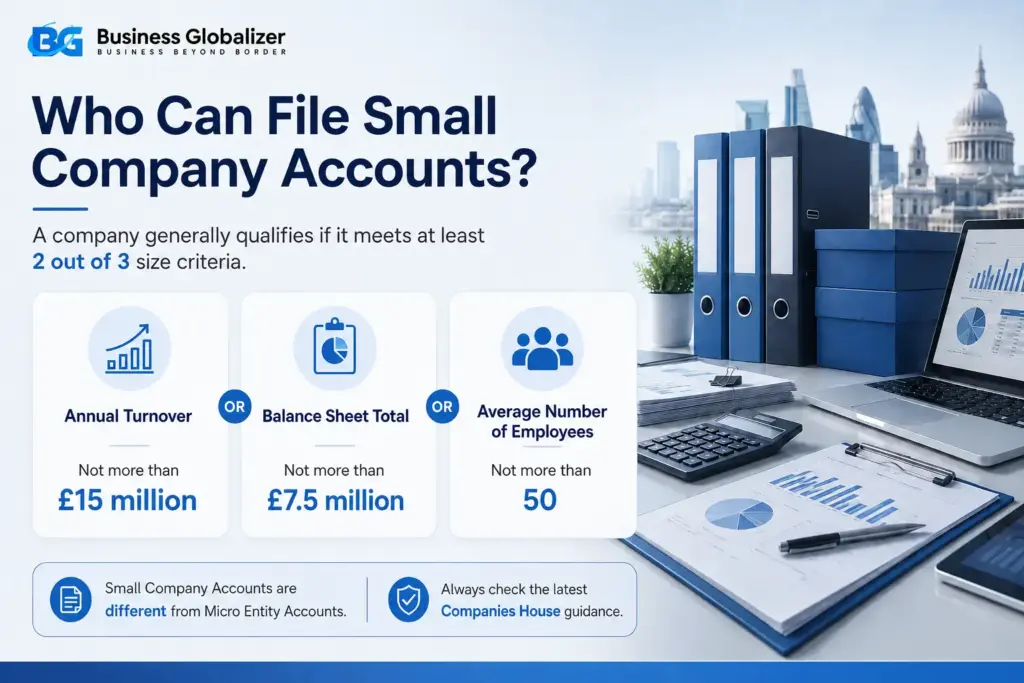
Not every company qualifies. To prepare Small Company Accounts, your business must generally meet the legal definition of a small company.
That usually means meeting at least two of the following three size criteria during the relevant financial year.
Small Company Thresholds
This is the section most directors are looking for. Under the current UK company size criteria, a company generally qualifies as small if it meets at least two of these three limits:
| Small Company Criteria | Current Limit |
| Annual turnover | Not more than £15 million |
| Balance sheet total | Not more than £7.5 million |
| Average number of employees | Not more than 50 |
These thresholds are reviewed by the UK government from time to time, so it is always worth checking the latest Companies House guidance before preparing your accounts.
What Do Small Company Accounts Include?
Although simpler than Full Accounts, Small Company Accounts still provide a clear picture of the company’s financial position. Depending on the reporting framework and circumstances, they commonly include:
- Balance Sheet
- Profit and Loss Account
- Notes to the Accounts
- Directors’ Statement where required
Exactly what is filed may vary depending on the company’s eligibility and the reporting options available at the time of filing.
Small Company Accounts vs Micro Entity Accounts
These two reporting options are often confused because both are designed for smaller businesses. The biggest difference is eligibility.
| Small Company Accounts | Micro Entity Accounts |
| Turnover up to £15 million | Turnover up to £1 million |
| Balance sheet total up to £7.5 million | Balance sheet total up to £500,000 |
| Up to 50 employees | Up to 10 employees |
| Simplified reporting | Even simpler reporting for the smallest qualifying companies |
If your business qualifies as a micro-entity, you may be able to prepare an even simpler set of accounts. We’ve covered that separately in our guide to Micro Entity Accounts.
Small Company Accounts vs Full Accounts
The reporting framework becomes more detailed as companies grow.
| Small Company Accounts | Full Accounts |
| Available only to qualifying small companies | Usually prepared where simplified reporting is not available |
| Fewer disclosure requirements | More comprehensive financial reporting |
| Designed to reduce reporting complexity | Designed to provide fuller financial disclosure |
Neither option is better. The correct reporting framework depends entirely on your company’s legal eligibility.
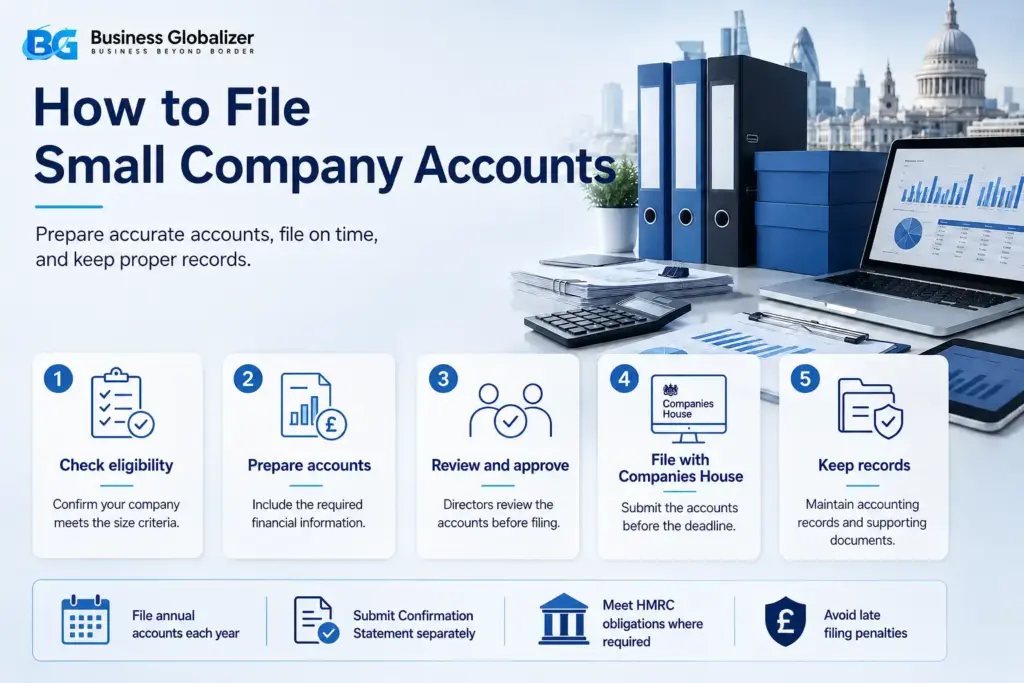
Companies House Filing Requirements for Small Company Accounts
Qualifying for Small Company Accounts does not reduce your responsibility to file them correctly. If your company is eligible, you’ll generally need to:
- Prepare annual accounts for each financial year.
- File the appropriate accounts with Companies House before the filing deadline.
- Keep accounting records that support the figures in the accounts.
- Submit a Confirmation Statement separately to keep your company information up to date.
- Meet any Corporation Tax reporting obligations with HMRC where required.
Remember, Companies House and HMRC serve different purposes. Filing with one does not automatically satisfy the requirements of the other.
Companies House Penalties for Non-Compliance
Missing a filing deadline is only part of the risk.
Companies House now has wider powers to deal with companies that fail to meet their legal obligations. Depending on the circumstances, non-compliance may lead to late filing penalties, financial penalties under the current enforcement framework, prosecution of directors, or further action affecting the company’s standing on the register.
The simplest way to avoid these problems is to prepare your Small Company Accounts early, keep accurate records, and file everything on time.
Common Mistakes Directors Make & How to Avoid Them
Many filing problems start with small misunderstandings rather than complicated accounting issues. Here are some of the mistakes directors make most often:
- Assuming every small business automatically qualifies for Small Company Accounts.
- Confusing Small Company Accounts with Micro Entity Accounts.
- Forgetting to review whether the company still meets the size thresholds.
- Leaving bookkeeping until the filing deadline is close.
- Assuming Companies House and HMRC have the same filing requirements.
- Using outdated guidance without checking the latest reporting rules.
A little planning throughout the year usually prevents these issues from becoming expensive problems later.
Business Globalizer: Helping You File the Right Accounts
Preparing Small Company Accounts is about more than meeting a deadline. It is about keeping your company compliant while choosing the reporting framework that genuinely fits your business.
At Business Globalizer, we help UK companies with annual accounts, Companies House filings, Confirmation Statements, Corporation Tax support, registered office services, company dissolution, restoration, and ongoing compliance guidance.
Whether you’re filing Small Company Accounts for the first time or reviewing your reporting obligations as your company grows, we’re here to help you stay on the right track.
Closing Thoughts
As your business grows, the way you report your finances can change too. Understanding Small Company Accounts helps you prepare the right annual accounts, meet your legal obligations, and avoid filing under the wrong reporting framework.
The important thing is not choosing the simplest option. It is choosing the correct one. Once you understand where your company fits, annual reporting becomes much easier to manage and far less stressful.
Key Insights
- Small Company Accounts allow qualifying companies to prepare simpler annual accounts than Full Accounts.
- A company generally qualifies by meeting at least two of the three size thresholds.
- Small Company Accounts are different from Micro Entity Accounts, even though both offer simplified reporting.
- Qualifying as a small company does not remove your annual filing responsibilities.
- Companies House and HMRC have different reporting roles.
- Filing the correct account type helps avoid unnecessary compliance issues.
- Good bookkeeping throughout the year makes annual accounts much easier to prepare.
- Company size should be reviewed regularly because eligibility can change as the business grows.
FAQ’s on Small Company Accounts
What are Small Company Accounts?
Answer: Small Company Accounts are simplified annual accounts that qualifying UK companies can prepare instead of Full Accounts. They reduce certain reporting requirements while still meeting Companies House obligations.
Who can file Small Company Accounts?
Answer: A company will generally qualify if it meets at least two of the three current size thresholds for turnover, balance sheet total, and average number of employees, provided it is eligible under the relevant legislation.
What are the current Small Company thresholds?
Answer: A company generally qualifies by meeting at least two of these three limits:
- Annual turnover: not more than £15 million
- Balance sheet total: not more than £7.5 million
- Average employees: not more than 50
- Always check the latest Companies House guidance, as these thresholds may change over time.
Are Small Company Accounts the same as Micro Entity Accounts?
Answer: No. Both offer simplified reporting, but Micro Entity Accounts are intended for the smallest qualifying businesses and have lower eligibility thresholds than Small Company Accounts.
What do Small Company Accounts include?
Answer: They generally include a balance sheet, profit and loss account, notes to the accounts, and other information required under the applicable reporting framework.
Do Small Company Accounts need to be filed with Companies House?
Answer: Yes. Qualifying companies must still prepare and file their annual accounts with Companies House and continue meeting any separate HMRC reporting obligations where applicable.
What happens if Small Company Accounts are filed late?
Answer: Late filing can result in automatic penalties. Continued non-compliance may also lead to further enforcement action, making it important to prepare and submit your accounts before the deadline.
Can my company stop qualifying for Small Company Accounts?
Answer: Yes. If your business grows beyond the qualifying size thresholds or no longer meets the legal criteria, you may need to move to a different reporting framework, such as Full Accounts, for future accounting periods.