 Quick Answer: A Micro Entity Accounts are simplified annual accounts that certain very small UK companies can file with Companies House. They are designed to reduce reporting requirements while still meeting legal obligations.
When you’re running a small business, you have a million things on your plate, and it’s easy for accounting tasks to get pushed to the back burner until they become urgent. It often hits home when a deadline is looming, your accountant asks a tricky question, or you’re just going through your company formation in the UK and realizing everything that compliance actually entails.
That’s usually when Micro Entity Accounts come into focus. They’re not as complicated as they sound. In fact, they exist to make life easier for very small businesses.
If your company qualifies, Micro Entity Accounts can reduce the amount of reporting required and simplify the annual filing process. The key is understanding whether you’re eligible and how to use them correctly.
What Are Micro Entity Accounts?
Let’s start with the question most founders ask first.
Micro Entity Accounts are simplified annual accounts available to certain very small UK companies, and they are a type of limited company accounts. They were introduced to reduce reporting requirements for the smallest businesses while still maintaining basic financial transparency.
The important thing to understand is that a micro-entity is not a company type in the UK. It is simply an accounting category. Your company is still a limited company. The difference is that qualifying companies may be allowed to prepare and file a simplified version of their annual accounts.
Who Can File Micro Entity Accounts in the UK?
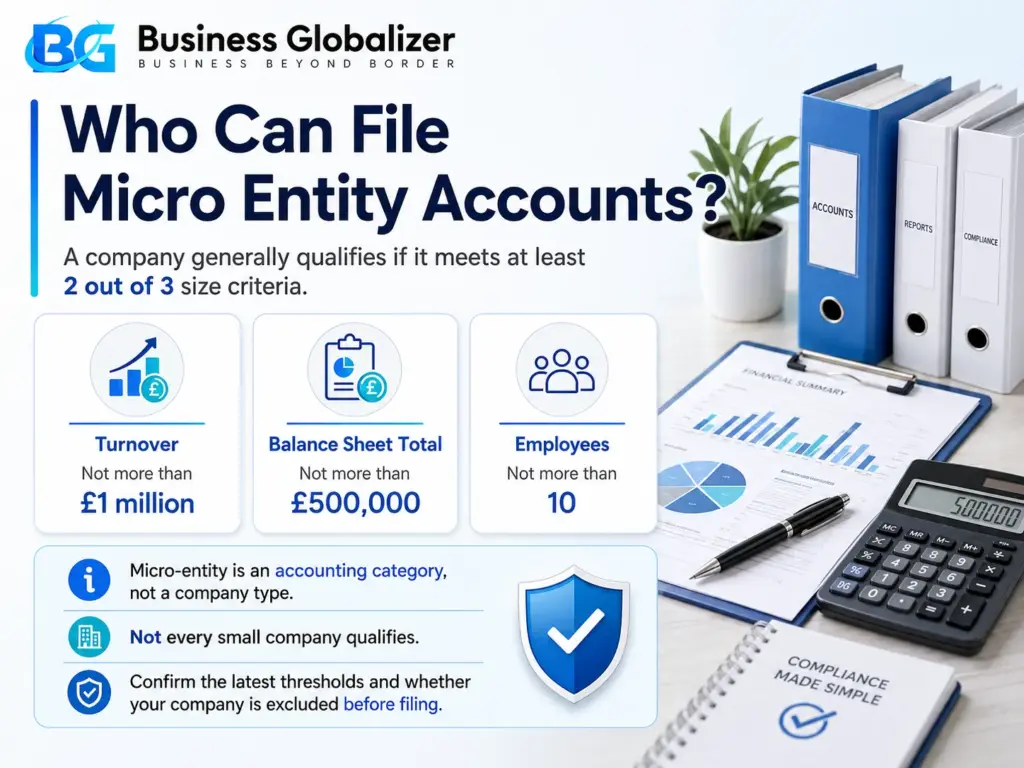
Not every small company automatically qualifies. A company generally qualifies as a micro-entity if it meets at least two of the relevant size thresholds relating to:
- Turnover
- Balance sheet total
- Number of employees
For current Companies House size criteria, a company generally qualifies as a micro-entity if it meets at least two of these three limits:
| Micro-Entity Criteria | Current Limit |
| Turnover | Not more than £1 million |
| Balance sheet total | Not more than £500,000 |
| Employees | Not more than 10 |
So, your company does not need to meet all three. Meeting two is usually enough, as long as the company is not excluded from using the micro-entity regime.
The UK government occasionally updates these thresholds, so directors should always check the latest figures before filing. It is also worth noting that some companies are excluded from the micro-entity regime, even if they appear small enough on paper.
That is why eligibility should always be confirmed before preparing accounts.
Why Do Micro Entity Accounts Exist?
Let’s be honest. The accounting requirements for a multinational company and a small local business should not be identical. That is exactly why the micro-entity regime exists. The goal is to:
- Reduce administrative burden
- Simplify compliance
- Lower reporting complexity
- Make filing easier for very small businesses
It allows qualifying companies to focus more on running the business and less on producing extensive financial disclosures.
Micro Entity Accounts vs Small Company Accounts
This is one of the most common areas of confusion. Both categories are designed for smaller businesses, but they are not identical.
| Micro Entity Accounts | Small Company Accounts |
| Designed for the smallest qualifying companies. | Designed for smaller companies that may not qualify as micro-entities. |
| Generally involves fewer disclosures. | Usually contain more detailed reporting requirements. |
| Simpler filing structure. | More extensive accounting disclosures may apply. |
| Must meet micro-entity eligibility conditions. | Must meet small company eligibility conditions. |
| Intended to reduce compliance complexity. | Offers simplification compared to full accounts, but not as much as micro-entity reporting. |
For many founders, the question is not which option they prefer. The question is which option their company actually qualifies for.
What Information Is Included in Micro Entity Accounts?
Many people hear “simplified accounts” and assume almost no information is required. That is not quite true. Micro Entity Accounts generally include:
- A balance sheet
- Required statutory statements
- Director approval information
- Basic company details
The exact requirements depend on the circumstances of the business, but the reporting burden is generally lighter than for larger companies. Even simplified accounts must still be accurate and properly prepared.
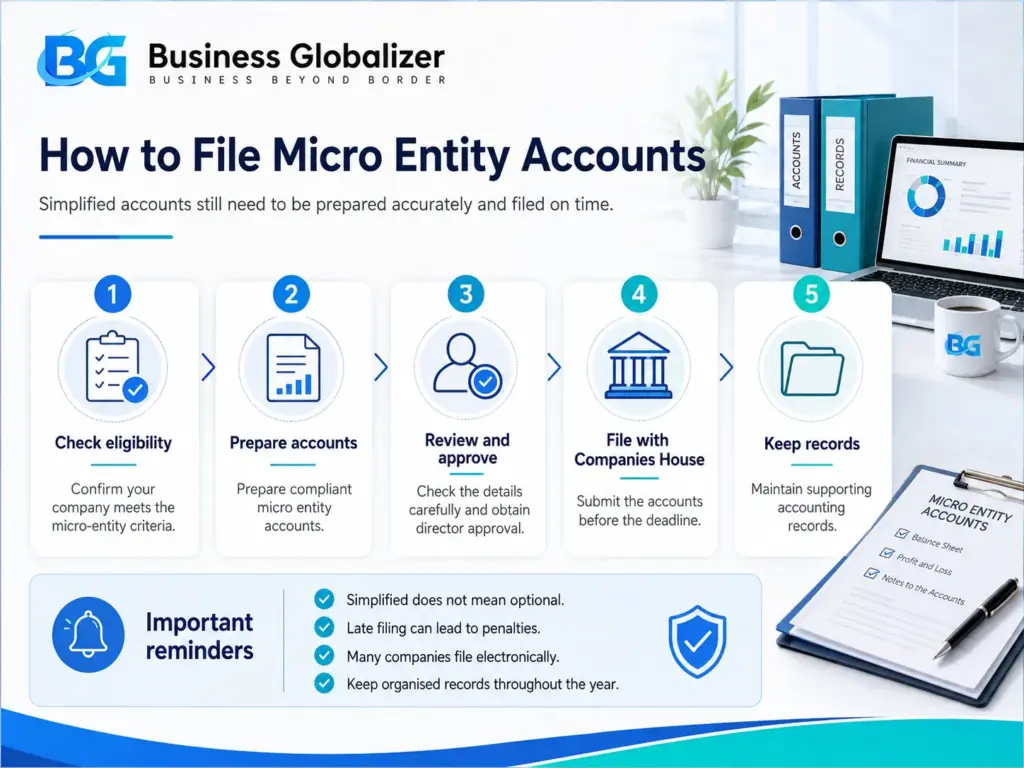
How to File Micro Entity Accounts
The filing process is often simpler than founders expect. In general, the process involves:
- Confirming the company qualifies as a micro-entity
- Preparing compliant accounts
- Reviewing the information carefully
- Filing with Companies House before the deadline
- Keeping accounting records that support the figures submitted
Many companies file electronically, which is usually quicker and easier than paper filing. The key point is that simplified does not mean optional. The filing obligation still exists.
Companies House Micro Entity Accounts: What Gets Filed?
Many directors want to know exactly what Companies House sees. When filing Companies House Micro Entity Accounts, qualifying companies generally submit the required simplified accounts rather than more extensive financial statements used by larger businesses. This helps reduce public disclosure requirements while still meeting legal filing obligations.
The exact information submitted depends on the company’s circumstances and the accounting framework being used.
Common Mistakes Founders Make
Micro Entity Accounts are simpler than many other forms of limited company accounts, but mistakes still happen. Common examples include:
- Assuming every small company qualifies
- Using outdated eligibility thresholds
- Missing filing deadlines
- Confusing micro-entity status with dormant status
- Filing incorrect account formats
- Failing to maintain supporting records
To avoid these issues, founders should confirm eligibility each year, stay updated with current thresholds, track filing deadlines carefully, understand the difference between accounting categories, use the correct account format, and keep organised financial records.
Most problems are avoidable when eligibility is checked early.
Expert Tips Before Filing
A few simple habits can make filing much smoother.
- Confirm eligibility every year
- Keep accounting records organised
- Monitor filing deadlines carefully
- Review Companies House requirements regularly
- Use professional support if the company’s situation becomes more complex
A little preparation usually saves a lot of stress later.
Business Globalizer: Helping UK Companies Stay Compliant
Whether your company qualifies for Micro Entity Accounts, small company accounts, or another reporting category, compliance still matters.
At Business Globalizer, we help founders with UK company formation, annual accounts, confirmation statements, UK Taxation, registered office services, dormant company filings, company restoration, dissolution support, and ongoing compliance guidance.
Because, filing requirements are much easier to handle when you understand them before the deadline arrives.
Closing Thoughts
For many small businesses, Micro Entity Accounts offer a practical way to keep reporting simple without losing sight of compliance. They are designed to reduce effort, but they still rely on the same fundamentals: accurate records, timely submissions, and a clear understanding of eligibility.
If there is one takeaway from this guide, it is this: Micro Entity Accounts work best when you approach them with clarity from the start. Taking the time to confirm your status and prepare properly means fewer surprises later and a smoother filing process when deadlines come around.
Key Insights
- Micro Entity Accounts are a simplified reporting option for qualifying UK companies.
- A micro-entity is not a separate business structure; it is an accounting classification.
- Many small businesses qualify for Micro Entity Accounts without realising it.
- Companies usually need to meet at least two eligibility conditions to qualify.
- Micro Entity Accounts contain less information than many other limited company accounts.
- Not every small company can use the micro-entity regime.
- Companies House filing requirements still apply even when accounts are simplified.
- Micro Entity Accounts can reduce administrative work, but accuracy still matters.
- Founders often confuse small company accounts with micro-entity accounts.
- Choosing the correct accounting regime helps avoid filing mistakes and unnecessary complexity.
FAQ’s on Micro Entity Accounts
What are Micro Entity Accounts?
Answer: Micro Entity Accounts are simplified annual accounts that certain very small UK companies can prepare and file if they meet the relevant eligibility requirements.
Who can file Micro Entity Accounts UK?
Answer: Companies that meet the required size criteria, typically based on turnover, balance sheet total, and employee numbers, may qualify. At least two qualifying conditions generally need to be met.
Are Micro Entity Accounts the same as small company accounts?
Answer: No. Micro Entity Accounts are usually simpler and designed for the smallest qualifying companies, while small company accounts apply to a broader group of businesses.
Do Micro Entity Accounts apply to all limited company accounts?
Answer: No. Not every limited company qualifies for the micro-entity regime. Eligibility must be assessed before filing.
What information is included in Micro Entity Accounts?
Answer: They generally include a balance sheet, statutory statements, director approval details, and certain required company information.
How to file Micro Entity Accounts?
Answer: The usual process involves confirming eligibility, preparing compliant accounts, reviewing the information, and filing with Companies House before the relevant deadline.
What are Companies House Micro Entity Accounts?
Answer: These are the simplified accounts that qualifying micro-entities file with Companies House to satisfy their annual reporting obligations.
Can a dormant company file Micro Entity Accounts?
Answer: A dormant company may qualify for separate dormant company filing requirements. Dormancy and micro-entity status are different concepts and should not be treated as the same thing.
Are Micro Entity Accounts public?
Answer: The accounts filed with Companies House become part of the public company record, subject to the rules that apply to the filing regime being used.
What happens if Micro Entity Accounts are filed late?
Answer: Late filing can lead to penalties and potential compliance issues, even if the company otherwise qualifies as a micro-entity.