
 Quick Answer: Dormant Company vs Active Company in the UK comes down to business activity. A dormant company has no significant accounting transactions, while an active company is carrying out business operations and reporting those activities accordingly.
There is a moment many founders experience that feels strangely confusing.
The company exists. The registration is done. The name appears on Companies House. Whether it was part of a UK company formation process completed recently or a company formed months ago, business has not really started yet.
Maybe the launch got delayed. Maybe the project paused. Maybe the company is simply sitting there waiting for the right time. Then comes the awkward question: “Wait… is this company dormant or active?” At first, the answer feels obvious. But the more you look into it, the less obvious it becomes.
That is why understanding Dormant Company vs. Active Company in the UK matters. The difference affects your accounts, tax obligations, and filing requirements, and in some cases, can even lead to penalties. More often than you might expect, founders realise they have been describing their company status incorrectly all along.
What Is a Dormant Company?
Let’s start with the easier side of the comparison: the definition of a dormant company.
For Companies House purposes, a dormant company is generally a UK company that has had no significant accounting transactions during the financial year. In practical terms, the company is not actively carrying on business.
Common situations include:
- Saving a company name for future use
- Delaying a business launch
- Pausing operations temporarily
- Holding an unused company structure
- Preparing for a future project
The company still exists legally. It still appears on the register. It still has responsibilities. But it is not actively conducting normal business activity.
What Is an Active Company?
Now for the other side: the active company.
An active company is a company that is carrying out business activities and recording transactions as part of its operations.
Those activities may include:
- Selling products
- Providing services
- Receiving income
- Paying suppliers
- Employing staff
- Operating business bank accounts
- Entering commercial agreements
This is important: A company does not need to be profitable to be active. A company can make no profit, or even operate at a loss, and still be fully active. The key factor is business activity, not business success.
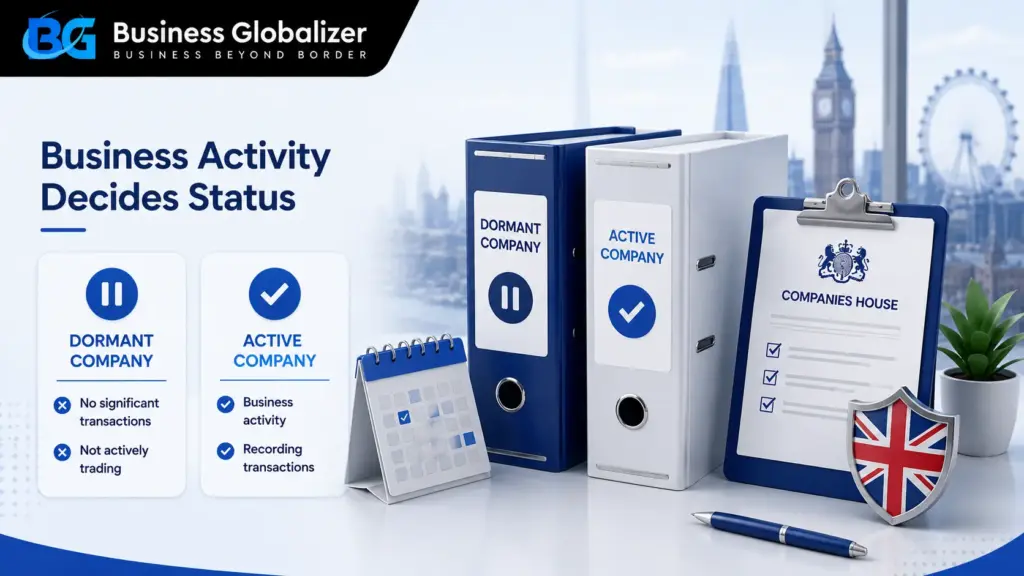
Dormant Company vs Active Company in the UK: The Core Difference
Many founders overcomplicate this comparison, but the distinction becomes much easier when viewed side by side.
1. Business Activity
Dormant Company
- Has little or no qualifying business activity.
- Is not actively trading or operating.
- May be just keeping a company name for future use.
- May be waiting for a future launch or investment.
Active Company
- Is carrying out business operations.
- May be trading, providing services, or selling products.
- Can receive income and pay business expenses.
- Regularly engages in commercial transactions.
2. Company Status
Dormant Company
- Still exists as a legal entity.
- Remains registered with Companies House.
- Is inactive but not closed or dissolved.
Active Company
- Exists as a legal entity and actively operates.
- Conducts ongoing business activities.
- Uses its company structure for commercial purposes.
3. Profitability
Dormant Company
- Dormancy is not determined by profit levels.
- Can remain dormant regardless of future business plans.
Active Company
- Does not need to be profitable to be active.
- Can be active even if it makes no profit or operates at a loss.
4. Accounting and Filing Requirements
Dormant Company
- Generally reports that no significant accounting transactions occurred during the year.
- May be eligible to file dormant accounts.
- Still has certain filing obligations, such as a Confirmation Statement.
Active Company
- Must maintain accounting records that reflect business activity.
- Usually has broader reporting and tax obligations.
- Must meet the relevant filing requirements based on its operations and company size.
5. Compliance Impact
The distinction matters because different obligations apply depending on the company’s status.
A dormant company typically tells Companies House that no significant accounting activity took place during the reporting period. An active company must report its business activities through appropriate accounting records, annual accounts, and tax filings.
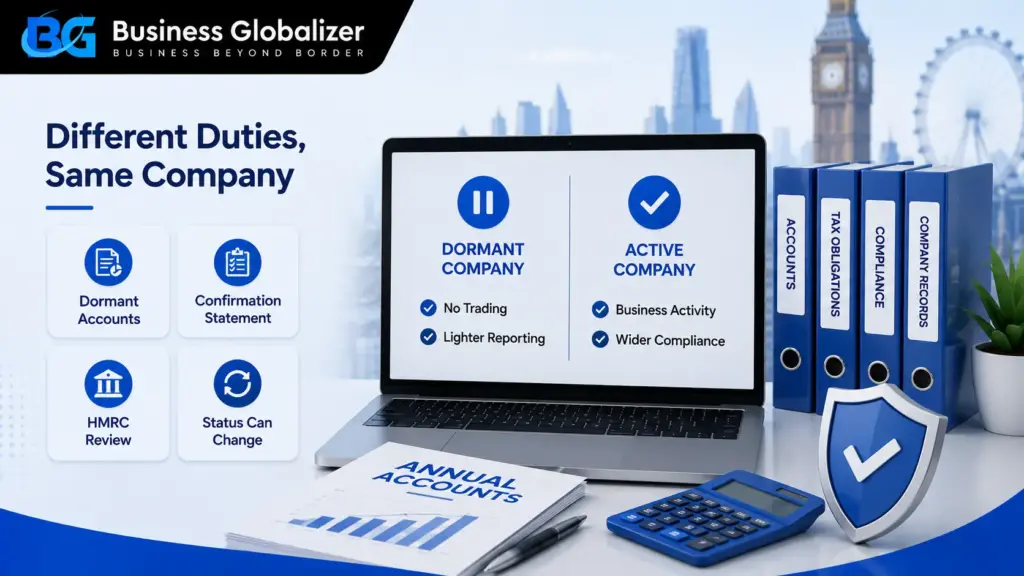
Dormant Company vs Active Company in the UK: Comparison Table
If you want a quick overview, the comparison table below highlights the key differences between dormant and active companies at a glance.
| Feature | Dormant Company | Active Company |
| Business Activity | Has no significant accounting transactions and does not actively trade or operate. | Actively trades, operates, or carries out commercial activities. |
| Legal Status | Remains a registered legal entity despite having little or no business activity. | Remains a registered legal entity while actively conducting business. |
| Income and Expenses | Typically does not receive business income or incur routine business expenses. | May generate income, pay expenses, and enter into regular business transactions. |
| Profitability | Dormancy is determined by activity, not profit. | Can be active whether profitable, breaking even, or making a loss. |
| Accounts | May qualify to file dormant accounts if eligibility requirements are met. | Files accounts reflecting actual trading activity and financial performance. |
| Tax and Compliance | Usually has lighter reporting obligations but must still meet statutory filing requirements. | Typically has wider accounting, tax, and compliance obligations. |
| Confirmation Statement | Filing a Confirmation Statement does not by itself make the company active. | Filing a Confirmation Statement is required alongside other active company obligations. |
| Common Purpose | Often used to protect a company name, postpone a launch, or temporarily pause operations. | Used to operate an ongoing business and carry out commercial activities. |
| Change of Status | Becomes active once significant business transactions or operations begin. | Remains active while continuing business operations. |
This is why Dormant Company vs Active Company in the UK is more than a technical definition. It shapes what you file, when you file it, which records you need to keep, and how Companies House and HMRC treat your company’s status. Once you know where your company stands, staying compliant becomes much easier, and you’re far less likely to run into filing problems you could have avoided.
What Triggers Dormant Status to End?
This is where many companies accidentally move from dormant to active. A company can stop being dormant when it begins carrying out significant accounting transactions.
Common examples include:
- Receiving business income
- Paying business expenses
- Trading with customers
- Purchasing stock or inventory
- Paying employees
- Receiving investment funds
- Conducting normal commercial activity
Put simply: once the company starts trading, it usually stops being dormant. This is why founders should be careful before assuming a company remains dormant after opening bank accounts, receiving payments, or making operational purchases.
Companies House vs HMRC: Why the Definitions Can Differ
This is one of the most common areas of confusion for company directors. A company may appear dormant from one perspective while being treated differently by another authority.
Why This Happens
- Companies House and HMRC do not always apply dormancy in exactly the same way.
- A company may qualify to file dormant accounts with Companies House, while HMRC may still have separate Corporation Tax considerations.
- The rules applied by each authority can differ depending on the company’s circumstances.
What Directors Should Remember
- Do not assume Companies House and HMRC use identical definitions of dormancy.
- Review the requirements of both authorities separately.
- If there is any uncertainty, check your obligations with each organisation before filing.
Why Companies Become Dormant
Not every dormant company is abandoned. In fact, many dormant companies are intentional. Founders commonly choose dormancy when:
- Protecting a business name
- Preparing for a future launch
- Holding intellectual property
- Restructuring operations
- Pausing a business temporarily
- Waiting for funding or investment
Sometimes dormancy is a strategic decision rather than a sign of failure. The key is understanding that dormant status still comes with responsibilities.
Common Mistakes Founders Make
Many compliance problems arise from simple misunderstandings rather than deliberate mistakes.
Some of the most common include:
Misunderstanding Dormant Status
- Assuming no sales automatically means the company is dormant
- Believing a company can remain dormant after carrying out business transactions
- Assuming HMRC and Companies House use identical definitions of dormancy
Missing Ongoing Obligations
- Forgetting annual filings because the business is inactive
- Overlooking Confirmation Statement requirements
- Ignoring Companies House reminders and deadlines
Confusing Company Statuses
- Confusing dormancy with company dissolution
- Accidentally carrying out transactions that end dormant status
Most issues can be avoided by regularly reviewing the company’s activities and filing responsibilities.
Expert Tips for Directors
Whether your company is dormant or active, a few simple habits can help keep it compliant.
Stay organized.
- Keep accurate records from day one
- Track filing deadlines carefully
- Review your company’s status regularly
Monitor Compliance Requirements
- Check both Companies House and HMRC obligations
- Avoid unnecessary transactions if you intend to maintain dormancy
Seek Advice When Needed
- Get professional guidance before making major structural or operational changes
A short compliance review today can prevent costly mistakes and unnecessary paperwork later.
Business Globalizer: Helping UK Companies Stay Compliant
The difference between a dormant company and an active company may seem small at first, but it affects filings, tax obligations, reporting requirements, and long-term compliance.
At Business Globalizer, we help founders with UK company formation, dormant company filings, annual accounts, confirmation statements, registered office services, tax guidance, company restoration, and dissolution support.
Because compliance problems are usually much easier to prevent than to fix.
Closing Thoughts
Coming back to the question we started with: is your company dormant or active? For many founders, the answer feels obvious until they look closely at what the company has actually been doing. Understanding Dormant Company vs. Active Company in the UK matters because the difference comes down to activity, transactions, and legal duties; not future plans or whether the company made a profit.
A dormant company can still have filing responsibilities, while an active company may earn little or no profit and still be fully operational. The companies that stay compliant are usually the ones that understand their status and act accordingly.
Key Insights
- Dormant status is determined by business activity and accounting transactions, not by whether the company makes a profit.
- Active companies carry out business operations and generally have wider accounting, tax, and compliance obligations.
- A company can remain legally registered while dormant, but it still has ongoing filing responsibilities.
- Many founders incorrectly assume that having no sales automatically makes a company dormant.
- Companies House and HMRC may apply different rules when assessing whether a company is dormant.
- Significant accounting transactions can cause a dormant company to become active.
- Dormant companies often exist to protect a company name, delay a launch, or pause operations temporarily.
- Filing dormant accounts does not remove the requirement to submit a Confirmation Statement.
- Understanding your company’s actual status helps avoid compliance mistakes and missed deadlines.
- The distinction between dormant and active status affects reporting requirements, tax obligations, and regulatory compliance.
Frequently Asked Questions on Dormant Company vs Active Company
What is the difference between a dormant company and an active company?
Answer: A dormant company is not really doing business and has no significant accounting transactions. An active company, on the other hand, is trading, providing services, earning income, or paying normal business expenses.
Can a dormant company become active?
Answer: Yes. A dormant company can become active again whenever it starts trading, operating, or making significant accounting transactions.
Does a dormant company need to file accounts?
Answer: Yes. In most cases, a dormant company still has to file dormant accounts with Companies House, even if it has not traded during the year.
Does a dormant company need to file a Confirmation Statement?
Answer: Yes. Dormant companies usually still need to file a Confirmation Statement every year to keep their company details up to date.
Can a company be dormant for Companies House but not for HMRC?
Answer: Yes. Companies House and HMRC do not always treat dormancy in the exact same way, so both sides need to be checked.
What transactions can make a dormant company active?
Answer: Receiving income, paying business expenses, trading with customers, or making other significant accounting transactions can make a dormant company active.
Is a dormant company the same as a dissolved company?
Answer: No. A dormant company still legally exists and remains registered with Companies House. A dissolved company has been removed from the register and no longer exists as a legal company.
Why would someone keep a company dormant?
Answer: Founders often keep a company dormant to protect a company name, prepare for a future launch, pause trading for a while, or keep the structure ready for later use.
Do active companies have more filing obligations than dormant companies?
Answer: Generally, yes. Active companies usually have more accounting, reporting, and tax duties because they are actually doing business and recording transactions.